The Last Walk to the Low-Water Mark
On May 23, 1701, Captain William Kidd stood on a scaffold at the edge of the Thames with a noose around his neck and a crowd of several hundred pressing against the mud. He was drunk. The Admiralty marshal had allowed him a final measure of rum, a customary mercy that doubled as crowd management — a man too inebriated to give a rousing final speech was a man who could not turn the mob against the authorities. Kidd had tried anyway. He slurred a few words insisting on his innocence, cursing the Whig politicians who had funded his privateering voyage and then abandoned him when it became politically convenient to call him a pirate.
The hangman pulled the lever. The rope snapped. Kidd's body dropped into the Thames mud, alive, gasping, covered in filth. The crowd erupted. A Newgate chaplain standing nearby later recorded that in the minutes it took to drag Kidd upright, retie the rope, and haul him back onto the scaffold, the captain was offered a final chance to repent. He reportedly could not speak. The second rope held. Kidd died choking on the short drop — a method that did not break the neck but strangled the condemned over several minutes, their legs kicking above the rising tide.
His body was not cut down and buried. It was coated in tar, locked inside an iron cage called a gibbet, and hung from a post at Tilbury Point on the Thames estuary, where it remained for three years. Every merchant vessel, Royal Navy frigate, and fishing boat entering London passed beneath William Kidd's blackened remains. That was the point. Execution Dock was never primarily about justice. It was about messaging — a four-century advertising campaign conducted in human flesh, designed to remind every sailor on every ship that the sea belonged to the Crown, and disobedience ended here, at the low-water mark, where the Admiralty's jurisdiction began and a man's life could be publicly extinguished to protect the empire's commerce.
How the Admiralty Built a Killing Ground at Wapping
The High Court of Admiralty and Maritime Law
The legal architecture behind Execution Dock rested on a jurisdictional technicality that shaped centuries of death. English common law governed crimes committed on land. Crimes committed at sea — piracy, mutiny, murder aboard ship, wrecking, smuggling — fell under the authority of the High Court of Admiralty, a separate legal system with its own judges, its own rules of evidence, and its own execution ground. The distinction mattered enormously. Common-law criminals were hanged at Tyburn or, later, outside Newgate Prison. Maritime offenders were hanged at the water's edge, on ground that flooded at high tide, in a deliberate assertion that this death belonged to the sea.
The Admiralty's jurisdiction technically extended to any crime committed below the high-water mark or on navigable tidal waters. Placing the scaffold at Wapping's foreshore — the strip of mud and gravel exposed at low tide — was a legal performance as much as a practical choice. The condemned died on the boundary between land and sea, in a space that literally belonged to the Admiralty twice a day when the tide rolled in. The custom required that after hanging, the body be left until three tides had washed over it. Only then was the sentence considered complete. For ordinary pirates, this meant cutting the corpse down after roughly 36 hours and burying it in an unmarked grave along the riverbank. For the most notorious offenders — Kidd, and dozens of others — it meant the gibbet, the tar, and months of public decomposition.
The Execution Dock Site and the Ritual of the Procession
The exact location of Execution Dock shifted over the centuries, but it consistently occupied the Wapping riverfront, roughly between what is now Wapping New Stairs and the site of the Town of Ramsgate pub. The area was London's maritime underbelly — a dense grid of warehouses, ropewalks, chandleries, and sailors' lodging houses that had grown around the legal quays east of the Tower of London. Wapping stank of tar, bilge, and river mud. It was not a place of civic grandeur. It was a working waterfront, and the Admiralty chose it precisely because the audience was already there.
The procession to the gallows followed a set ritual that barely changed between the 16th and 19th centuries. The condemned were held at Marshalsea Prison in Southwark — the same debtors' prison that would later imprison Charles Dickens's father — and transported across the river by cart. The Admiralty marshal led the procession carrying the Silver Oar, the ceremonial symbol of Admiralty authority, mounted on a pole ahead of the condemned. The route wound through Wapping's narrow streets, past taverns where dockworkers and sailors crowded the doors to watch. Vendors sold food and drink along the route. The atmosphere was closer to a public carnival than a solemn judicial proceeding — contemporary accounts describe cheering, jeering, and heavy drinking from both the crowd and, frequently, the condemned.
The scaffold itself was a simple wooden platform built at the low-water mark, accessible only when the tide was out. The method was the short drop — a rope around the neck and a step off a ladder or the removal of a supporting barrel. Death came by strangulation, not by the sharp cervical fracture of the later long-drop method. It could take anywhere from four to twenty minutes. The crowd watched the entire process. Children were present. Sailors were sometimes ordered to attend by their captains, the execution serving as a mandated lesson in the cost of disloyalty.
Pirates, Mutineers, and Smugglers Who Died at Execution Dock
Captain William Kidd and the Rope That Broke Twice
William Kidd's path to the Wapping scaffold was less a story of piracy than of political betrayal. Born in Dundee around 1645, Kidd was a respectable New York-based sea captain who in 1695 was commissioned by a syndicate of powerful Whig politicians — including the Earl of Bellomont and, indirectly, King William III himself — to hunt pirates in the Indian Ocean and capture French merchant vessels under a letter of marque. The arrangement was essentially a joint venture: Kidd would do the dangerous work, and his aristocratic backers would take the lion's share of the profits.
The voyage was a catastrophe. Kidd's crew threatened mutiny repeatedly. Supplies ran short. Legitimate prizes were scarce. In a confrontation with his gunner, William Moore, Kidd struck the man in the head with an iron-bound bucket, killing him — an act that would later be charged as murder. Under mounting pressure from his crew, Kidd seized the Quedagh Merchant, an Armenian-owned vessel sailing under a French pass. The capture was arguably legal under his commission, but by the time Kidd returned to the Atlantic in 1699, the political winds in London had shifted. His Whig backers were under attack from Tory opponents who used Kidd's alleged piracy as a weapon in parliamentary battles. The men who had sent him to sea now needed him to hang.
Kidd was arrested in Boston, shipped to London, and held in Newgate Prison for over a year before trial. The French passes that might have legitimized his capture of the Quedagh Merchant conveniently disappeared — they were not rediscovered until 1910, in the Public Record Office. The trial before the Admiralty court was, by modern standards, a predetermined outcome. Kidd was denied adequate counsel and convicted of both piracy and the murder of William Moore. The sentence was death at Execution Dock.
The botched hanging — the snapped rope, the fall into the mud, the second hanging — became the most famous execution in the dock's history. Whether the broken rope was accident or sabotage was debated in London's coffeehouses for weeks. The Admiralty, embarrassed by the spectacle, ensured the aftermath sent an unambiguous message: Kidd's gibbeted corpse hung at Tilbury for three years, a rotting signpost at the mouth of the empire's busiest river. His story became the foundational myth of the pirate-as-victim — a narrative that historians have argued over ever since, unable to fully separate the man's actual crimes from the political machinery that consumed him.
The Mass Hangings of the Golden Age of Piracy
Kidd's execution in 1701 arrived at the front edge of what historians call the Golden Age of Piracy, a roughly thirty-year period between 1700 and 1730 when piracy in the Atlantic and Caribbean reached its peak. Execution Dock's busiest decades coincided almost exactly with this era. The Admiralty used Wapping as an industrial-scale deterrent, hanging pirates in batches that sometimes numbered a dozen or more in a single day.
In 1722, the crew of Bartholomew Roberts — the most successful pirate of the age, who captured over 400 ships — were tried at Cape Coast Castle in present-day Ghana, but the Admiralty's pattern of mass trials and public executions at Wapping continued throughout the decade. London's courts processed pirates captured across the Atlantic and brought to England for trial. The sheer volume was staggering: between 1716 and 1726, the Admiralty hanged an estimated 400 to 600 pirates across its various jurisdictions, with Execution Dock handling the most politically significant cases.
The men who died at Wapping were overwhelmingly working-class sailors — former merchant seamen, naval deserters, and pressed men who had turned to piracy out of desperation, opportunity, or coercion. The average age of executed pirates was mid-twenties. Many were illiterate. Their trials were conducted in legal language they could not follow, and their executions were attended by crowds who viewed them with a complex mixture of contempt, fascination, and sympathy. The pirate as romantic outlaw was already emerging in popular culture even as the real men were strangling on short-drop ropes above the Thames mud. Daniel Defoe's A General History of the Pyrates, published in 1724, drew heavily on Admiralty trial records from this period — many of them generated by cases that ended at Execution Dock.
Gibbeting on the Thames — The Corpses That Guarded the River
The gibbet was the Admiralty's signature punishment, and it distinguished Execution Dock from every other gallows in England. Ordinary hanging killed the man. Gibbeting made his corpse work for the state.
After execution, the bodies of selected pirates and mutineers were transported downriver to strategic points along the Thames estuary — Tilbury Point, Blackwall, and Bugsby's Reach were the most common locations. The corpse was first coated in Stockholm tar, a pine-derived preservative used in shipbuilding, which slowed decomposition and kept the body recognizable for months. It was then fitted into an iron cage — a custom-made frame that held the body upright, sometimes with iron bands around the skull, chest, and thighs — and suspended from a wooden post at the water's edge.
The gibbets were placed at bends in the river where they were impossible to miss. A merchant captain bringing a cargo vessel upriver to London's legal quays would pass three, four, sometimes half a dozen decomposing bodies in iron cages before reaching the city. The visual message was unambiguous: this is what happens. The practice was not unique to the Admiralty — land-based courts also used gibbets — but the Thames installations were singular in their scale and their strategic placement. They turned the river approach to London into a corridor of warning, a gauntlet of dead men that every foreign sailor, every naval recruit, and every potential smuggler had to pass through.
The smell was appalling. Residents of riverside parishes petitioned repeatedly for the removal of gibbets near their homes. The Admiralty generally refused. A gibbeted pirate named William Fly, hanged in Boston in 1726, was displayed in the harbor for years; the London installations followed the same logic. The bodies were left until they fell apart — until the tar cracked, the iron rusted through, and the bones dropped into the mud. Some gibbet cages have been recovered from the Thames foreshore by mudlarkers and archaeologists. They are surprisingly small. The men inside them were often malnourished, short, and young.
The Slow Death of Execution Dock
The Final Executions and the End of Public Maritime Hanging
Execution Dock's use declined sharply after the Golden Age of Piracy. By the late 18th century, large-scale Atlantic piracy had been suppressed, and the Admiralty's courts were processing fewer capital cases. The dock continued to be used for mutineers and occasional smugglers, but the mass hangings of the 1720s were not repeated.
The last confirmed executions at Execution Dock took place in December 1830, when George Davis and William Watts were hanged for piracy and murder committed aboard the brig Pluto off the West African coast. The case was unremarkable — a violent seizure of a merchant vessel by two of its crew members — but the executions attracted significant public attention precisely because they were understood to be among the last of their kind. Parliament had been steadily reducing the number of capital offences since the 1820s, and public appetite for execution as spectacle was waning. The Judgments of Death Act of 1823 had already given judges discretion to commute death sentences for most offences. The Admiralty's separate jurisdiction, and its separate killing ground, were becoming anachronisms.
Public execution in England ended entirely in 1868. The High Court of Admiralty's criminal jurisdiction was absorbed into the Central Criminal Court at the Old Bailey in 1834. Execution Dock, with no court to feed it and no legal framework to justify it, simply stopped being used. There was no formal closure, no ceremony, no marker. The scaffold was dismantled. The mud remained.
Wapping's Transformation from Scaffold to Dockland
The Wapping that had served as London's maritime execution ground for four centuries was already transforming before the last hanging took place. The construction of the London Docks in 1805 and St Katharine Docks in 1828 reshaped the waterfront from a chaotic tangle of open wharves and stairs into enclosed, industrialized basins. The narrow streets where the Admiralty marshal's procession had wound past taverns and ropewalks were demolished and rebuilt to serve the new dock infrastructure.
The area was devastated by the Blitz during World War II. Wapping took heavy bombing in the autumn of 1940, and many of the surviving 18th- and 19th-century buildings were destroyed. The London Docks closed in 1969, victims of containerization, and for nearly two decades the area was derelict — a strange echo of the abandoned foreshore where the gallows once stood. The redevelopment of London's Docklands in the 1980s transformed Wapping into expensive residential property. Converted warehouses that once stored sugar, tobacco, and rum now sell for millions.
The exact site of Execution Dock is a matter of educated guesswork. Historical maps and contemporary accounts place it near Wapping New Stairs, a narrow passage between buildings that still provides access to the foreshore at low tide. The foreshore itself — the same mud where William Kidd fell when the rope broke — is accessible to anyone willing to climb down at low tide, though the Thames Discovery Programme recommends caution. The river still floods the spot twice a day, just as it did when the Admiralty required three tides to wash over the dead.
Execution Dock Today — What Remains at Wapping
The Site, the Pub, and the Missing Gallows
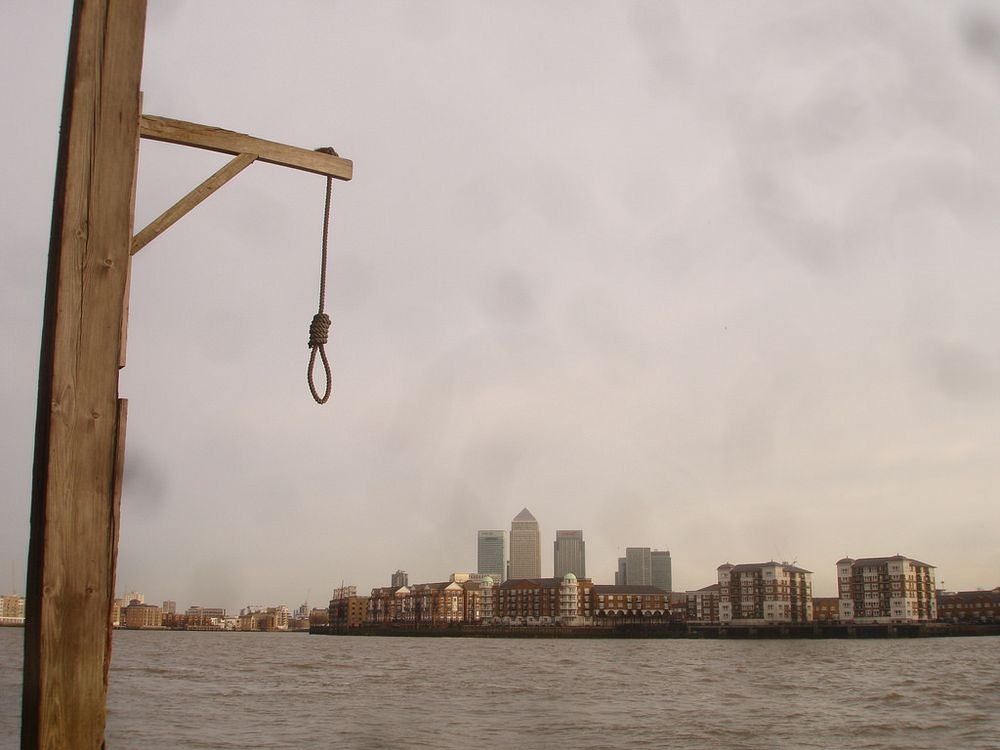
Two pubs compete for the association with Execution Dock. The Prospect of Whitby, a few hundred meters east on Wapping Wall, claims to be London's oldest riverside pub (dating to 1520) and hangs a replica noose from a gibbet post on its river terrace — a cheerful piece of macabre marketing that draws tourists but has no direct connection to the execution site. The Town of Ramsgate, located at Wapping Old Stairs, has a stronger geographic claim: its cellar was reportedly used to hold condemned prisoners on the night before execution, and the Old Stairs are close to the most commonly cited location of the dock itself.
Neither pub is the execution site. The actual scaffold stood on the foreshore below — a stretch of river mud that is underwater for most of the day and indistinguishable from any other section of the Thames bank when exposed. There is no memorial. There is no plaque. English Heritage has not designated the spot. The Corporation of London has not marked it. The hundreds of men who were strangled, displayed, and forgotten here have no physical monument beyond the river itself, which continues to rise and fall over the ground where they died, just as the Admiralty once demanded.
The gibbet sites downriver have similarly vanished. Tilbury Point, where Kidd's body hung for three years, is now an industrial zone adjacent to the Tilbury container port. Bugsby's Reach, another common gibbet location, is part of the Greenwich Peninsula redevelopment that includes the O2 Arena. The Thames has erased its own history.
Visiting Execution Dock
Wapping is served by the Overground (Wapping station) and is a 15-minute walk east from the Tower of London, which processed many of the same prisoners who ended their lives at the dock. The area is residential and quiet — dramatically different from the raucous maritime slum it was during the dock's active centuries. Wapping New Stairs and Wapping Old Stairs both provide access to the foreshore at low tide, but visitors should check tide tables before descending and be aware that the Thames foreshore is regulated by the Port of London Authority.
The Prospect of Whitby and the Town of Ramsgate are both open to the public and serve as informal orientation points. The Museum of London Docklands, housed in a Georgian sugar warehouse on West India Quay (a short bus ride east), provides the best contextual exhibit on Wapping's maritime history, including material on piracy and Admiralty justice.
Nassau's pirate republic and Port Royal were the Caribbean staging grounds for the men who ended their lives at Wapping. Tortuga served the same function a generation earlier. The connection between these sites is not thematic but literal — the same individuals moved between them, and the Admiralty's jurisdiction linked the Caribbean killing grounds to the Thames killing ground in a single legal chain.
Standing at Wapping Old Stairs at low tide, looking out at the brown water and the mud, it is difficult to feel anything dramatic. The site resists memorialization. There is no architecture of suffering here, no preserved cell or bloodstained wall. There is only the river, doing what it has always done — flooding and receding, covering and uncovering the ground where hundreds of men died for the crime of defying the sea's most powerful landlord. The Admiralty is gone. The pirates are gone. The Thames remains, indifferent to both.
Frequently Asked Questions
Where was Execution Dock in London?
Execution Dock was located on the Thames foreshore at Wapping, in the East End of London. The exact position shifted over the centuries but is most commonly placed near Wapping New Stairs or Wapping Old Stairs, between the present-day Town of Ramsgate and Prospect of Whitby pubs. The scaffold was built below the high-water mark on tidal mud, meaning the site is underwater for much of the day. No plaque or memorial marks the location today.
Why were pirates hanged at the water's edge?
The High Court of Admiralty had jurisdiction over crimes committed at sea, and its legal authority symbolically began at the high-water mark. By executing condemned pirates and mutineers on the foreshore — the strip of ground between low and high tide — the Admiralty was asserting that these deaths belonged to maritime law, not common law. The custom also required that three tides wash over the body after death before the sentence was considered complete.
Who was the most famous person executed at Execution Dock?
Captain William Kidd, hanged on May 23, 1701, is the most famous person executed at the dock. His hanging was botched — the rope snapped on the first attempt, dropping him alive into the Thames mud — and he was hanged a second time. His tarred body was afterward displayed in an iron gibbet at Tilbury Point for three years. Kidd's case remains controversial because the French passes that may have legitimized his captures were suppressed at trial and not rediscovered until 1910.
What was gibbeting and why was it done?
Gibbeting was the post-execution practice of coating a corpse in tar, locking it inside a custom-fitted iron cage, and suspending it from a post at a prominent riverside location. The Admiralty used gibbets at strategic points along the Thames estuary — Tilbury Point, Blackwall, and Bugsby's Reach — so that every vessel entering London would pass decomposing bodies displayed as warnings. The practice was intended as a deterrent against piracy and mutiny, and some bodies remained on display for years.
When was the last execution at Execution Dock?
The last confirmed executions took place in December 1830, when George Davis and William Watts were hanged for piracy and murder aboard the brig Pluto. The Admiralty's criminal jurisdiction was transferred to the Central Criminal Court at the Old Bailey in 1834, and public execution in England ended entirely in 1868. There was no formal closure of the site.
Can you visit Execution Dock today?
The site is accessible but unmarked. Wapping is served by the London Overground, and the Thames foreshore can be reached via Wapping New Stairs or Wapping Old Stairs at low tide. The Prospect of Whitby pub displays a replica noose on its river terrace, and the Town of Ramsgate pub sits adjacent to the most commonly cited location. The Museum of London Docklands provides the best contextual exhibition on the area's maritime and judicial history.
Sources
* The Pirate Hunter: The True Story of Captain Kidd — Richard Zacks (2002)
* A General History of the Pyrates — Captain Charles Johnson [attributed to Daniel Defoe] (1724)
* Execution: A History of Capital Punishment in Britain — Simon Webb (2011)
* The Admiralty Sessions, 1536–1834: Maritime Crime and the Silver Oar — J.C. Appleby, in Journal of Legal History (1990)
* Pirates of the British Isles — Joel Baer (2005)
* Hanging Not Punishment Enough: The Criminal Cases of the Admiralty Court — Basil Lubbock (1952)
* London's Docklands: A History of the Lost Quarter — Malcolm Tucker (2010)
* Gibbet and Gallows: The Use of Public Execution in Early Modern England — Paul Friedland, in Past & Present (2012)
* The Thames: A Biography — Peter Ackroyd (2007)
* Captain Kidd and the War Against the Pirates — Robert C. Ritchie (1986)