The Two Swords: The Insult That Opened the Battle of Grunwald
Two heralds rode into the Polish-Lithuanian camp on the morning of 15 July 1410 carrying naked swords. They came from Ulrich von Jungingen, Grand Master of the Teutonic Order, and they presented the weapons to King Władysław Jagiełło and Grand Duke Vytautas as a gift, with a message: if the two of them lacked the courage to come out of the treeline, here were blades to help them find it. The Grand Master would even pull his own army back to give them room to form up.
The gesture was chivalric etiquette used as an insult, and it was calculated. Jagiełło had spent the morning hearing mass and showed no inclination to hurry. The Teutonic army had been standing in formation in full harness since dawn, in July heat, on open ground with no shade.
Jagiełło took the swords and said he had plenty of swords of his own, but would accept these as well.
By evening von Jungingen was dead on the field, along with the Grand Marshal, the Grand Commander, the Treasurer and most of the senior officers of the Order. The two swords entered the Polish royal treasury and became one of the oldest national symbols the country has.
The army that died here belonged to a crusade that had already ended. Lithuania was the last pagan state in Europe and the Teutonic Order existed to fight it, and in 1386 the Lithuanians accepted baptism and the Order's licence expired. It went on campaigning for another twenty-four years, insisting the conversion was a fraud, because by 1410 it was no longer a mission with a territory attached. It was a territory with a mission attached, and states do not dissolve themselves when their founding purpose has been met. They find a reason to continue, and the reason is usually the one that pays.
Grunwald is where that ran out. The blow was fatal and the dying took a hundred and fifteen years, which is the ordinary speed at which institutions die.
The field never stopped being arguable afterwards, and that is the second half of the story. A state built on a justification everyone privately knew was hollow leaves behind a defeat that anyone can pick up and use. Four modern nations claim this ground. Germany reached back across five centuries to name a different battle after it, built a fortress of a monument to that revenge, and then destroyed the monument itself rather than surrender it. The farmland outside Stębark is unremarkable. Every layer of meaning laid over it was added afterwards by someone who needed the battle to mean something, and most of those layers have since been demolished by someone else.
The Teutonic Order in Prussia: A Crusader State That Ran Out of Pagans
How the Teutonic Knights Built a Monastic State on the Baltic
The Teutonic Order arrived in the Baltic as hired help. A Polish duke facing raids from pagan Prussian tribes invited the knights north in the 1220s to secure his border, and the Order took the commission and then took the country. Over the following century it conquered Prussia, converted or destroyed its population, imported German settlers, built a network of brick fortresses and governed the result as a sovereign state administered by celibate monks in armour.
The arrangement worked because it had a purpose. Western European nobles came east every year to campaign against pagans as a form of armed pilgrimage, and the Order supplied the enemy, the logistics and the moral licence.
The Conversion of Lithuania and the Crusade That Lost Its Justification
Lithuania was the last pagan state in Europe, and it was the Order's entire reason to exist. The Grand Duchy held out against Christianity longer than anywhere else on the continent, and its capital Vilnius was still burning offerings to the old gods when Paris had Notre-Dame.
That ended in 1386. Grand Duke Jogaila accepted baptism, married the eleven-year-old Polish queen Jadwiga, took the Polish crown as Władysław II Jagiełło, and brought Lithuania into the Church and into union with Poland in a single transaction. The Order's justification evaporated in an afternoon.
The knights kept campaigning anyway, arguing that the conversion was insincere and that Lithuanians were Christian only on paper. The argument was self-serving and every court in Europe understood it as such. It was also, from the Order's position, unavoidable.
The economics are what make the insistence darker than simple stubbornness. The Order's Baltic operation ran on guest crusaders — Western nobles who came east each season to campaign against pagans as an armed pilgrimage, arriving with retinues, paying their own costs, and returning home with prestige that converted into donations, endowments and recruits. That traffic required an enemy of a specific legal type. Christians could not be crusaded against. Remove the pagans and the campaigns became ordinary border wars between Catholic powers, and the men and the money stopped coming.
So the Order needed Lithuania to still be pagan, and said so, for twenty-four years after it stopped being true. A military-religious corporation that had spent a century and a half fighting heathens found itself sharing a border with a Catholic kingdom and went on raiding it, because the alternative was to admit that the work was finished and that an organisation with a state, an army and a revenue stream had no further reason to hold any of them.
The specific trigger came in 1409, when Samogitia rose against Teutonic rule with Vytautas's quiet backing. The Order demanded Polish neutrality. Jagiełło declined. The Order invaded Poland, and both sides spent the winter preparing for a battle they now knew was coming.
15 July 1410: How the Battle of Grunwald Was Fought
The Armies at Grunwald: Poles, Lithuanians, Tatars and Teutonic Guests
Both armies at Grunwald were coalitions, and both were enormous by the standards of medieval Europe. Estimates of their size vary widely and always have — the surviving sources count banners rather than men, and historians have produced totals ranging from roughly 16,000 to nearly 40,000 on the allied side alone. The honest summary is that this was among the largest battles fought in Europe between the fall of Rome and the gunpowder age, and that nobody can give a reliable headcount.
The composition matters more than the arithmetic. Jagiełło commanded Polish banners, Lithuanian and Ruthenian forces under Vytautas, regiments from Smolensk, Tatar cavalry under a Golden Horde claimant, Moldavian contingents and Czech and Moravian mercenaries. The Order fielded its own knights and sergeants, Prussian levies, mercenaries, and guest crusaders from across Western Europe who had come for a season's campaigning and found themselves in a general engagement.
The Morning Wait: Armour, Heat and the Hours Before the Charge
The Teutonic army lost the battle partly by winning the race to the field. Von Jungingen deployed first, on open rising ground between the villages of Grunwald and Tannenberg, with his lines dressed and his guns sited, and then waited.
The allied army stayed in the woods. Jagiełło heard mass, and then heard another one. His commanders grew restive and he declined to be hurried, and whether this was piety, nerves or a deliberate decision to leave the enemy standing in the sun has been argued over ever since.
The men in the Teutonic lines wore mail and plate over padded garments in the middle of a Baltic July, on ground with no water and no shade, holding formation for hours. Some collapsed before a blow was struck. The two swords arrived out of that frustration — an army cooking inside its own armour, sending a dressed-up demand that the other side hurry up and die.
The Lithuanian Withdrawal and the Death of Ulrich von Jungingen
Vytautas attacked first, and after roughly an hour of fighting the Lithuanian wing broke and streamed off the field. Teutonic knights went after them, which is the standard fate of heavy cavalry presented with a fleeing enemy and no discipline to resist it.
The pursuit is the most argued-over hour in Polish and Lithuanian military history. Long tradition holds it as a feigned retreat, a steppe manoeuvre learned from Tatar practice and executed to pull the Order's right wing out of position. The competing reading is that the wing genuinely broke and that Vytautas rallied it and brought it back. The evidence supports either and the Order's right wing was ruined in the same way regardless: it dissolved into a chase, lost cohesion, and came back to find the battle had moved without it. Three banners from Smolensk did not run, and held the hinge of the allied line while the rest of the wing was gone.
Von Jungingen made his decision in the late afternoon with the battle turning against him. He took sixteen reserve banners, roughly the last intact force the Order had, and led them personally in a charge aimed at Jagiełło's position — an attempt to kill the king and end the day in one stroke. The charge went in, was contained, and then surrounded.
The Grand Master died in the middle of it. So did Grand Marshal Friedrich von Wallenrode. So did Grand Commander Kuno von Lichtenstein, and the Treasurer, and almost every senior officer in the Order's hierarchy. A governing structure that had taken two centuries to build was killed in an afternoon on a slope in Masuria, and the surviving Teutonic army came apart and was hunted across the countryside until dark.
Von Jungingen's body was found the next day, washed, and sent to Malbork under escort. Jagiełło had the Order's dead treated properly, which was both decent and useful.
Why Winning at Grunwald Did Not Destroy the Teutonic Order
The Siege of Malbork and the Commander Who Saved the Order
Heinrich von Plauen was not at Grunwald. He commanded at Świecie, well away from the fighting, and when the news reached him he moved on Malbork with a few thousand men and got inside the walls ahead of the allied army.
Malbork was the largest brick fortress in Europe and the Order's capital, and von Plauen had it provisioned, garrisoned and burning its own suburbs to deny cover before the Poles and Lithuanians arrived. The siege that followed lasted around two months and failed. The allied army had no siege train adequate to the walls, no supply system built for a long investment, and an increasingly restive coalition. Disease worked through the camp. Vytautas took the Lithuanians home in September.
The greatest victory in Polish medieval history was followed within eight weeks by a retreat from an unbroken castle.
The Peace of Toruń and the Order's Long Decline
The treaty signed in February 1411 at the Artus Court in Toruń was mild to the point of anticlimax. Lithuania recovered Samogitia, and only for the lifetimes of Jagiełło and Vytautas. Poland recovered the Dobrzyń Land. The Order agreed to a large ransom for the captured Western knights, which it never fully paid, and kept its territory otherwise intact.
The damage was structural rather than territorial. The Order had lost its army, its leadership, its aura of invincibility and the flow of guest crusaders that had subsidised it, and it began raising taxes on Prussian towns that had no reason to love it. Fifty years later those towns rebelled and invited Poland in. The Second Peace of Toruń in 1466 cut the Order's state in half. In 1525 the last Grand Master in Prussia converted to Lutheranism, dissolved the branch and turned it into a hereditary duchy for himself.
The Teutonic Order died of the wound it took at Grunwald, slowly, over a hundred and fifteen years. The last Grand Master in Prussia ended the argument the only way it could end: he kept the state and dropped the mission, which is what the Order had effectively been doing since 1386 without saying so out loud.
Grunwald as National Myth: Matejko's Painting and the Nazi Bounty
Jan Matejko's Battle of Grunwald and the Canvas the Gestapo Hunted
Jan Matejko painted Grunwald in 1878, into a country that did not exist. Poland had been partitioned off the map for eighty years, and Matejko spent a career producing enormous canvases of Polish triumphs for a nation that could only look at them. The Battle of Grunwald runs nearly ten metres wide and over four high, centres on the death of von Jungingen, and puts Vytautas rather than Jagiełło at the middle of the composition in red with a raised sword.
The occupation authorities understood exactly what it was. Grunwald and Matejko's Prussian Homage sat at the top of the Nazi list of Polish artworks marked for destruction, and Goebbels put a bounty of two million marks on the Battle of Grunwald, later raised to ten.
Getting it out of Warsaw took a fortnight and cost two lives. The decision to evacuate came on 30 August 1939, days before the invasion. Staff at the Zachęta gallery cut the canvas from its frame — it fell during the operation and nearly crushed the gallery's deputy director, the painter Stanisław Ejsmond — rolled it with a second Matejko onto a wooden roller a metre thick, sewed the bundle into oilcloth and packed it into an asbestos-lined crate nearly five metres long. A lorry was arranged and then swapped for a horse-drawn platform, because the roads were being bombed and a cart could go where a lorry could not.
Ejsmond and the painter Bolesław Surałła brought the crate into Lublin on 9 September. Both men were killed in an air raid on the city shortly afterwards.
The painting stayed in Lublin, walled up behind a false library and later buried, and the small number of people who knew where it was became the only route to it. The Gestapo interrogated Ejsmond's widow. It interrogated the Zachęta staff. Members of the Polish underground were tortured and executed over the location of a painting, and none of them gave it up.
It was dug up after the war, restored, and has hung in the National Museum in Warsaw since 1949.
Žalgiris: What Grunwald Means in Lithuania
The same battle carries a different name and a different owner two hundred kilometres northeast. Lithuanians call it Žalgiris, and for them the central figure has never been Jagiełło — who left for the Polish throne — but Vytautas, who stayed.
The name did political work under Soviet rule. Žalgiris became the name of the Kaunas basketball club, and through the 1980s its games against the Red Army's CSKA Moscow turned into the largest legal gatherings of Lithuanian national feeling available. A crowd could not chant for independence, and could chant for Žalgiris, and everyone in the building knew what the word meant.
Belarusian and Ukrainian historians claim the field as well, through the Ruthenian banners and the regiments from Smolensk that held the line when the wing broke. Four national stories run through one afternoon on one slope, and each of them is defensible from the sources.
Tannenberg 1914: The Battle Germany Renamed to Avenge Grunwald
The 1914 Victory That Was Deliberately Misnamed
Germany won a battle in East Prussia in August 1914 that destroyed a Russian army and made Paul von Hindenburg a national figure. The fighting took place around Allenstein, some distance from the village the Germans called Tannenberg.
They named it Tannenberg anyway. The choice was made deliberately, at the suggestion of Hindenburg's own staff, so that the victory would enter the record as an answer to 1410 — a German army winning on the field where the Order had lost, five hundred and four years late. A modern battle was renamed to edit a medieval defeat.
The Tannenberg Memorial, Hindenburg's Tomb and the Dynamite
The monument that followed matched the ambition. The Tannenberg-Denkmal went up near Hohenstein — now Olsztynek, twenty kilometres from Grunwald — on eight towers of twenty metres each arranged in an octagon, a plan its architects took from Frederick II's Castel del Monte and, they said, from Stonehenge. It was funded by public subscription and dedicated in September 1927, with twenty unknown German soldiers of 1914 buried inside and a line of veterans in imperial uniform stretching ten kilometres.
Hindenburg was interred there in 1934, against his stated wish to be buried at the family plot in Hanover. Hitler had the complex reworked and renamed the Reichsehrenmal, and used it as a stage. A stone fortress in East Prussia commemorating revenge for a medieval battle turned out to be an almost perfect set for the Third Reich, which is presumably why it was chosen.
The Germans destroyed it themselves. On 21 January 1945, with the Red Army closing, retreating Wehrmacht units removed Hindenburg's coffin, laid charges in the entrance tower and the tower that had held it, and brought both down. They spent another thirty tonnes of explosives on the rest the following day. The same retreat blew up the Führer's own headquarters at Wolf's Lair in the same province in the same weeks, on the same principle: destroy the monuments rather than let anyone else have them.
What the Wehrmacht left, Poland took apart. Locals stripped the bronze and carried off the stone to rebuild Olsztynek. The communist government ordered the remaining structure dismantled in 1949, and material from the site went into reconstruction projects at a moment when the country was rebuilding Warsaw out of its own rubble. Scavenging continued into the 1980s.
The site today is a raised patch of scrub in a field, with a pit where the Court of Honour was. One carved lion from the entrance survived and stands in the town square at Olsztynek, a few hundred metres from people buying groceries.
The Grunwald Battlefield Today: Monument, Chapel and the Search for the Battle
The 1960 Monument and the Politics of Commemorating Grunwald
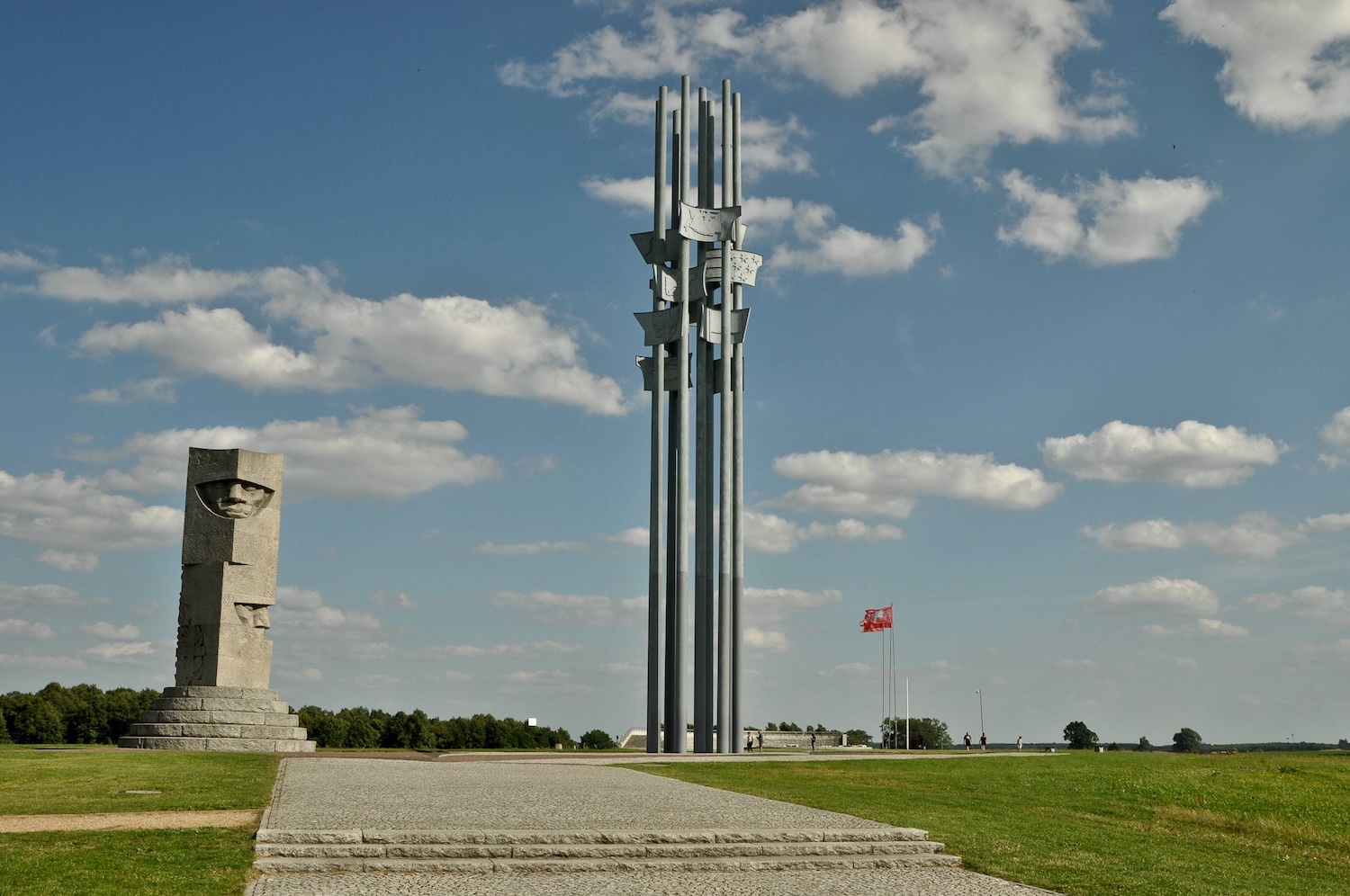
Poland marked the 550th anniversary in July 1960 with a monument on the ridge and a museum at its foot, and the timing tells you what the commemoration was for. A communist government fifteen years after the occupation, holding territory taken from Germany and nervous about keeping it, had every reason to build a large permanent argument about Germans losing here.
The monument is a granite obelisk carved with faces and a group of steel masts standing like banners on the skyline, with an amphitheatre cut into the slope below. It is grim, effective and completely of its decade.
Battlefield Archaeology and the Problem of Finding Grunwald
Grunwald left startlingly little in the ground. Tens of thousands of men fought here and the archaeological record is thin enough that establishing where the main fighting happened has taken most of a century — medieval battlefields were stripped of anything reusable within days, and metal was far too valuable to leave lying in a field.
Mass graves turned up in 1958 and 1960 during construction, near the ruins of the memorial chapel. The chapel is worth pausing on: the Order built it in 1411 over the dead of its worst defeat, and the Grand Master who ordered it was Heinrich von Plauen, the man whose defence of Malbork had just saved the Order from the consequences of that same battle.
Finding the graves did not find the battle. A Polish-Scandinavian project worked the ground with metal detectors between 2014 and 2017, targeting a valley south and east of Stębark that Polish archaeologists had long argued was the decisive ground. The museum now runs an annual volunteer sweep across roughly a hundred hectares, with dozens of detectorists working in rows, and the finds come up in fragments — crossbow bolt heads, arrowheads, spurs, pieces of sword, a gauntlet, axes recovered from marshy ground where nobody thought to look.
Days of Grunwald: Europe's Largest Medieval Battle Reenactment
Grunwald is refought every July by several thousand people in armour. The reenactment has run since the late 1990s, draws participants from across Europe and beyond, and pulls tens of thousands of spectators onto the fields for a weekend of camps, markets and a staged battle on the anniversary.
The event is enormous, popular, commercially serious and entirely sincere on the part of most of the people in it. It also means that the single largest gathering ever held on this ground since 1410 involves Poles, Lithuanians, Germans, Czechs and Russians arriving voluntarily to hit each other with blunted weapons and then drink together, which is a considerable improvement on every previous arrangement.
Visiting the Grunwald Battlefield and Museum in Poland
The battlefield sits outside Stębark in Warmian-Masurian Voivodeship, around two and a half hours north of Warsaw and forty minutes from Olsztyn, in gentle farming country of low ridges, woodland and lakes. Nothing about the landscape announces itself. The ground rises slightly and there are trees on the horizon, and that is the whole of it.
The museum reopened in 2022 after a rebuild costing around 47 million złoty, and it is the reason to come. The architects sank most of the building below ground level so that it would not interrupt the sightlines of the battlefield, which took the exhibition from under 300 square metres to nearly 4,000 without putting a large modern object on a historic field. The displays run to interactive maps, 360-degree film and the excavated material — the bolt heads and armour fragments that took sixty years of searching to accumulate.
A path runs from the museum up to the monument hill, with the chapel foundations and Jagiełło's Mound nearby. Guides work the fields through the summer. The reenactment weekend in mid-July fills every room for thirty kilometres and should be either the reason for the trip or the thing carefully avoided.
The Tannenberg Memorial site near Olsztynek is twenty minutes away and worth the detour precisely because there is nothing to see. A raised area in a field, some scattered concrete, a pit. The largest monument the Weimar Republic and the Third Reich ever raised in the east, holding the body of a German head of state, reduced to a shape in the ground that a visitor would drive past without noticing.
Masuria carries more of this history than anywhere else in Poland, and anyone making the trip with a car should know that Wolf's Lair lies about 140 kilometres east near Kętrzyn, roughly two hours on these roads. Hitler's field headquarters and a medieval battlefield have no historical connection worth claiming, beyond the fact that the retreating Wehrmacht dynamited the bunkers there in the same weeks it dynamited the Tannenberg Memorial here. Grunwald, Olsztynek and Gierłoż make a straightforward weekend.
Standing on the ridge at Grunwald, the thing that registers is how small the field is for what has been loaded onto it. A shallow valley, a few kilometres of farmland, a village either side. Four nations have built their sense of themselves partly out of one July afternoon here, and Germany built and destroyed a fortress of a monument nearby trying to unwrite it. The ground itself has been growing rye through all of it and will carry on.
The Battle of Grunwald: Frequently Asked Questions
Who won the Battle of Grunwald?
The combined forces of the Kingdom of Poland and the Grand Duchy of Lithuania won, commanded by King Władysław Jagiełło and Grand Duke Vytautas. The Teutonic Order's field army was destroyed on 15 July 1410 and its entire senior leadership was killed, including Grand Master Ulrich von Jungingen, the Grand Marshal, the Grand Commander and the Treasurer. Thousands of Teutonic soldiers died and thousands more were captured. The allied army failed to follow the victory up, and could not take the Order's capital at Malbork.
Why is the Battle of Grunwald also called Tannenberg?
The battle has three names because three nations claim it. Poles call it Grunwald, Lithuanians call it Žalgiris, and Germans call it Tannenberg, each after a village near the field. The German name became politically significant in 1914, when a German victory over the Russians in East Prussia was deliberately named the Battle of Tannenberg despite being fought some distance away, so that it would be recorded as revenge for the defeat of 1410.
What happened to the Teutonic Order after Grunwald?
The Order survived the battle but never recovered from it. Heinrich von Plauen reached Malbork ahead of the allied army and held the fortress through a two-month siege, and the Peace of Toruń signed in February 1411 left Teutonic territory largely intact. The lasting damage was structural: the Order had lost its army, its leadership and the flow of Western guest crusaders that subsidised it, and it began taxing Prussian towns heavily enough to provoke rebellion. The Second Peace of Toruń in 1466 cut its state in half, and in 1525 the last Grand Master in Prussia converted to Lutheranism and turned the territory into a hereditary duchy for himself.
What were the two swords of Grunwald?
The two swords were a formal insult delivered by Teutonic heralds on the morning of the battle. They were presented to Jagiełło and Vytautas as a gift from Grand Master Ulrich von Jungingen, with a message suggesting the two rulers needed weapons to find the courage to leave the treeline and fight. Jagiełło accepted them without visible offence. The swords entered the Polish royal treasury and became one of the country's oldest national symbols, and the man who sent them was dead by that evening.
Why did the Teutonic Knights fight Poland and Lithuania?
The Teutonic Order was founded to fight pagans, and Lithuania was the last pagan state in Europe. That justification ended in 1386, when Grand Duke Jogaila accepted baptism, married the Polish queen and brought Lithuania into the Church and into union with Poland. The Order continued campaigning for another twenty-four years on the argument that the conversion was insincere, largely because its whole operation depended on the annual arrival of Western European crusaders who could only be recruited to fight non-Christians. The immediate trigger for the 1410 war was a Samogitian uprising against Teutonic rule in 1409, backed quietly by Vytautas.
Can you visit the Grunwald battlefield?
The battlefield is open to visitors and lies outside the village of Stębark in Warmian-Masurian Voivodeship, roughly two and a half hours north of Warsaw. The Museum of the Battle of Grunwald reopened in 2022 in a new building deliberately sunk below ground level so as not to obstruct the sightlines of the field. Paths lead from the museum to the 1960 monument on the ridge, the foundations of the memorial chapel built in 1411, and Jagiełło's Mound. A large reenactment is staged every July on the anniversary of the battle.
Sources
Annales seu cronicae incliti Regni Poloniae — Jan Długosz (15th century)
Cronica conflictus Wladislai regis Poloniae cum Cruciferis — anonymous contemporary account (c. 1410)
Die Schlacht bei Tannenberg 1410: Quellenkritische Untersuchungen — Sven Ekdahl (1982)
Battlefield Archaeology at Tannenberg (Grunwald, Žalgiris) — Sven Ekdahl
Battlefield Archaeology at Grunwald: A Polish-Scandinavian Research Project 2014–2017 — Muzeum Bitwy pod Grunwaldem and the Danish Archaeological Society Harja
Grunwald 1410: studies on the battle and the battlefield — Andrzej Nadolski
The Teutonic Knights: A Military History — William Urban (2003)
Permanent exhibition and archaeological collections — Muzeum Bitwy pod Grunwaldem, Stębark
Battle of Grunwald: collection record and conservation history — National Museum in Warsaw
Records of the 1939 evacuation of the Battle of Grunwald — Zachęta Society for the Encouragement of Fine Arts
The Tannenberg Memorial: construction, use and destruction — documentation of the Tannenberg-Denkmal
Grunwald battlefield site records — Museum of Warmia and Masuria, Olsztyn