The Night the Bomb Came Up Out of the Ground
Just after midnight on August 6, 1945, a tractor towed a silver B-29 backwards across the hardstand at Tinian North Field until its bomb bay sat directly over a rectangular concrete pit. Below, in the pit, a four-and-a-half-ton object the length of a small car rested on a hydraulic lift. The crew called it Little Boy. It was ten feet long and twenty-eight inches across, and it could not be loaded the way every other bomb in the Pacific was loaded — slung up through the open bay doors — because it was too tall to clear the lip of the aircraft. So the engineers had solved the problem in reverse. They put the bomb in a hole, rolled the airplane over the hole, and raised the weapon up into the belly of the plane from underneath.
The lift rose. Men in coveralls guided the casing by hand as it climbed into the bay. Floodlights threw hard shadows across the coral. When it was secured, the bomb bay doors closed over the first nuclear weapon ever used in war, and the loading pit was just an empty rectangle in the ground again.
This is the thing about Tinian that the photographs never quite capture: it was an industrial site. The atomic age did not begin in a laboratory or a desert flash. It began on a logistics platform — a place built for moving tonnage at scale, where one particular five-ton package happened to be loaded out among thousands of others. Tinian was where two of the twentieth century’s most lethal inventions met. One was the strategic bombing campaign, the systematic erasure of cities from the air. The other was the bomb itself. The island took the first idea to its absolute industrial peak and then handed it the second. For a few weeks, this strip of paved reef was simultaneously the most productive airport in human history and the launch point for the weapon that would make all of it obsolete.
How a Coral Island Became the World’s Busiest Airport
Tinian sits in the Mariana Islands, a chain of volcanic and coral specks roughly 1,500 miles south of Tokyo. That distance was the whole point. The United States Army Air Forces had a new bomber, the B-29 Superfortress, that could carry bombs farther than any aircraft ever built — and from the Marianas, Japan was finally, just barely, within reach. Whoever held these islands could bomb the Japanese home islands around the clock. In 1944, nobody held them but Japan.
The 1944 Battle for Tinian and the Marianas Campaign
The Marianas campaign was brutal and brief. American forces took neighboring Saipan in a bloodbath through June and July 1944, then turned to Tinian. The fight for Tinian lasted nine days, from July 24 to August 1, and military historians have often called it the most tactically perfect amphibious operation of the Pacific war — a feint at the obvious beaches, a real landing at two narrow strips of sand the Japanese had dismissed as too small to matter. The cost was still measured in bodies. Most of the island’s Japanese garrison of around 8,000 men died rather than surrender. Hundreds of Japanese civilians, terrified by propaganda that the Americans would torture them, walked off the cliffs at the island’s southern end. The Americans renamed those cliffs and moved on, because they were not there for the island. They were there for what they could build on it.
Building North Field: The Seabees and Four Runways of Crushed Coral
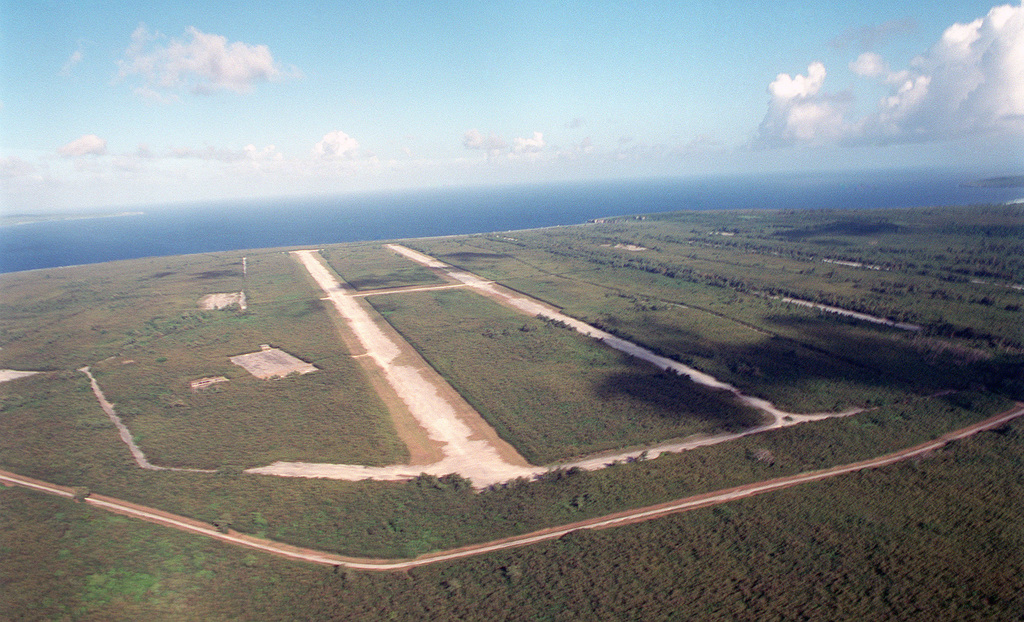
Tinian was almost laughably suited to its purpose: flat, hard, and shaped a little like Manhattan. The U.S. Navy’s construction battalions — the Seabees — seized on the resemblance and laid the island out like New York, with a grid of roads they named Broadway, 42nd Street, and Wall Street. Then they went to work with a ferocity that still defies belief. At the island’s northern end they carved North Field, four parallel runways each roughly 8,500 feet long, plus taxiways and hardstands for hundreds of aircraft, all surfaced with crushed coral quarried straight from the island. It became the largest operational airfield of the entire war.
By the summer of 1945, North Field and its southern companion, West Field, launched B-29s in numbers that strained comprehension. On a single peak day, more than 500 bombers took off from Tinian to burn Japanese cities. The roar over the island was constant. Aircraft queued nose to tail. Crews flew, slept, and flew again. This was strategic bombing as assembly line — and into that ceaseless industrial churn, in the summer of 1945, the U.S. quietly slotted a group of men who did not fly the regular missions, did not socialize with the other crews, and would not say what they were doing.
The 509th Composite Group and the Secret on Tinian
The newcomers arrived in stages through the summer of 1945 and kept to themselves. They were the 509th Composite Group, commanded by a 30-year-old colonel named Paul Tibbets, and they had trained for months in the Utah desert to do one thing: drop a single enormous bomb and turn away from it fast enough to survive the blast. The other airmen on Tinian resented them. The 509th flew strange, infrequent missions, lived in a fenced and guarded compound, and answered no questions. A piece of doggerel circulated on the island mocking the secretive unit that seemed to do nothing while everyone else flew into flak every night.
Project Alberta and the Arrival of the Atomic Bombs
The 509th was the delivery half of a larger operation. The scientific half was Project Alberta, the field unit of the Manhattan Project — the men who had built the bombs at Los Alamos and now followed them across the Pacific to assemble them for use. The components came in by air and by sea. The most infamous shipment crossed the ocean aboard the cruiser USS Indianapolis, which delivered the uranium core and gun assembly for Little Boy to Tinian on July 26, 1945 — and then, four days later, was torpedoed on her way onward and went down with most of her crew, many of them taken by sharks over the following days. The bomb that the Indianapolis carried to Tinian would outlive almost everyone who had sailed it there.
Inside the guarded compound, Alberta’s scientists worked in air-conditioned huts assembling weapons whose physics had been proven only weeks earlier, at the Trinity Site in the New Mexico desert. Trinity had tested the plutonium implosion design on July 16. The Fat Man weapon staged on Tinian was its twin. Little Boy, the uranium gun-type bomb, had never been tested at all. Its design was considered so reliable that the first time it would ever be detonated would be over a living city.
Bomb Pit No. 1 and Bomb Pit No. 2
The loading problem was real and strange. Both bombs were too large to hoist into a B-29 by the normal method, so the engineers built two concrete pits into the hardstand at North Field. Bomb Pit No. 1 would load Little Boy; Bomb Pit No. 2 would load Fat Man. The procedure was the inverse of everything the ground crews knew. A bomb was lowered into the pit on its trailer, the aircraft was towed rearward until its open bay sat over the opening, and a hydraulic lift raised the weapon up into the plane. It took hours and a great deal of nerve. The men guiding several tons of untested nuclear weapon by hand, in a hole in the ground, in the dark, did so knowing only that they had been told it was important and that they should not drop it.
Paul Tibbets, the Enola Gay, and the Hiroshima Mission
On the afternoon of August 5, 1945, Paul Tibbets had his mother’s name painted on the nose of his B-29: Enola Gay. He chose the aircraft personally and put his own family on it as a kind of talisman. That night, after the midnight loading, the crew gathered for a pre-flight briefing and a breakfast that several of them barely touched. A chaplain offered a prayer for the men aboard the aircraft. Nobody prayed aloud for the people of the target city, because almost no one on Tinian knew exactly what the bomb would do.
At 2:45 a.m. on August 6, the Enola Gay rolled down the full length of Runway Able. Tibbets held the heavily overloaded aircraft on the ground far longer than normal, letting speed build, and lifted off with runway to spare. The bomb was not yet fully armed; a weapons officer named Deak Parsons, worried that a crash on takeoff would obliterate the island, completed the final arming of Little Boy in flight, crouched in the cramped bomb bay with a written checklist he had practiced until his fingers bled. Six and a half hours later, at 8:15 a.m. local time, Little Boy fell over Hiroshima. It detonated about 1,900 feet above the city. Tens of thousands of people died in the first seconds. The Enola Gay was forty miles away and still felt the shockwave slap the aircraft like flak.
Bockscar, Fat Man, and the Nagasaki Mission
The second mission was supposed to be a copy of the first, and it nearly became a catastrophe of a different kind. Three days after Hiroshima, with Japan still not surrendered, the 509th prepared a second strike using the Fat Man implosion bomb. The aircraft chosen was a B-29 named Bockscar, and the man flying it that day was Major Charles Sweeney.
The August 9 Flight and Its Near-Disaster
Almost everything that could go wrong on the August 9 mission did. Before takeoff, a ground crew discovered that a fuel transfer pump had failed, trapping 600 gallons of fuel in a reserve tank that Bockscar could carry but never use. Sweeney flew anyway. At the rendezvous point over Japan, a third observation aircraft failed to appear, and Sweeney circled for forty wasted minutes burning fuel he did not have. The primary target, the city of Kokura, was covered by haze and the smoke of a neighboring city that had been firebombed the day before. Bockscar made three bombing runs over Kokura and never found a clear aiming point. Each pass burned more fuel and drew more anti-aircraft fire.
Running dangerously low, Sweeney turned for the secondary target: Nagasaki. It too was covered in cloud. With barely enough fuel to reach a friendly airfield and orders forbidding a radar drop, the bombardier found a single gap in the overcast at the last possible moment and released Fat Man through it at 11:02 a.m. The bomb missed its intended aiming point by nearly two miles, detonating instead over the Urakami valley, where Nagasaki’s Catholic cathedral and a dense industrial district absorbed the blast. Bockscar limped to Iwo Jima and then onward to Okinawa, where it landed with its tanks nearly dry and one engine already dead from fuel starvation. The destruction of Nagasaki had been, in the cockpit, a near-run thing.
The End of the War and Tinian’s Sudden Irrelevance
Japan announced its surrender on August 15, 1945, six days after Nagasaki. A third atomic bomb was being readied for shipment to Tinian; it was never needed. Almost overnight, the busiest airport on Earth lost its reason to exist. The thousand-plane raids stopped. The crews went home. The 509th’s strange secret compound emptied. Within months, the great engine of strategic bombing that Tinian had embodied simply switched off, and the island was left holding four enormous runways and two concrete pits with nothing left to launch.
The Jungle Reclaims the Atomic Airfield
Tinian’s decline was fast and total. The military that had built the world’s largest airfield in a matter of months walked away from it almost as quickly, and the tropical climate did the rest.
From Strategic Hub to Overgrown Ruin
After the war, much of the Marianas was deliberately reseeded from the air with a fast-growing scrub called tangantangan, scattered to control erosion on land the bulldozers had stripped bare. The plant took to Tinian with a vengeance. Within a generation it had swallowed roads, hardstands, and the edges of the runways under a dense, monotonous thicket that grows back almost as fast as it can be cleared. The Manhattan street grid faded into the brush. Of North Field’s four runways, only fragments remain usable; the rest are cracked coral disappearing under green. The island’s population today is small, its economy modest, and most visitors come for diving and quiet beaches rather than history.
The Memorialized Bomb Pits Today
The two loading pits survived, and they are the heart of what remains. Bomb Pit No. 1 and Bomb Pit No. 2 have been excavated, marked, and covered with thick glass panels so visitors can look down into the rectangular concrete openings where Little Boy and Fat Man were raised into their aircraft. Bronze plaques and informational panels stand beside them. The presentation is restrained — no triumphalism, no condemnation, simply the pits, the dates, and a short account of what was loaded here and where it was flown. What a visitor brings to the glass is largely what a visitor takes away. To some, the pits are monuments to the weapons that ended a war and the invasion that would have cost far more lives. To others, they are the precise ground-zero point of the deaths of well over a hundred thousand civilians. Both stand at the same pane of glass, looking down into the same empty hole.
Visiting Tinian North Field
Tinian is reached by a short flight or ferry from Saipan, the larger and more developed island just to the north, itself connected by air to Guam and onward to Asia and the United States. The island is small enough to drive in a day, and North Field lies at its northern tip, accessible by public road. There are no gates and no admission fee. Visitors typically rent a car on Saipan, bring it across, and drive themselves out to the field, where signage marks the route to the atomic bomb pits.
What survives is austere. The glass-covered pits, the plaques, and long stretches of the original coral runways lying open under the sky are the main features; everything else has gone to brush or been removed. Standing at Bomb Pit No. 1, a visitor is looking at the exact spot where the first nuclear weapon ever used in war was lifted into an aircraft. The drive out is quiet, the field is usually empty, and the experience is less a tour than a confrontation with a flat patch of ground that does not look like anything until you know what it is. There is no crowd to absorb the weight of the place, no curated emotional arc — only the heat, the wind through the tangantangan, and two rectangles of concrete that were, for a few hours in August 1945, the most consequential spot on Earth. Visitors are asked to treat the site with the gravity it deserves, and most, standing alone at the glass, need no reminding.
Frequently Asked Questions
Where is Tinian North Field located?
Tinian North Field is at the northern end of Tinian, a small island in the Northern Mariana Islands, a United States commonwealth in the western Pacific roughly 1,500 miles south of Tokyo. The island lies just south of Saipan, which serves as the main gateway. Most visitors reach Tinian by short flight or ferry from Saipan, then drive to the field, which is open to the public without an admission fee.
Which atomic bombs were loaded at Tinian?
Both atomic bombs used in the Second World War were loaded at Tinian North Field. Little Boy, the uranium bomb dropped on Hiroshima on August 6, 1945, was loaded into the B-29 Enola Gay from Bomb Pit No. 1. Fat Man, the plutonium bomb dropped on Nagasaki on August 9, 1945, was loaded into the B-29 Bockscar from Bomb Pit No. 2. Both pits survive today and are marked memorials.
Why were the bombs loaded from pits in the ground?
Little Boy and Fat Man were both too tall to be hoisted up into a B-29’s bomb bay using the standard overhead loading method. Engineers solved this by digging concrete pits into the airfield, lowering each bomb into the pit on a trailer, towing the aircraft rearward until its open bomb bay sat directly over the opening, and then using a hydraulic lift to raise the weapon up into the plane from below. The procedure was slow and unusual, but it was the only way to get the oversized weapons aboard.
Can you visit the atomic bomb pits on Tinian today?
Yes. Bomb Pit No. 1 and Bomb Pit No. 2 are preserved at North Field and covered with glass panels so visitors can look down into the original concrete openings. Bronze plaques and informational signs stand beside them. The site is on public land at the island’s northern tip, reachable by car, with no gate or fee. The surrounding runways still exist, though much of the area has been overgrown by dense tropical scrub.
What happened to Tinian after the war?
Tinian’s military importance collapsed almost immediately after Japan’s surrender in August 1945. The mass bombing raids ended, the crews departed, and the world’s largest operational airfield was left with little to do. Postwar erosion-control efforts seeded the island with a fast-growing scrub called tangantangan, which overran the runways, roads, and hardstands. Today Tinian is a quiet, lightly populated island, and only fragments of North Field’s four runways and the two bomb pits remain as reminders of its role.
Sources
The Making of the Atomic Bomb — Richard Rhodes (1986)
Enola Gay: The Bombing of Hiroshima — Gordon Thomas and Max Morgan Witts (1977)
Ruin from the Air: The Atomic Mission to Hiroshima — Gordon Thomas and Max Morgan Witts (1977)
The Manhattan Project: The Birth of the Atomic Bomb — Cynthia C. Kelly, ed. (2007)
Tinian and the Bomb: Project Alberta and Operation Centerboard — Don A. Farrell (2018)
Now It Can Be Told: The Story of the Manhattan Project — General Leslie R. Groves (1962)
Mission to Hiroshima — Paul W. Tibbets, in flight reports and later memoir Return of the Enola Gay (1998)
War’s End: An Eyewitness Account of America’s Last Atomic Mission — Charles W. Sweeney (1997)
Battle for Tinian: Vital Stepping Stone in America’s War Against Japan — John C. Chapin, U.S. Marine Corps Historical Center (1994)
The Pacific War Online Encyclopedia: Tinian — Kent G. Budge (2007)