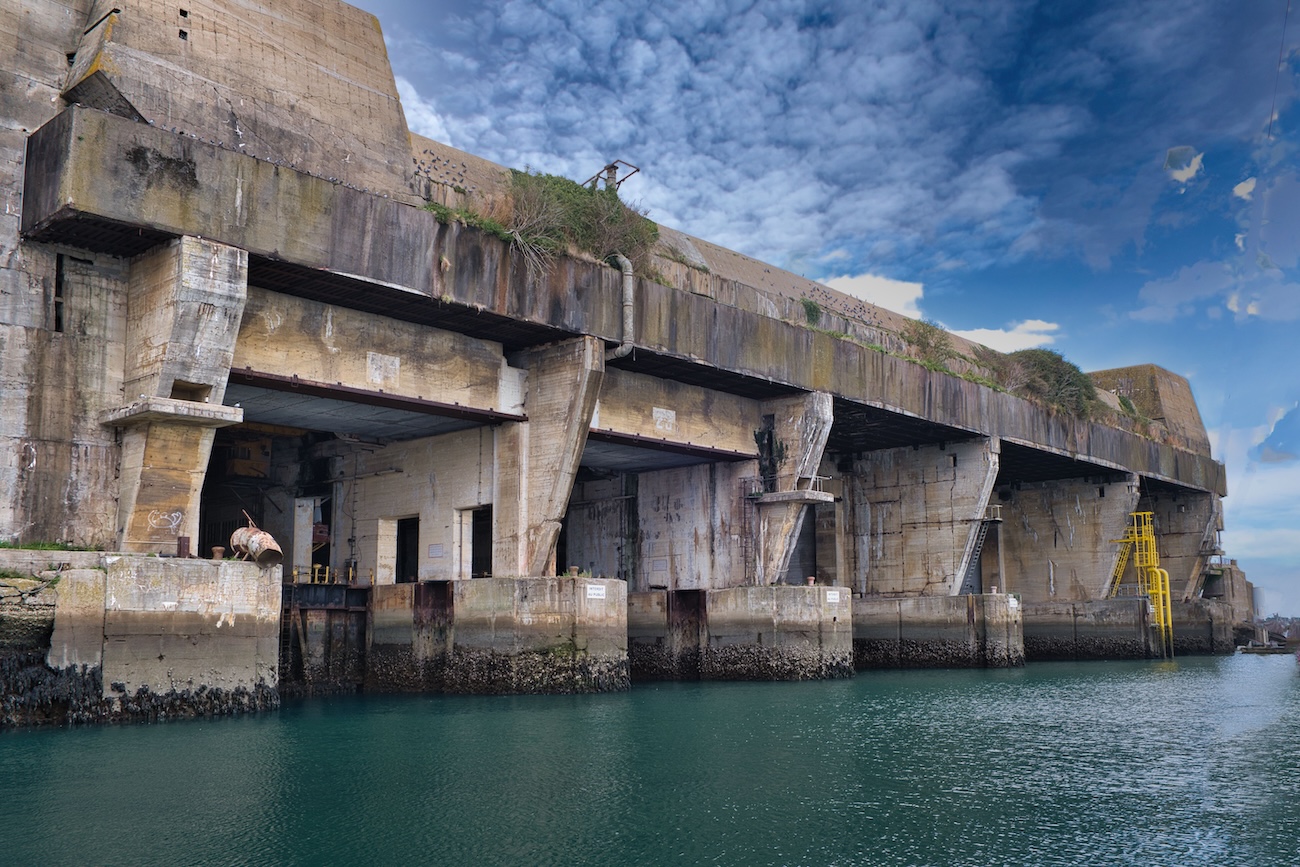
The 1943 Bombing of Lorient: The Raid That Erased a City and Failed to Dent a Bunker
The evacuation order went out on 3 February 1943. Lorient had been burning for three weeks by then — high explosive in daylight, incendiaries after dark, British and American bombers working over a Breton port of forty-six thousand people in relays. Families left on foot and by cart, past the burnt frames of their own houses. By the end of that month the town held a few hundred residents. Two hundred and thirty people were dead. Three and a half thousand buildings had been destroyed in five weeks.
Two kilometres south, the target was untouched.
Inside Keroman III, German submariners sat out the raids beneath seven metres of reinforced concrete. Bombs landed on the roof and did nothing. One direct hit snapped a beam in the upper slab, and the break is still visible today; the structure below it did not move. Early 1943 was the base's peak — twenty-eight U-boats were berthed at Lorient at the same time, while the town above them was being burned off the map. Not one submarine in the pens was damaged by bombing at any point in the war.
Keroman is what happens when overwhelming force meets something it cannot reach. The Allies had the largest bomber fleets ever assembled and a directive signed off by the Combined Chiefs of Staff, and against a box of concrete they were useless. So the campaign shifted onto the thing that could be destroyed — the town that fed the base, housed its workers, and had the misfortune to sit beside it. Power that cannot hit its target does not stop. It finds something softer.
The most serious damage anyone ever did to the U-boat war at Lorient was done by a French engineer walking the site with German clearance, counting submarines, spat at in the street by his own neighbours.
How Nazi Germany Captured Lorient and Won the Atlantic Coast
The Fall of France and the Race for the Biscay Ports
German forces took Lorient on 21 June 1940, in the last days of a collapse that had already stranded a British army on the beaches at Dunkirk. Karl Dönitz reached the decision within a week. On 28 June he committed to building a submarine base on the Keroman peninsula.
Lorient came with everything he needed already installed. The town held a French naval arsenal with dry docks and machine shops. Its fishing wharf had a boat lift built to haul trawlers out of the water for repair — and the lift could take a Type VII U-boat. There were bars, cafés and a red-light district for crews coming off eight weeks at sea.
The first boat arrived on 7 July 1940. U-30 came alongside under Kapitänleutnant Fritz-Julius Lemp, the first German submarine to resupply at any French base. Lemp was twenty-six. Ten months earlier, on the opening night of the war, he had put two torpedoes into a blacked-out ship off Ireland that he took for an armed merchant cruiser. It was the liner Athenia, carrying civilians to Canada, and 117 of them died. The Kriegsmarine falsified his log to bury it. That was the man who opened the Atlantic campaign's new front door.
Why Brittany Changed the Battle of the Atlantic
Geography did more for the U-boat arm in 1940 than any new weapon. A submarine leaving the Baltic had to run the North Sea, round the top of Scotland and come down through hostile water before it reached the convoy lanes — roughly a week each way, burning fuel and crew endurance on transit. From Lorient the boats were on the shipping routes in a couple of days. Effective patrol time roughly doubled without a single extra submarine being launched.
Dönitz was running a second attempt at an idea Germany had already tried once. The unrestricted campaign of the First World War, the one that put the RMS Lusitania on the seabed off Kinsale and helped drag America into the fight, had been an arithmetic problem: sink merchant tonnage faster than Britain could replace it. He called it the tonnage war and he very nearly solved it. In 1942 U-boats sent roughly 7.8 million tons to the bottom — a million tons more than the Allies could build.
Building Keroman: Organisation Todt, 15,000 Workers and the Roof That Beat the Bomb
The Dom Bunkers and the Slipway: Hauling U-Boats Out of the Atlantic
The RAF made the case for concrete on 27 September 1940, with the first air raid on Lorient. Submarines lying alongside in the open were obvious, valuable and unprotected. Construction of shelters began that November.
Bedrock beneath the peninsula ruled out digging deep wet pens for the whole fleet, so the Germans solved the problem sideways. They took the French fishing-boat lift and scaled it up. A submarine was hauled up a slipway onto a cradle, rolled onto a mobile transfer platform, and pushed along rails into a covered cell — a 750-tonne warship shunted around a dockyard like rolling stock. The first two shelters went up over the old fishing wharf: the Dom bunkers, East and West, cathedral-shaped, 81 metres long and 25 metres high, with a metre and a half of concrete overhead. Each held exactly one U-boat.
They were obsolete within months.
Keroman I, II and III: Inside the Largest U-Boat Shelter Ever Built
Work on Keroman I started on 2 February 1941 and finished that September — five bomb-proof dry pens, 120 metres by 101, eighteen and a half metres tall, under three and a half metres of roof, in seven months. Keroman II was laid down three months behind it and added seven more pens, a garage and barracks for a thousand men. Keroman III, begun in October 1941, was the monster: 170 metres wide, 24,000 square metres of floor, seven wet pens fed directly from the water so that boats could come and go without ever surfacing under an open sky. It was partly usable at the start of 1943 and fully operational by May.
The material bill is the part that stops people. The Keroman bunkers consumed close to a million cubic metres of reinforced concrete — approaching a quarter of all the concrete Germany poured in France for the entire war effort. Forty thousand cubic metres of timber went into formwork alone. Sixty thousand wagonloads of material came onto the peninsula, on railway lines built specially to carry sand.
Lorient became the busiest submarine yard in occupied Europe. Of the 1,149 major U-boat overhauls carried out across all five French bases during the war, 492 were done here.
The Fangrost Bomb Trap: The Roof Built to Kill a Bomb in Mid-Air
Each bunker got a thicker roof than the last, because Allied bombs kept getting heavier and the Germans kept reading the intelligence. Keroman III eventually received a solution that was closer to a trick than a wall. Above the main slab of reinforced concrete they laid a second layer of heavy beams in rows, with a gap of about a metre between the two. The Germans called it Fangrost — a catch grate. A bomb striking the upper grid detonated in open air inside the void, and spent itself on nothing before it ever reached the roof that mattered.
On 6 August 1944 the RAF put a 12,000-pound Tallboy onto Keroman III. Barnes Wallis's earthquake bomb was the heaviest airborne weapon in the Allied inventory, twenty-one feet of hardened steel designed to punch deep and shake a structure apart from beneath.
The bunker held.
Who Poured the Concrete: Organisation Todt, Forced Labour and French Wages
Roughly 15,000 people built Keroman, under the direction of Organisation Todt, the same engineering apparatus that raised Hitler's command bunkers at the Wolf's Lair and applied the same doctrine there — when the bombs get bigger, pour more concrete. By early 1942 the workforce included more than five thousand German personnel and around 4,300 French workers, with the balance drawn from across occupied Europe under forced-labour programmes and housed in camps around the site.
The French labourers occupy the ugliest position in the story. Lorient was a port town with no port work left; the Germans paid, and thousands of men took the wages. They spent 1941 and 1942 mixing and pouring the structure that would, in January 1943, become the reason the RAF burned their houses down. The bombs that killed 230 of their neighbours were aimed at concrete they had helped set.
Life at the Lorient U-Boat Base: The Aces, the Rituals and the Odds
The 2nd U-Boat Flotilla and the Men Who Sailed from Keroman
The 2nd U-boat Flotilla — the Saltzwedel Flotilla — moved into Lorient in June 1940 and stayed until August 1944, joined by the 10th Flotilla in 1942. Over four years, 203 U-boats passed through the base.
The men who made the U-boat arm famous sailed from these quays, and the myth around them died here in ten days. Günther Prien, who had taken U-47 into the anchorage at Scapa Flow in October 1939 and sunk the battleship Royal Oak at her moorings, went out on patrol and was lost with all hands on 7 March 1941. Four days later Lemp in U-110 and Joachim Schepke in U-100 left Lorient to join Otto Kretschmer in U-99 on the convoy routes south of Iceland. On the night of 16 March the destroyer HMS Vanoc found U-100 on the surface and rammed her; Schepke was crushed against his own bridge as the bow came through. Within hours HMS Walker forced U-99 up. Kretschmer, the highest-scoring submarine commander of the entire war, spent the next six years in a prison camp in Canada.
Berlin held the announcement of Prien's death back for weeks. Germany's three most celebrated submariners were dead or captured in a fortnight, and the Kriegsmarine could not afford to say so.
Château de Kernével: Dönitz's Command Post Facing the Bunkers
Dönitz moved his operational headquarters to Paris in September 1940, then out to Lorient that November, into a requisitioned house at Kernével on the far bank, looking straight across the water at the Keroman construction site. The owners were given notice and put out of their own homes. From those rooms he ran the Battle of the Atlantic — plotting convoys, positioning wolfpacks, signalling boats a thousand miles out.
He met the submarines himself. A returning boat came up the channel to a brass band on the quay, flowers, photographers, and the commander-in-chief waiting on the concrete to shake hands with men who had not washed in two months. The ritual was deliberate and it worked; crews described it for the rest of their lives.
He left in March 1942, after British commandos rammed an explosive-packed destroyer into the dock gates at Saint-Nazaire and demonstrated that a headquarters sitting on the coast was a target. Dönitz went back to Paris. The band stayed.
Seventy-Five Percent: The Odds of Coming Home from a Lorient Patrol
Around 40,000 men served in the German submarine arm during the Second World War, and roughly 28,000 of them died. Three in four. No other branch of any military in the conflict came close to that rate, and the men on the quay at Lorient knew the numbers as well as anyone.
In 1942 the base built them a tower to practise dying more slowly. It was a water-filled column where crews rehearsed free ascent from a sunken submarine — controlled exhalation, a slow rise, the discipline required to leave a flooding hull without killing yourself on the way up. The French renamed it the Davis Tower after the war. It still stands, and it is still the oldest surviving structure of its kind.
The arithmetic broke in May 1943. Forty-one U-boats were lost that month; on 24 May, Dönitz pulled his boats out of the North Atlantic entirely. Five days before he gave that order, his son Peter died aboard U-954 in the same waters.
Jacques Stosskopf: The Engineer Lorient Called a Traitor
The Man Who Counted the Submarines
Jacques Stosskopf was born in Paris in 1898 to an Alsatian family and grew up bilingual. He went into the artillery in 1917 and came out with the Croix de Guerre, entered the École Polytechnique in 1920, and qualified as a marine engineer. By 1939 he ran the new-construction department at the Lorient naval arsenal with the rank of Chief Engineer, First Class.
The Germans took the arsenal in June 1940 and kept him in post. His fluent German and his hard, cold manner with French workers convinced the occupiers he was reliable, and they gave him what almost no other Frenchman in Brittany had: authorised access to the Keroman site as it was being built.
He began using it in September 1940. In 1942 he joined the Alliance network, the largest Allied intelligence operation in occupied France, and passed out everything he saw — the layout and construction of the pens, and the movement of individual submarines in and out of Lorient. Boats that left Keroman were sometimes met on the convoy routes by escorts who had reason to know they were coming.
His own town read him exactly as the Germans did. Neighbours crossed the street. He appeared on the quiet lists people were keeping for the reckoning that would come after the liberation. He said nothing, to anyone, for four years.
Arrested in Vannes, Executed at Struthof
A captured Alliance agent broke under torture and gave up his name. The Gestapo arrested Stosskopf at Vannes on 21 February 1944.
Lorient understood the disappearance as a promotion — the German-speaking engineer rewarded for his loyalty and sent east. He was deported under Nacht und Nebel, the programme designed to make resisters vanish without record or grave. On 1 September 1944 he was shot at Natzweiler-Struthof, the only Nazi concentration camp built on French soil, days ahead of the Allied advance.
The truth surfaced in August 1945, when France made him a Commander of the Legion of Honour posthumously and the people who had wanted him tried found out what he had actually been doing. In July 1946 the French Navy renamed the entire complex Base Ingénieur Général Stosskopf.
His name is bolted to the wall of Keroman II, on concrete he helped the Germans pour.
Why the Bombing Failed: The Casablanca Directive and the Death of Lorient
Casablanca, January 1943: The Order That Doomed the Town
Allied leadership met at Casablanca in January 1943 with the shipping figures in front of them and the Atlantic looking lost. On 21 January the Combined Chiefs of Staff approved the directive that set bomber priorities for the coming year, and German submarine yards went to the top of the list — above the aircraft industry, above transport, above oil.
Churchill had already moved on the bases themselves. On 14 January he ordered the destruction of the towns surrounding them, to cut off their supply. Lorient was designated the priority target.
The reasoning was explicit and its consequences were understood. The pens could not be broken, so everything serving them would be broken instead: water, power, rail, housing, shops, the dockyard workforce and the streets they lived in.
Four Thousand Tons: What the Raids Did to Lorient
Between 14 January and 17 February 1943 more than 4,000 tons of bombs fell on Lorient. The evacuation order followed on 3 February, and a town of forty-six thousand emptied to a few hundred. Three thousand five hundred buildings were destroyed in that window and 230 people were killed. By the end of the war the tally for Lorient and neighbouring Keryado stood at 4,095 buildings destroyed and another 3,245 needing urgent repair — around ninety percent of the place.
Keroman absorbed more than thirty major raids and over 4,500 tons of ordnance across the war and lost nothing. No submarine sheltering in the pens was ever damaged from the air.
The raids did achieve something narrower. Cutting the water supply, the power and the road links made the base progressively harder to run, and the campaign degraded Lorient's usefulness by strangling it rather than smashing it. Allied command understood the difference between that and what they had set out to do. By April 1943 area bombing of the Biscay ports was quietly abandoned as ineffective.
Tallboy: The Bomb That Worked, and Arrived Too Late
Barnes Wallis's Tallboy entered service in June 1944 and changed the mathematics. Dropped from height, the 12,000-pound casing reached supersonic speed and drove deep into the earth beside a target before detonating, transmitting the shock through bedrock into foundations that no surface bomb could reach. RAF Lancasters used them against the pens at Brest and La Pallice, and some of those roofs finally opened.
Lorient's turn came on 6 August 1944. The Tallboy hit Keroman III and failed to penetrate.
The following morning, American armour was fighting on the outskirts of the town. The only weapon capable of cracking the fortress arrived in the same week the fortress stopped mattering.
The Lorient Pocket: The Garrison That Surrendered After the War Ended
Festung Lorient: The Siege That Started in August 1944
American units broke out of the Normandy beachhead in late July 1944, six weeks after the landings that had put them ashore at Omaha Beach, and armoured columns ran west into Brittany faster than the Germans could reorganise. Elements of the 4th Armored Division were fighting on the edge of Lorient by 7 August.
Allied command looked at seven metres of concrete, a ring of flak batteries and a fortified perimeter, and declined the assault. They drew a line around the town and sat on it. Infantry divisions and Free French units held the cordon for the next nine months while the war moved east without them.
The submarines left first. Most of the boats cleared Lorient in the opening fortnight of August; the last operational departure was U-155 on 5 September 1944. The 10th Flotilla was disbanded in October, when U-boat activity at the base ceased altogether.
Around 25,000 German troops remained inside under General Wilhelm Fahrmbacher, and they moved into the bunkers. The pens built to shelter submarines from bombing spent the final winter of the war as barracks for a garrison that no longer had any submarines to shelter.
10 May 1945: The Last Surrender in France
Hitler killed himself on 30 April. Germany surrendered unconditionally on 7 May, effective the following day, and across Europe the shooting stopped.
Fahrmbacher held for two more days. The formal capitulation took place on 10 May 1945 at Caudan, outside Lorient, where he handed over his sidearm to General Herman Kramer of the US 66th Infantry Division. Lorient was among the last German strongholds in western Europe to fall, and it fell after the war it belonged to had already ended.
Two submarines were found inside. U-129 had been scuttled in front of Keroman III on 18 August 1944; she was raised and scrapped. U-123 was sitting intact in pen K3. The French Navy repaired her and commissioned her in 1947 as Blaison, and she served France for more than a decade — a German U-boat, taken in a German bunker, sailing under a French flag out of the base her crew had abandoned.
From U-Boat Bunker to Sailing City: What Keroman Became
Fifty Years of French Submarines at Base Stosskopf
The French Navy inherited the largest submarine facility in Europe and used it exactly as intended. Base Stosskopf operated until February 1997, running up to ten boats with around 2,000 personnel, and it trained crews through the whole of the Cold War — including, in the 1960s, the men who would take France's first ballistic-missile submarines to sea, working up aboard the experimental Gymnote. The base finally closed because it could not handle nuclear submarines, which is to say it was retired for a reason that had nothing to do with its walls.
The slipway that had hauled U-boats out of the Atlantic was removed in 2005, sixty-four years after it was laid.
Rebuilding Lorient: The Concrete Town That Replaced the One the Bombs Took
Lorient came back quickly and plainly. Reconstruction ran from the late 1940s into the early 1960s and produced a modern town on a new grid — reinforced concrete apartment blocks, wide streets, functional and fast and almost entirely without a past. The choice was pragmatic. Housing was needed immediately and there was very little left standing to restore.
Warsaw faced comparable destruction and made the opposite decision, reconstructing its erased old town facade by facade from paintings and pre-war drawings until the city recovered a face it had lost. Lorient chose speed. The medieval and eighteenth-century port that the bombs took has no successor; what stands there now is a different town with the same name.
The bunkers outlasted both the bombing and the reconstruction, for the same reason in both cases. Demolition was studied, costed and dropped. Removing a million cubic metres of steel-reinforced concrete from a working harbour was harder and more expensive than living with it.
La Base Today: Yacht Sheds, a Submarine Museum and Concrete Nobody Can Remove
Sailing arrived in the 1990s. Ocean-racing skippers noticed that a bomb-proof submarine pen is an outstanding boat shed — cavernous, dry, secure, with direct deep-water access — and moved in. An offshore racing centre grew around them. Multihull teams now build carbon-fibre masts and refit racing trimarans inside the alveoli where Type VII U-boats were serviced.
The Cité de la Voile Éric Tabarly opened on the site in 2008. The Flore, a Daphné-class submarine launched in 1961, sits in a Keroman II pen as a museum of the submariner's trade. The Davis Tower runs exhibitions on underwater escape and the wrecks lying in the bay outside. The complex draws around 200,000 visitors a year and carries formal protection as twentieth-century heritage.
Lorient spent five weeks being destroyed on account of this concrete. Eighty years later the town keeps it, maintains it, charges admission to it, and races boats out of it.
Visiting the Keroman Submarine Base: Tours, the Flore Submarine and What to Expect
The exteriors of Keroman I, II and III are open ground and can be walked freely, which is the best way to register the scale — the blocks read as geological rather than architectural, and photographs consistently fail to convey how large they are. The interior of K3 is accessible only on a guided tour booked through the Lorient tourist office and run by the city's heritage service. English-language guides are available by prior arrangement rather than as standard, and off-season availability is limited, so booking ahead matters. Tours typically include the pens themselves and access to the roof, where a wartime anti-aircraft position survives and the view runs across the harbour to Kernével at Larmor-Plage, Dönitz's command post, clearly visible on the far bank.
The Flore and its museum operate as a separate visit, as does the Davis Tower. The Stosskopf memorial plaque is mounted on the wall of Keroman II. Under the modern city centre, the preserved civil-defence shelter where the remaining population sat out the 1943 raids can also be visited by guided tour, and seeing both in one day is the most direct way to understand what the campaign actually did.
Lorient sits on the Paris–Quimper line, roughly three hours from Montparnasse, and is straightforward to reach by road from Nantes or Rennes. The site is a working port and business park as well as a monument, and it does not present itself with any particular solemnity.
The pens are cold, wet and very dark. Water gets in and drips continuously; sound travels strangely and dies fast. The place was built by conscripted and coerced labour to shelter a weapon system that killed roughly 30,000 Allied merchant seamen, and it succeeded completely — which is precisely why the town beside it was erased instead. That is the moral shape of the site, and Lorient has made no attempt to soften it or to stage it. The city was not given the option of forgetting the concrete, so it decided to use it.
What remains is a record with no commentary attached. The snapped beam in the upper roof where a direct hit landed and achieved nothing. The rail bed where submarines were rolled out of the sea. An engineer's name on a wall, put there by the town that had wanted him hanged. In the pen below, a French submarine that will never go to sea again, and outside on the water, a racing trimaran going out on the tide.
FAQ
Why couldn't Allied bombs destroy the Keroman submarine base?
The bunkers were built with roofs of between 3.5 and roughly 7 metres of steel-reinforced concrete, far beyond what any bomb in service in 1943 could penetrate. Keroman III also carried a Fangrost defence — a grid of heavy beams laid above the main roof with a gap of about a metre between them, designed to detonate bombs in open air before they reached the structure below. More than thirty major raids and over 4,500 tons of ordnance fell on the site across the war without damaging a single submarine sheltering inside. The RAF finally dropped a 12,000-pound Tallboy earthquake bomb on Keroman III on 6 August 1944, and it failed to penetrate.
Why did the Allies bomb the city of Lorient instead of the submarine base?
Churchill ordered the destruction of the towns surrounding the Atlantic U-boat bases on 14 January 1943, and Lorient was designated the priority target. The reasoning was that the pens themselves could not be broken, so everything serving them would be broken instead — water, power, rail links, housing and the dockyard workforce. Between 14 January and 17 February 1943 more than 4,000 tons of bombs fell on the town, destroying around 3,500 buildings and killing 230 people. The area bombing of the Biscay ports was abandoned as ineffective by April 1943.
Can you visit the Keroman submarine base today?
The exteriors of Keroman I, II and III are open ground and can be walked freely. The interior of Keroman III is accessible only on guided tours booked through the Lorient tourist office and operated by the city's heritage service, which include the pens and access to the roof with its surviving anti-aircraft position. The submarine Flore and its museum, and the Davis Tower escape-training column, run as separate visits on the same site. English-language guides are available by prior arrangement rather than as standard, and off-season availability is limited, so booking ahead is advisable.
Who was Jacques Stosskopf?
Jacques Stosskopf was a French marine engineer who served as deputy director of naval construction at Lorient and used the position to spy for the Allies. Fluent in German and outwardly cooperative, he was trusted by the occupiers and granted authorised access to the Keroman construction site, from which he passed on the layout of the pens and the movement of individual U-boats. He joined the Alliance intelligence network in 1942, was denounced by a captured agent under torture, and was arrested by the Gestapo at Vannes on 21 February 1944. He was executed at Natzweiler-Struthof on 1 September 1944, and the French Navy renamed the base in his honour in July 1946.
When did the Lorient Pocket finally surrender?
The German garrison at Lorient surrendered on 10 May 1945, two days after the war in Europe officially ended. American forces had reached the outskirts on 7 August 1944 but declined to assault the fortified perimeter, choosing instead to blockade it for nine months. Around 25,000 troops under General Wilhelm Fahrmbacher held out inside, using the empty submarine pens as barracks. The formal capitulation took place at Caudan, outside Lorient, where Fahrmbacher handed his sidearm to General Herman Kramer of the US 66th Infantry Division.
How many U-boats operated from the Lorient base?
Lorient was the largest and busiest German submarine base of the war, with 203 U-boats passing through it between 1940 and 1944. At its peak in early 1943, twenty-eight submarines were berthed there simultaneously. Of the 1,149 major U-boat overhauls carried out across all five French Atlantic bases, 492 were done at Lorient. The 2nd U-boat Flotilla was stationed there from June 1940 until August 1944, joined by the 10th Flotilla in 1942.
Sources
Ten Years and Twenty Days: Memoirs — Karl Dönitz (1958)
Hitler's U-Boat War: The Hunters, 1939–1942 — Clay Blair (1996)
Hitler's U-Boat War: The Hunted, 1942–1945 — Clay Blair (1998)
Hitler's U-Boat Bases — Jak P. Mallmann Showell (2002)
The U-Boat: The Evolution and Technical History of German Submarines — Eberhard Rössler (1981)
Forgotten Blitzes: France and Italy under Allied Air Attack, 1940–1945 — Claudia Baldoli and Andrew Knapp (2012)
Les Français sous les bombes alliées, 1940–1945 — Andrew Knapp (2014)
The Strategic Air Offensive Against Germany 1939–1945 — Charles Webster and Noble Frankland, HMSO Official History (1961)
The Bomber Offensive from the United Kingdom, C.C.S. 166/1/D (Casablanca Directive) — Combined Chiefs of Staff, US Department of State, Foreign Relations of the United States (1943)
Noah's Ark: The Secret Underground — Marie-Madeleine Fourcade (1968)
Barnes Wallis' Bombs: Tallboy, Dambuster and Grand Slam — Stephen Flower (2002)
Albums of Air Photographs: Keroman, Lorient, AIR 34/744 — Air Ministry, The National Archives, United Kingdom (1942)