D-Day Landing Chaos: The Morning of Systematic Slaughter
The ramp of the Higgins boat drops, and the world turns into a pressurized chamber of lead and salt spray. At 06:30, the men of the 1st and 29th Infantry Divisions did not land on a beach; they stepped into a pre-registered kill zone. The English Channel is a freezing, diesel-slicked churn of vomit and metallic-smelling blood. If you jump too early, the 80-pound combat load on your back drags you to the floor of the sea like an anchor. If you jump too late, you are dismantled by an MG-42 burst before your boots hit the steel.
The German defense is not a line; it is a three-dimensional grid of extermination. From the 100-foot bluffs above, the German 352nd Infantry Division looks down through the narrow slits of reinforced concrete bunkers. They do not need to aim. They simply sweep their weapons across the draws—the natural exits from the beach—turning the sand into a meat grinder. The water turns a literal, viscous red as the tide carries the first wave’s remains back out to sea, only to wash them up against the second wave ten minutes later. By 07:00, Omaha is not a battlefield; it is a landfill of shattered equipment and human debris.
Atlantic Wall Defenses at Vierville-sur-Mer
The geography of Omaha was a gift to the defender. While Utah Beach—located fifteen miles to the west—was relatively flat, Omaha was a crescent-shaped bowl overlooked by steep cliffs. Every square inch of the sand was pre-registered. German mortar crews had already calculated the exact math required to drop shells onto specific rocks and tide-markers.
The beach was littered with Hedgehogs, Belgian Gates, and Hemmbalken—massive steel and timber obstacles tipped with Teller mines. The plan was for specialized demolition teams to blow these up in the first minutes to clear a path for the landing craft. They couldn't. With a casualty rate approaching 40% in the first half-hour, the engineers died with their TNT still in their hands. This left the incoming boats with nowhere to go. They were forced to weave through a maze of explosives while being systematically dismantled by 88mm Flak guns firing from the bluffs at WN-62 and WN-70.
Failure of the Sherman DD Tanks at Omaha
The American infantry was promised steel cover. The Sherman DD tanks, fitted with canvas flotation skirts, were supposed to swim to the shore and provide mobile fire support. It was a mechanical delusion. In the Omaha sector, four-foot swells shredded the canvas. Of the 32 tanks launched by the 741st Tank Battalion, 27 sank instantly. They didn't even make it to the surf. Their crews, trapped inside the iron coffins, dropped to the bottom of the Channel. The infantry looked back for their support and saw nothing but whitecaps and the oily bubbles of sinking tanks. This failure was uniquely localized to Omaha; at the calmer waters of Utah Beach, the tanks successfully reached the shore, highlighting the extreme geological misfortune that defined the Omaha landing.
Red Beach and the Tides of Human Debris
By 07:30, the tide was rising, pushing the men of the first wave into a narrowing strip of sand cluttered with the wreckage of their own invasion. The Red Beach sector became a graveyard of burning LCVPs and shattered equipment. Because the engineers were decimated, they were unable to clear paths through the obstacles. Incoming boats, blinded by smoke and the chaos of the surf, crashed into the Belgian Gates. Some were detonated by mines; others were wedged in place and systematically dismantled by German mortar crews. The wounded were trapped at the water's edge. As the tide came in, it didn't just bring more troops; it moved the bodies of the fallen, washing them up against the living who were huddled behind the seawall.
Strategic Importance of Operation Overlord and Omaha Beach
To understand why 2,400 Americans had to bleed out on a strip of French sand, you must look at a map of a dying continent. By 1944, Nazi Germany had spent four years turning Fortress Europe into an impenetrable shell. The Soviet Union was screaming for a Second Front to relieve the pressure in the East. The Western Allies—the US, Great Britain, and Canada—knew that if they didn't land in France soon, the USSR might either collapse or win the war alone, dictated by Stalin’s terms.
Global Context of the Normandy Invasion
Operation Overlord was the code name for the impossible. It required the movement of 156,000 Allied troops, 6,939 vessels, and 11,590 aircraft across the most treacherous body of water in Europe. While Omaha and Utah were American responsibilities, the British took Gold and Sword beaches, and the Canadians took Juno.
Omaha was the hinge. It was the vital link between the British sectors to the east and the American landing at Utah Beach to the west. If Omaha failed, the Allied front would be split in two. The Germans could then drive a wedge between the American and British forces, destroying the invasion piecemeal. This is why, despite the terrifying terrain, the Allies could not skip Omaha. It was the geographic necessity that demanded a human sacrifice.
The German 352nd Infantry Division Intelligence Failure
The Allies thought they were fighting children and grandfathers. Intelligence reports suggested Omaha was defended by the 716th Static Division, a unit of conscripts from occupied territories who were expected to surrender.
They were wrong. Weeks before the invasion, the German 352nd Infantry Division—battle-hardened veterans of the Russian Front—had moved into the Omaha sector for anti-invasion exercises. Allied aerial reconnaissance missed them entirely. The Americans rowed into the shore thinking they would find half-hearted resistance; instead, they found the elite of the Wehrmacht waiting with their fingers on the triggers of the most efficient machine guns in history. This intelligence failure meant that the volume of fire directed at the beach was quadruple what the planners had predicted.
The Weather Window and the 13,000-Bomb Failure
The date, June 6, 1944, was a gamble based on a narrow weather window. General Dwight D. Eisenhower needed a full moon for paratrooper visibility and a low tide at dawn to expose beach obstacles. A massive storm on June 5 nearly cancelled the operation.
But the clouds remained. Minutes before the troops hit Omaha, 13,000 bombs were dropped by B-24 Liberators. Fearing they would hit their own landing craft in the fog, the pilots delayed their releases by just a few seconds. Those two seconds meant every single bomb missed the beach. They fell miles inland, blowing holes in empty fields and killing French livestock. The German bunkers remained untouched. When the American ramps dropped, the enemy was not dazed or suppressed; they were perfectly rested and waiting.
Breakthrough at the Bluffs: How Omaha Was Won
By 08:30, the American plan at Omaha was dead. The beach was a logjam of burning vehicles and huddled men who had reached the limit of human endurance. General Omar Bradley, watching from the USS Augusta, seriously considered abandoning Omaha and diverting the remaining waves to Utah Beach. The battle was won not through a grand strategic maneuver, but through the granular, bloody initiative of small groups of men who realized that the only way off the beach was straight up.
Small Unit Leadership and the Dog Green Massacre
The most concentrated massacre occurred at Dog Green, directly in front of the Vierville draw. This was the landing zone for Company A, 116th Infantry. Within ten minutes, the company was non-existent. Of the 197 men, 91 were killed and 64 were wounded. This included the "Bedford Boys"—a group of friends from Bedford, Virginia, who had enlisted together. A single town lost its entire youth population in the span of a cigarette break.
The breakthrough began when survivors realized the draws—the paved exits through the cliffs—were death traps. Instead of following orders to push through these heavily defended gaps, small clusters of Rangers and infantrymen from the 1st and 29th Divisions began to improvise. They used Bangalore torpedoes—long tubes of explosives—to blast holes in the concertina wire at the base of the cliffs. One by one, men began to crawl up the near-vertical grassy slopes between the German bunkers. They climbed using their bayonets as handholds, moving through minefields where every step was a gamble with physics.
Brigadier General Norman Cota and the Seawall Breach
On the beach, Brigadier General Norman "Dutch" Cota ignored the snipers and walked onto the sand upright. He famously told the 5th Ranger Battalion: "Gentlemen, we are being killed on the beaches. Let’s go and be killed inland." This psychological shift turned a panicked crowd into a focused, if fragmented, assault force. By scaling the cliffs directly, they flanked the German gun nests that had been firing for three hours straight, ending the stalemate with grenades and bayonets.
Naval Destroyers and Point-Blank Fire Support
The literal turning point of the battle happened at sea. Seeing the carnage on the shore, several Allied destroyers—including the USS Emmons and USS Carmick—defied orders to stay in the deep-water channels. They steered their ships dangerously close to the shore, scraping their hulls on the sandbars. From a distance of barely 800 yards, they began firing their 5-inch guns directly into the German concrete embrasures.
This point-blank naval bombardment did what the aerial bombing had failed to do. It blinded the German gunners and cracked the reinforced concrete of strongpoints like WN-62. Under the cover of these naval shells, American infantry finally reached the crest of the bluffs. They didn't capture the bunkers with finesse; they cleared them with flamethrowers and grenades, fighting room-by-room until the guns finally went silent. By midday, the high ground was American, and the slaughter on the sand below began to ebb.
The Physics of the Gut Punch: The Cost of the Bluffs
To understand Omaha, one must understand the physical toll it took on the human body. This was not a clean battlefield; it was a site of high-velocity trauma where the laws of physics were weaponized against the infantry.
The Ballistics of "Hitler’s Buzzsaw"
The MG-42 earned its nickname because its rate of fire—1,200 rounds per minute—sounded like tearing linoleum. At Omaha, these guns fired from an elevated "plunging" angle. This meant the bullets didn't just hit the first man in line—they passed through him and hit the man behind him. The kinetic energy of the 7.92mm rounds was enough to penetrate standard-issue helmets at several hundred yards. The medical corps found it impossible to work; the plasma bottles were smashed by shrapnel, and the tide turned red—a literal description of the water that morning.
The Drowning of the Heavy Weapons Teams
The weight killed as many men as the bullets. Infantrymen carried M1 Garands, mortar baseplates, and 100-round ammunition belts. If a landing craft dropped its ramp in six feet of water, a soldier carrying 100 pounds of gear went down like a stone. The "Mae West" lifebelts, if inflated under the weight of a heavy pack, would flip a soldier face-down. Survivors recall the air bubbles of their comrades rising from the depths—perfectly healthy men who were simply too heavy to ever see the sun again. At least 300 men at Omaha died of drowning before a single shot was fired.
From Battlefield to Memorial: The Aftermath of Tragedy
The end of the shooting was only the beginning of Omaha’s transformation. In the days following the landing, the beach became the busiest port in the world. Engineers constructed Mulberry harbors—artificial docks—and paved the very draws that had been soaked in blood hours earlier to move thousands of tons of supplies toward the heart of Germany.
The Transformation of the Calvados Coastline
Once the war moved inland, Omaha became a massive salvage yard. Thousands of tons of steel—shattered landing craft, sunken tanks, and twisted obstacles—littered the coast. The local French population, having lived through the occupation and the bombardment, began the slow process of reclaiming their land. For years, the landscape was a scarred mix of craters and abandoned bunkers.
In the late 1940s, the decision was made to preserve the site not as a functional beach, but as a permanent record of sacrifice. The United States was granted a perpetual lease by the French government for the land atop the bluffs at Colleville-sur-Mer. This became the Normandy American Cemetery. The transition was clinical: the temporary graves scattered across the dunes were consolidated into the geometric rows of marble we see today. The bluffs were re-seeded with grass to hide the scars of the trenches, and the bunkers were left to the elements, slowly sinking into the earth as monuments to a failed defense.
Geometry of Grief at the Normandy American Cemetery
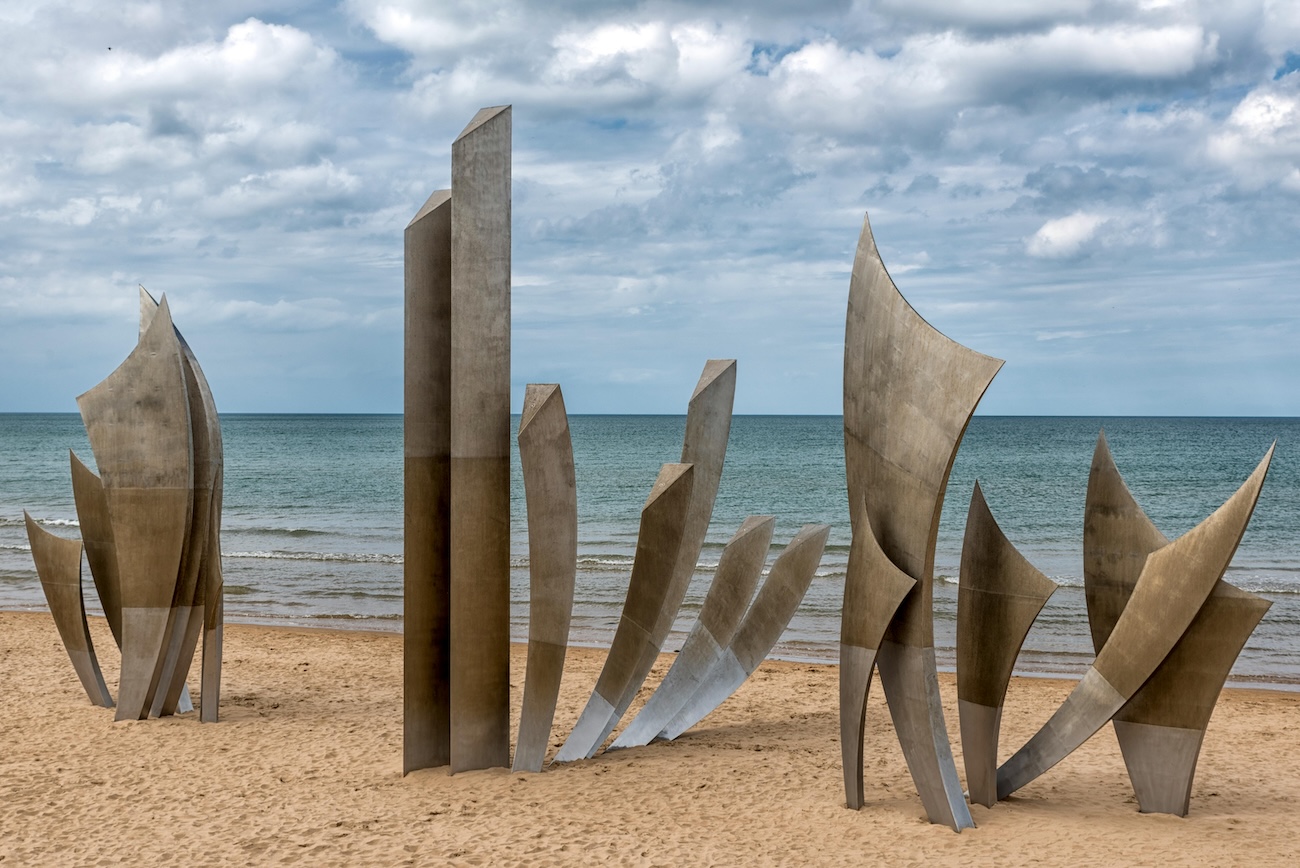
Today, the site is a sociological study in the scale of loss. The cemetery contains 9,388 American military dead, each aligned with mathematical precision. The architecture is designed to evoke a sense of "the silent ranks." Standing at the edge of the memorial, looking down at the sand, the distance seems impossibly small. You can see the exact path a soldier had to run, a distance of barely 300 yards that, on June 6, took six hours and thousands of lives to cross. It is a place where the heroic narrative of the war meets the cold, hard reality of human erasure.
Standing on the Sands of Easy Red: A Visitor's Guide
Visiting Omaha is an exercise in cognitive dissonance. On a summer day, it is a beautiful stretch of the French coast. To understand the site, you must strip away the modern tranquility and engage with the geography of the tragedy.
Logistics and Tide Timings for D-Day Sites
To see the beach as the soldiers did, you must track the tides. Arrive at low tide to reveal the killing flat.
- The Experience: Walk from the water's edge to the shingle bank. It takes about four minutes at a brisk pace. Now, imagine doing it while carrying 80 pounds of gear while the air around you is thick with shrapnel.
- WN-62 and the Strongpoints: Visit the ruins of the German bunkers. Standing in the gun embrasure gives you the German perspective—the terrifying realization of how clearly the entire beach is visible. It feels like looking at fish in a bowl.
- The Ethical Perspective: There is a hollow silence at Omaha that you won't find at the more commercialized D-Day sites. It is technically a mass grave; shifting sands still occasionally reveal the remains of those the tide couldn't carry away.
The Silence of the Seawall
Omaha Beach remains a site of hollow victory. The cliffs are silent now, but the weight of what happened here remains embedded in the silt and the stone. It serves as the somber introduction to the Normandy campaign—a contrast to the logistical miracle we will explore in our next entry at Utah Beach.
The ghosts of Omaha didn't win the war with a single stroke; they won it by refusing to stay on the sand. They climbed, they bled, and they broke the wall, ensuring that the path to Europe’s liberation began on the most inhospitable ground imaginable. The survival of the beachhead ensured that the "Atlantic Wall" was shattered, but the cost is mapped out in the geometry of the headstones. To walk these sands today is to walk through the most significant failure and the most significant triumph of the American Century.
FAQ
Who exactly was in charge of the German defense?
The German defenses were overseen by Field Marshal Erwin Rommel, the "Desert Fox." While Rommel was a brilliant tactician, he was hampered by a fractured command structure. He believed the invasion must be stopped on the water's edge, but Hitler held the vital Panzer (tank) divisions in reserve, refusing to release them on the morning of June 6 because he was asleep and his staff were too terrified to wake him. This delay allowed the Americans just enough time to scale the bluffs before the German armor could counter-attack.
How many people died at Omaha compared to the other beaches?
Omaha was a statistical outlier. Total Allied casualties on D-Day were roughly 4,400 confirmed dead. Omaha Beach alone accounted for over 2,400 of those casualties. In contrast, Utah Beach—saw only 197 casualties. The difference was a combination of the 100-foot bluffs, the arrival of the veteran German 352nd Division, and the total failure of the preliminary bombardment.
Did the Americans fight alone at Omaha?
While the ground troops were the 1st and 29th Infantry Divisions (US Army), the operation was a massive coalition effort. The naval bombardment was supported by British Royal Navy warships, and the transport of troops involved Free French and Coast Guard personnel. However, the soldiers who hit the sand and scaled the cliffs at Omaha were almost exclusively American.
What happened to the Germans in the bunkers?
The German 352nd Division suffered heavy losses once the Americans breached the bluffs. Many were killed in close-quarters combat inside the Resistance Nests. Those who survived were eventually pushed back as the Allied bridgehead expanded, but they succeeded in their primary goal: delaying the American advance for an entire day and nearly breaking the back of the invasion.
Why was June 6 specifically chosen?
The date was determined by a narrow weather window. General Eisenhower needed three things to align: a full moon for paratrooper visibility, a low tide at dawn to expose beach obstacles, and manageable seas. After a delay on June 5 due to storms, a brief break in the weather forced a "Go" decision. If they had missed this window, the moon and tide would not align again for several weeks, risking the discovery of the entire operation.
Sources & References
- The Dead and Those About to Die: D-Day: The Big Red One at Omaha Beach - John C. McManus (2014)
- Omaha Beach: A Flawed Victory - Adrian R. Lewis (2001)
- D-Day: The Climactic Battle of World War II - Stephen E. Ambrose (1994)
- The U.S. Army Center of Military History: Omaha Beachhead - Official Government Record (1945/1984)
- The Bedford Boys: One American Town's Ultimate D-Day Sacrifice - Alex Kershaw (2003)
- German 352nd Infantry Division at Omaha Beach - Military History Database.
- Normandy American Cemetery and Memorial Official Site - American Battle Monuments Commission.
- Beyond the Beach: The Allied War Against France - Stephen Alan Bourque (2018)