Operation Overlord: The Strategic Stakes of the Utah Beach Landing
The Big Picture: Why This Sand Mattered
By 1944, Hitler had turned the coast of France into a fortress. He had spent four years burying landmines, pouring millions of tons of concrete, and positioning heavy guns to sweep the beaches. To the East, the Soviet Union was already grinding the German army down, but they were exhausted. They needed the Americans and the British to jump across the English Channel and open a "Second Front" to split Hitler’s attention and end the war.
The plan was a massive gamble called Operation Overlord. The Allies divided the coast into five beaches. While Omaha Beach was the center of the line, Utah Beach was the key to the future. The Allies didn't just want to land soldiers; they needed a way to bring in the millions of tons of food, fuel, and bullets required to win a world war. That meant they needed a port. Utah was the closest landing site to the city of Cherbourg—the only place with a harbor big enough to feed the invasion. If Utah failed, the American army would be stuck on a narrow strip of sand with no gas for their tanks and no way to reach Berlin.
The Logistics of a D-Day Mistake: Landing in the Wrong Place
The ramp drops, but the world doesn’t explode. At 06:30 on the morning of June 6, 1944, the men of the 4th Infantry Division braced for the same wall of lead that was, at that exact moment, decapitating the first wave at Omaha Beach. They expected the interlocking fire of heavy machine guns and the concussive spray of 88mm shells. Instead, they found a strange, eerie quiet. The water was waist-deep, cold, and choppy, but the air wasn't thick with the "buzzsaw" sound of the MG-42.
As the soldiers waded toward the dunes, they looked around at a coastline that didn't match their maps. There were no high bluffs looming over them. There were no massive concrete strongpoints positioned to rake the sand from end to end. The smoke from the naval bombardment was so thick that the landmarks they had memorized—the church steeples, the specific house clusters—were nowhere to be found. They weren't just on a different beach; they were in a different world.
Navigational Errors and the Smoke of the English Channel
The "miracle" of Utah Beach began with a series of failures. The English Channel was in a state of violent unrest. Strong coastal currents, combined with the massive dust clouds kicked up by the Allied naval bombardment, had blinded the landing craft pilots. Of the first wave's thirty-two LCVPs, many were pushed nearly a mile and a half south of their intended target.
In military terms, this is usually the preamble to a disaster. Being "off-target" means landing in un-cleared minefields, missing your armored support, and leaving your flanks exposed. But at Utah, the mistake was the salvation. The original landing zone was heavily fortified, centered on a massive German strongpoint designed to wipe out the 4th Division. By drifting a mile south, the Americans accidentally landed in a "gap" in the Atlantic Wall. They hit a stretch of beach defended by only a few scattered outposts and light machine gun nests. The mistake had bypassed the teeth of the German defense before a single American boot hit the sand.
Theodore Roosevelt Jr. and the Decision to Pivot the Invasion
Standing in one of the first boats was a 56-year-old man with a severe limp, a cane, and a famous last name. Brigadier General Theodore Roosevelt Jr., the eldest son of the former U.S. President, had spent weeks pleading with his commanders to let him land with the first wave. He was the only general to hit the beach by sea that morning.
When he reached the dunes, he realized the navigation error immediately. He didn't panic. He didn't order the men back into the boats to find the "correct" beach. He walked along the seawall, leaning on his cane while bullets occasionally kicked up sand around him, and made a cold, tactical assessment. He knew that if they tried to move back to their original target, they would be caught in the open. He looked at his officers and uttered the line that would define the Utah landing: "We’ll start the war from right here." This wasn't just a brave quote; it was a pivot that saved the invasion. Roosevelt redirected the following waves of thousands of men and vehicles to the "wrong" beach. His calm presence prevented the kind of logjam that was currently paralyzing Omaha Beach.
Tactical Comparison: Why Utah Beach Stayed Blue
To understand the atmosphere at Utah, you have to look fifteen miles to the east. At Omaha Beach, the water was a literal, viscous red. Men were pinned behind a shingle bank, unable to move, while their commanders considered calling off the entire landing. At Utah, the water stayed blue. The 4th Infantry Division was moving.
The geography of the dunes at Utah was low and sandy, unlike the oppressive, 100-foot vertical cliffs of Omaha. While the Omaha soldiers were looking up at their deaths, the Utah soldiers were looking across a flat horizon. The sense of "luck" was palpable. While they knew their brothers were dying in the meat grinder to the east, the men at Utah were experiencing a "clean" landing—or as clean as a world war allows. The first wave suffered only a handful of casualties. It was a statistical anomaly that felt like a divine intervention.
Rommel’s Inland Sea: The Flooded Fields of the Cotentin
The ease of the beach landing was deceptive. The real danger at Utah wasn't on the sand; it was the landscape behind it. The German commander, Field Marshal Erwin Rommel, knew he couldn't defend every inch of the beach, so he had turned the French countryside into a death trap.
Defensive Flooding and the Atlantic Wall Strategy
Directly behind the dunes of Utah Beach lay several miles of low-lying marshland. Years before the invasion, the Germans had destroyed the local irrigation systems and dammed the Merderet and Douve rivers. This created a massive, shallow "inland sea" that was only a few feet deep—too deep for trucks to drive through, but shallow enough to hide deadly drainage ditches and rows of "Rommel’s Asparagus" (sharpened wooden poles tipped with mines).
For the soldiers of the 4th Division, the beach was the easy part. To get inland, they had to cross five narrow causeways—elevated roads that cut through the flooded fields. These causeways were "bottlenecks." If the Germans held the exits, they could trap the entire American army on the narrow strip of beach and pick them off with artillery. The battle for Utah wasn't about the sand; it was a race to secure these bridges before the German 709th Division could reinforce them.
Paratrooper Drops at Sainte-Mère-Église and the 101st Airborne
The reason the causeways weren't a slaughterhouse for the 4th Division was thanks to the chaos falling from the sky. Hours before the beach landing, the 101st and 82nd Airborne Divisions had dropped into the dark. It was a disaster of its own; paratroopers were scattered for twenty miles, many drowning in Rommel’s flooded fields under the weight of their parachutes.
However, this scattered drop created a "fog of war" that paralyzed the German high command. Small groups of paratroopers, lost and cut off, began attacking German outposts behind Utah Beach. In the town of Sainte-Mère-Église, the world saw the iconic image of Private John Steele hanging from the church steeple by his parachute while the battle raged below. By the time the 4th Infantry Division began moving off the beach and onto the causeways, the paratroopers had already seized the vital exits. The "miracle" of Utah was a puzzle: the navy landed in the wrong place, the air force dropped the paratroopers in the wrong place, and yet, the two errors canceled each other out to create a victory.
Armored Warfare Success: How the Utah Bridgehead Was Secured
While Omaha was won by the raw, bloody refusal of individuals to die, Utah was won by the clock and the machine. Because the resistance on the beach was light, the Americans were able to unleash their technological weight with a speed that the Germans couldn't match.
The Success Rate of Sherman DD Tanks at Utah Beach
At Omaha Beach, the "Sherman DD" tanks were a graveyard of drowned steel. At Utah, they were the deciding factor. The water in the western sector was significantly calmer, shielded by the Cotentin Peninsula. Of the 28 tanks launched by the 70th Tank Battalion, 24 successfully navigated the four-mile swim to the beach.
Seeing the tanks emerge from the surf was a psychological blow to the German defenders. The light machine gun nests in the dunes, which might have held up the infantry for hours, were systematically crushed by the 75mm guns of the Shermans. The infantry didn't have to scale cliffs with their bare hands; they followed the steel treads of their armored support through the gaps in the seawall.
Military Engineering and Beach Obstacle Removal
With the German fire being disorganized, the Navy Combat Demolition Units (NCDUs) were able to work with surgical precision. Unlike their counterparts at Omaha, who were being hunted by snipers as they tried to set their charges, the engineers at Utah were able to clear wide lanes through the Belgian Gates and Hedgehogs within the first hour.
This allowed the "follow-on" waves to land on a clean beach. By 10:00 AM, the beach at Utah looked less like a battleground and more like a busy industrial port. Trucks, bulldozers, and ambulances were pouring onto the sand. The engineers even used their explosives to blow massive holes in the seawall, allowing the tanks to bypass the mined draws and move directly toward the causeways. This speed was vital; it ensured that by the time the German command realized the landing was happening at the "wrong" beach, the Americans were already two miles inland.
Casualties of the Landing: The Human Cost of Utah Beach
History often glosses over Utah Beach because of the low casualty count. In the narrative of D-Day, Utah is the "easy" beach. But for the men who were there, "easy" is a relative and insulting term.
Analysis of the 197 American Casualties
The official record states that the 4th Infantry Division suffered 197 casualties on June 6. In the context of the 2,400 lost at Omaha, this seems like a triumph. But to the 197 families who received telegrams, the "miracle" was nonexistent. Many of these deaths occurred in the first minutes—men hit by stray mortar fire on the ramps or drowned in the deep runnels of the tide.
There was also the invisible cost of the Navy personnel and the paratroopers. If you include the 101st and 82nd Airborne casualties who died to secure the beach’s exits, the price of Utah Beach climbs into the thousands. The "clean" landing was bought with the lives of thousands of men who died in the dark, screaming in the swamps and orchards of the French interior so that the men on the sand could walk ashore in relative peace.
Survivor's Guilt and the Shadow of Omaha Beach
There is a psychological phenomenon unique to the survivors of Utah Beach. For decades after the war, veterans of the 4th Division spoke of a profound "survivor’s guilt." They knew that just fifteen miles away, the 1st and 29th Divisions were being chewed into pulp.
The soldiers at Utah could hear the distant, heavy thud of the bombardment at Omaha. They could see the smoke rising on the horizon. They landed, they walked inland, and they survived mostly by a stroke of navigation luck. That "luck" is a heavy burden. It creates a narrative of the "lucky" versus the "damned," a sociological scar that many Utah veterans carried until their deaths. They were the men who landed at the "wrong" place and lived, while better men landed at the "right" place and died.
Visiting Normandy Today: The Utah Beach Memorial and Museum
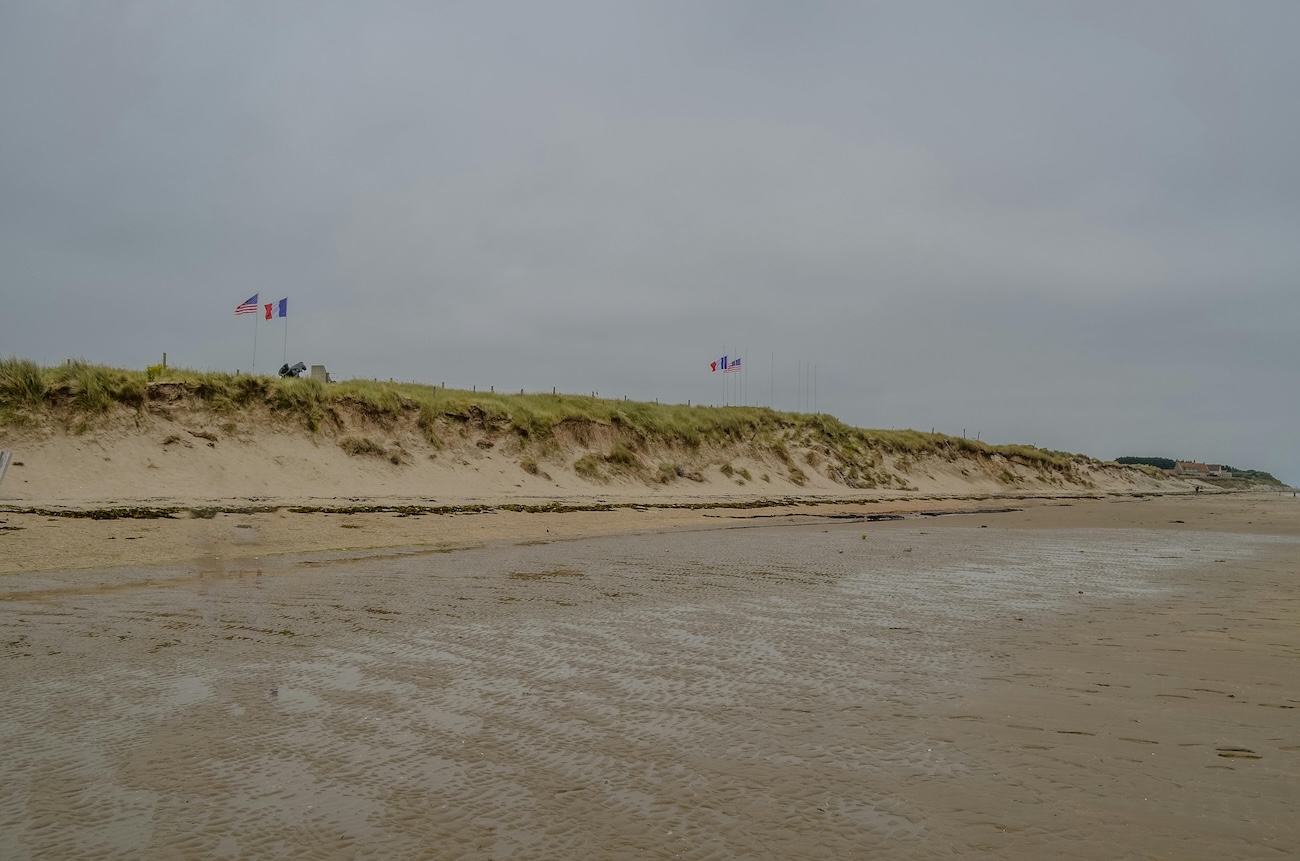
Today, Utah Beach is a place of quiet, rolling sand and sea grass. It lacks the oppressive, graveyard atmosphere of the Omaha bluffs. It is a site that celebrates the technical and accidental success of the invasion.
Highlights of the Utah Beach Landing Museum
The primary landmark today is the Musée du Débarquement Utah Beach, built directly into the dunes on the site of a former German bunker. It is one of the most comprehensive museums in Normandy, focusing on the logistical "miracle" of the landing.
The centerpiece is a beautifully preserved B-26 Marauder medium bomber. It serves as a reminder of the aerial support that was so vital—and so often failed—during the invasion. Walking through the museum, you see the Higgins boats and the equipment, but the most striking part of the experience is looking out through the large glass windows at the beach itself. You can see the very dunes where Theodore Roosevelt Jr. stood with his cane, looking at a landscape that didn't match his map and deciding to win the war anyway.
Psychological Experience of the "Wrong" Sands
The experience of visiting Utah is one of openness. You can walk for miles along the shoreline, and because it is less "famous" than Omaha, it is often much quieter. The "hollow silence" of Omaha is replaced here by a sense of historical irony.
When you stand at the low-lying dunes of La Madeleine, you realize how fragile the entire D-Day operation was. If the currents had pushed the boats at Omaha a mile south, those men might have lived. If the currents at Utah had pushed the boats a mile north, the 4th Division might have been slaughtered. To visit Utah is to stand at the intersection of professional planning and pure, unadulterated luck. It is a site that proves that in the history of human tragedy, sometimes the greatest successes are simply the result of getting lost at exactly the right time.
The Aftermath of Utah Beach: How an Accidental Breakthrough Accelerated the War
What Happened Next: Why the Mistake Won the War
The success at Utah Beach changed the entire timeline of the war. Because the 4th Division landed in the "wrong" place and faced so little resistance, they were able to move fast. While the men at Omaha were still huddled behind a seawall just trying to stay alive, the men at Utah were already miles inland, hooking up with the paratroopers who had dropped into the dark hours earlier.
The most important result was that it gave the Americans a head start. Within three weeks, they captured the port at Cherbourg. Even though the Germans tried to blow up the docks before they left, having that harbor gave the Allies a vital "gas station" in France.
But the real human consequence was about momentum. The soldiers who landed at Omaha were shattered; their units were so beat up they couldn't move for days. The units at Utah, however, were still a fresh, lethal force. They became the "punch" that finally broke through the French hedgerows and started the long drive toward Germany.
The miracle of the wrong landing site didn't just save lives on the first day—it gave the Allies the energy they needed to keep moving when the rest of the invasion was stalled in the mud. Utah Beach proves that sometimes, being lost is the only reason you win.
FAQ: The Logistics and Luck of the Utah Landing
How many men actually landed at Utah Beach on D-Day?
By the end of June 6, approximately 23,000 troops and 1,700 motorized vehicles had crossed the sands of Utah. While the initial waves were small, the lack of German resistance allowed the Allies to treat the beach like a high-speed conveyor belt, funneling an entire infantry division into France in a matter of hours.
Why didn't the Germans flood the beach itself?
The Germans couldn't flood the beach because of the tides, but they did the next best thing: they flooded the exits. By damming local rivers, they created a massive lagoon behind the dunes. Their plan was to let the Americans land and then trap them on the narrow causeways, where they could be destroyed by artillery. This plan only failed because U.S. paratroopers captured the "back doors" of those roads before the German army could set up their defenses.
Was Theodore Roosevelt Jr. the only general on the beach?
He was the only general to arrive in the first wave by sea. His presence was a major breach of protocol—generals usually wait until a beach is secure—but his arthritis and heart condition made him feel that if he didn't lead from the front, he wouldn't be able to lead at all. He died of a heart attack just one month later in France, never knowing he would be awarded the Medal of Honor for his actions at Utah.
How did the "swimming tanks" work at Utah compared to Omaha?
The Sherman DD (Duplex Drive) tanks used a large canvas screen and propellers to "float." At Omaha, the sea was too rough, and the screens collapsed. At Utah, the water was shielded by the peninsula, making it much calmer. Additionally, the tank commanders at Utah launched closer to the shore. These two factors meant the tanks arrived on time to provide the heavy firepower that kept American casualties so low.
Sources & References
- Utah Beach: The Amphibious Landing and Airborne Operations - U.S. Army Center of Military History (1948)
- The Longest Day - Cornelius Ryan (1959)
- D-Day, June 6, 1944: The Climactic Battle of World War II - Stephen E. Ambrose (1994)
- The Rise and Fall of the 4th Infantry Division at Utah - Military Heritage Records (2002)
- Theodore Roosevelt Jr.: The Life of a War Hero - H.W. Brands (2009)
- Sainte-Mère-Église: The First Liberated Town - Normandy Tourism Research (2015)
- Utah Beach Landing Museum Official Archives - Musée du Débarquement.
- World War II: The Visual History of the Cotentin Campaign - DK Publishing (2010)