How Malbork Castle Was Sold: The Fortress Nobody Could Storm
Oldřich Červenka sold the greatest fortress in Christendom in June 1457, and he was entirely within his rights.
Červenka was a Bohemian mercenary captain holding Malbork for the Teutonic Order, which had not paid him or his men for years. The Order was bankrupt, fighting a war against its own rebellious cities, and in October 1454 it had signed a treaty with its mercenary commanders granting them the right to sell its most important Prussian strongholds against unpaid wages — in exchange for a few more months in the field. The Order mortgaged its own capital to buy one more campaigning season.
The bill came due. Červenka took 190,000 Hungarian florins, roughly 660 kilograms of gold, and handed over Malbork along with the castles at Tczew and Iława. Grand Master Ludwig von Erlichshausen walked out of his own headquarters with his escort. Červenka stopped him taking the church silver on the way through.
Casimir IV Jagiellon rode in on 8 June 1457 and took homage from the burghers of the town. He entered without a fight, through the gates of a fortress no Polish army had ever managed to storm — including the army that had annihilated the Order's field force at Grunwald forty-seven years earlier, sat outside these walls for two months, and gone home. The northern gate was bricked up afterwards to mark the spot where he came through.
Malbork has almost never been taken. The largest castle in the world changed hands by transaction rather than assault across seven centuries — sold, ceded, partitioned, requisitioned, occupied — and the thing that reliably defeated it was paperwork.
What each new owner did instead was rewrite it. A monastic headquarters became a royal residence, then a barracks and a poorhouse, then a shrine to German destiny in the east, then a stage for the Third Reich, then rubble, then a Polish World Heritage Site. The brick is largely the same brick. Nothing else has held still. Power needs old stone to make itself look inevitable, and this is the largest piece of old stone in Europe.
Marienburg: How the Teutonic Order Built the Largest Brick Castle in Europe
From Venice to the Nogat: The Order Moves Its Capital in 1309
The Teutonic Order ran its affairs from Venice until 1309. The Grand Master sat in a trading republic in the Mediterranean, a convenient base for a crusading organisation whose original business was the Holy Land, and when that business ended the Order moved its headquarters to a brick castle on a river in Prussia.
Marienburg had been going up since the 1270s as a regional convent, named for the Virgin Mary. The relocation turned it into the capital of a sovereign state, and the building grew to match the claim — a fortified monastery expanded into a seat of government, with the Order's treasury, archive and command inside one enormous complex of red brick on the bank of the Nogat.
Inside Malbork Castle: The High, Middle and Low Castles
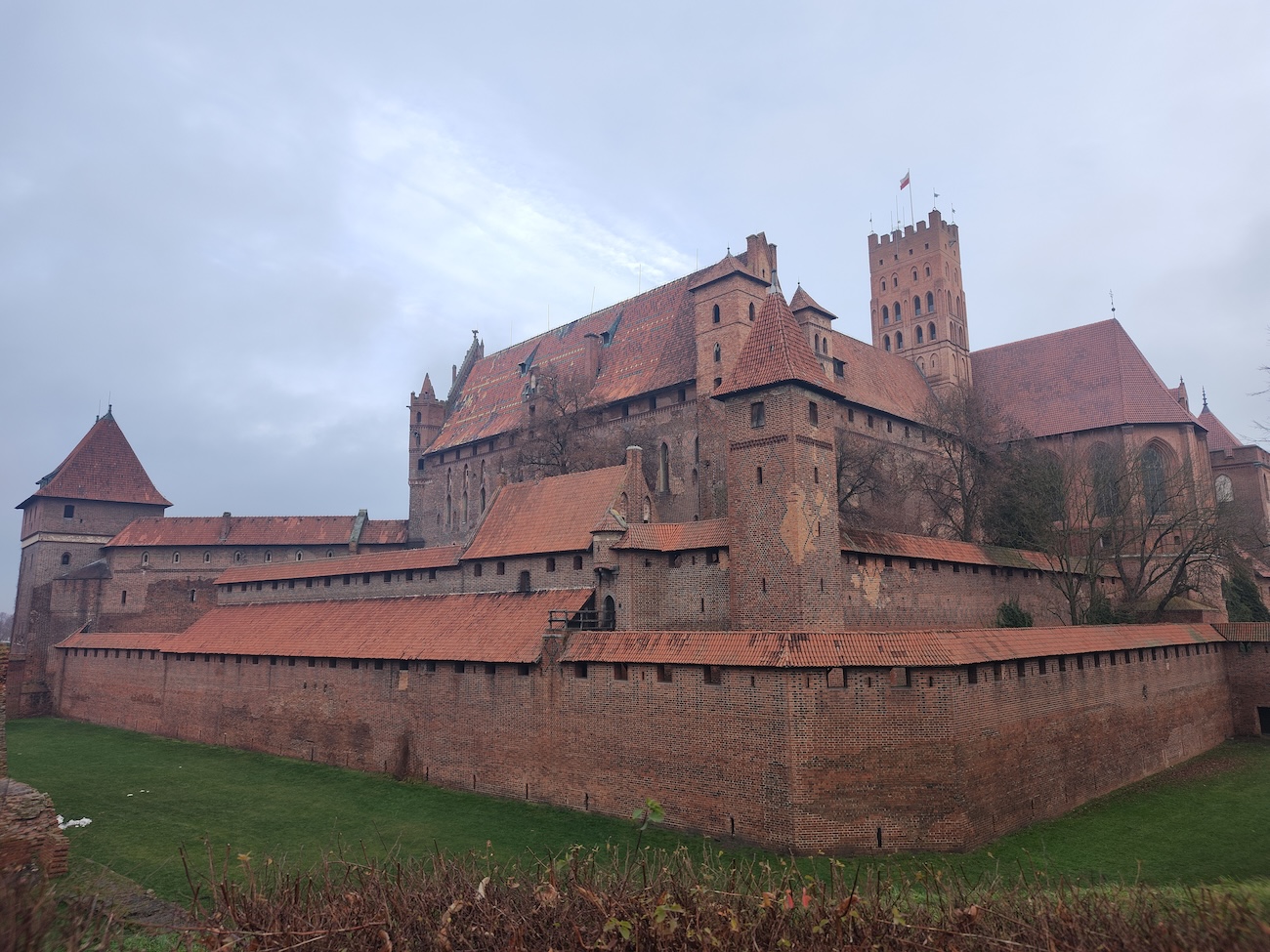
The complex runs to three linked castles behind a common circuit of walls and moats, covering some twenty hectares and built from something over twenty million bricks. The High Castle held the convent proper, the church and the chapter house, arranged around a cloister like any monastery and fortified like nothing else in Europe. The Middle Castle held the Grand Master's Palace and the Great Refectory. The Low Castle held the workshops, granaries, armouries and stables that made the whole thing self-sufficient under siege.
The engineering is the part worth pausing on. The Great Refectory carries a palm-vaulted ceiling on slender granite columns over a hot-air heating system running beneath the floor, so that four hundred men could eat in a warm hall in a Baltic January in the fourteenth century. The latrine tower stands apart from the main block, reached by a covered bridge, positioned so that everything it produced went into running water. Monks in armour built themselves the most technically advanced building in northern Europe and then filled it with weapons.
Military orders built the best fortifications of the medieval world, and the two greatest examples both refused to fall the way castles are supposed to. Krak des Chevaliers, the Hospitaller stronghold in Syria, went out on negotiated terms rather than by breach. Malbork was sold.
The Siege of 1410: The Castle That Saved the Teutonic Order
Heinrich von Plauen reached Malbork ahead of the news. He was commanding at Świecie, well away from the disaster at Grunwald, and when word came that the Grand Master and almost the entire leadership of the Order were dead on a field in Masuria, he moved on the capital with a few thousand men and got inside.
He burned the town outside the walls to deny the enemy cover. The people who lived in it lost everything they owned to a decision made by a commander who was not their commander, taken in an afternoon, and it worked exactly as intended. Malbork was a substantial merchant settlement of craftsmen, traders and their families, and von Plauen put it to the torch on military logic that was entirely sound and cost them everything.
The Polish-Lithuanian army arrived and sat down in front of a fortress it had no equipment to take. Grunwald had been won by heavy cavalry in an afternoon, and heavy cavalry is useless against twenty million bricks. The allies had no siege train capable of breaching walls of this scale, no supply system built for a long investment, and a coalition of Poles, Lithuanians, Tatars and Ruthenians with diminishing reasons to stay.
The siege ran roughly two months through the summer of 1410. Dysentery moved through the camp in the heat. Supplies ran short, the coalition frayed, and in September the Lithuanians went home. The greatest victory in Polish medieval history ended with a retreat from an unbroken castle, achieved by a commander who had not been at the battle.
Von Plauen was elected Grand Master for it. The Order lost its army in 1410 and kept its capital, and the second fact is the reason there was still an Order to sell the capital forty-seven years later.
1457: The Thirteen Years' War and the Sale of Malbork Castle
The 1454 Treaty That Let Mercenaries Sell the Order's Fortresses
The Order broke itself financially fighting its own subjects. Prussian towns and gentry, taxed to pay ransoms and war costs accumulated across half a century of losing to Poland, formed a confederation in 1454, rebelled, and asked the Polish king to take them. The war that followed ran thirteen years, and the Order fought it with mercenaries because it no longer had enough knights of its own.
Mercenaries expect payment. By October 1454 the Order could not provide any, and the agreement it signed at Malbork that month is one of the more remarkable documents in the history of European warfare: the Order's own commanders formally guaranteed their unpaid troops the right to sell the state's principal fortresses in lieu of wages. The soldiers accepted, and stayed in the field a few months longer on the strength of it.
An institution that had spent two centuries acquiring territory signed away the right to sell its capital in order to afford one more winter.
190,000 Florins and the Grand Master Walking Out
Three years later the mercenaries exercised the clause. Polish negotiators worked on the garrison through the spring of 1457, and money was raised in Danzig to make the purchase possible — the merchant city that had rebelled against the Order paying to buy the Order's capital out from under it.
Červenka took the gold. Casimir IV entered on 8 June and received the homage of the town. The Teutonic Order moved what remained of its government to Königsberg, and the castle it had spent a century and a half building passed to the enemy without a shot.
The Order tried to take it back almost immediately and spent three years failing. A siege ran from September 1457 to August 1460 and achieved nothing, which is the pattern of this building: attacking it does not work, and never has.
Bartholomäus Blume and the Town That Kept Fighting
The town outside the walls had no part in the sale and refused to accept it. Bartholomäus Blume, its mayor, held the settlement against Polish forces for three more years after the castle changed hands — a burgher defending a town on behalf of an order that had already left, against a king who had already bought the fortress it stood beneath.
He was captured in 1460 and hanged.
The castle was traded in an afternoon by men with no stake in it beyond back pay. The town took three years and a rope, and the two facts sit about four hundred metres apart.
Three Hundred Years as a Polish Royal Residence
Malbork was Polish for longer than it was Teutonic. The castle served as a royal residence and administrative seat from 1457 until the First Partition in 1772 — over three centuries, more than twice the span it spent as the Order's headquarters, and the fact reliably surprises visitors who arrive thinking of the place as German.
The building was put to ordinary use. Polish kings stayed here on the road to Gdańsk. The Great Refectory that had fed the convent held balls and feasts. The High Castle, the sacred heart of the complex, was demoted to a storehouse. The Polish Admiralty was based here from 1568 and a royal mint operated from 1584. Swedish armies occupied it twice in the seventeenth century and left it worse than they found it.
Nothing dramatic happened for a very long time, which is its own kind of answer to the question of what a fortress is for.
Barracks and Poorhouse: Malbork Castle Under Prussia After 1772
The Partition, the Garrison and the Plan to Demolish the Castle
Prussia took Malbork in the First Partition of Poland and found a use for it immediately. The castle became a barracks, a storage depot and a poorhouse. Interiors were stripped and partitioned, vaulting was knocked through for practicality, and the Grand Master's Palace was converted for institutional use.
Demolition was proposed seriously. The largest castle in the world spent part of the early nineteenth century as a candidate for the wrecking crews, valued at the price of its brick, and it survived on the arguments of a small number of people who thought it was worth something.
Conrad Steinbrecht and the Restoration That Shaped Modern Conservation
Romantic nationalism saved it, and the motive matters as much as the result. German writers and architects of the early nineteenth century reinvented Marienburg as the birthplace of German destiny in the east, a monument to the men who had carried civilisation to the Baltic, and restoration work began in 1817 on the strength of that idea.
The serious campaign ran under Conrad Steinbrecht from 1882 into the 1920s, and it was extraordinary work by any standard. Steinbrecht excavated, surveyed, measured and documented obsessively before rebuilding anything, and the methods developed at Malbork became foundational to the discipline. UNESCO's citation for the site names this explicitly: many conservation techniques now treated as standard were worked out on this building.
An ideological project produced the best restoration science of its era. That combination is going to matter enormously in about sixty years.
Marienburg as German Nationalist Shrine and Nazi Stage
The Castle in the Myth of the German East
The Teutonic Order had ceased to exist in Prussia in 1525, when its last Grand Master there converted to Lutheranism and turned the state into a private duchy. Nineteenth-century German nationalism resurrected it anyway, as a usable ancestor.
Marienburg became the emblem of the Drang nach Osten — proof, in brick, that German settlement and rule in the east ran back to the Middle Ages and was therefore natural. The castle was photographed, painted, written about and visited as a national pilgrimage site, and its restoration was funded as an act of political argument. A building constructed by a Catholic monastic order that had fought Poles, Lithuanians and its own Prussian subjects was recruited to prove something about the German nation, which did not exist while any of that was happening.
Hitler Youth Pilgrimages and the Ordensburg Idea
The Nazi regime inherited the myth fully formed and used it hard. Malbork became a destination for Hitler Youth pilgrimages and party ceremony, a backdrop for the eastern claim that would end in the invasion of Poland. The regime borrowed the word for its own leadership academies, calling them Ordensburgen — order castles — and casting its officials as heirs to knights who had been dead for four hundred years.
The appropriation was thorough and, in a sense, prophetic. A crusading order's fortress was used to advertise a war of conquest in the east, and the war came.
Festung Marienburg: The Destruction of Malbork Castle in 1945
The Germans turned it back into a fortress in 1945 and destroyed it doing so. With the Red Army advancing into East Prussia, Malbork was designated a strongpoint and defended, and the fighting ran for weeks through the winter and into spring across the river and through the complex itself.
Artillery and fire took more than half the castle. The eastern side was worst. The church of the High Castle was wrecked and the eight-metre figure of the Virgin on its outer wall, mosaic-covered and visible for miles, came down. Roofs, vaults and whole ranges of the Low Castle burned.
The medieval town outside the walls was almost entirely destroyed, which closed a circle nobody was in a position to notice at the time. Von Plauen had burned that town to save the castle in 1410. In 1945 the castle's defenders destroyed both.
The people went too. Marienburg's German inhabitants fled west ahead of the Red Army through one of the worst winters of the century, on roads shared with hundreds of thousands of others moving out of East Prussia, and those who stayed or came back were expelled under the postwar settlement. A town that had been German-speaking for six centuries was empty of Germans within about two years.
Poles arrived to replace them, and a great many had been expelled themselves. The Soviet Union kept the territory it had taken in Poland's east, and the Poles displaced from around Vilnius and Lwów were resettled westward into the land taken from Germany. They were moved into a ruined town beneath a wrecked German fortress, having lost their own cities to a border they had no say in, and told to make a life there.
The building had survived a two-month siege, a three-year siege, two Swedish occupations, a partition, institutional conversion and a demolition proposal. It was ruined by the people holding it, in front of a population that was then removed and replaced.
Rebuilding Malbork: The German Drawings That Restored a Polish Monument
Poland rebuilt Malbork, and the tool that made it possible came from the people who had built the myth. Steinbrecht and his successors had measured, drawn and photographed the castle in exhaustive detail to serve an argument about German civilisation in the east. Germany then destroyed the castle. The German documentation survived, and Polish conservators used it to put the building back.
The reconstruction ran for decades and is still not finished in every corner. The church of the High Castle was only completed and reopened in 2016, with the Virgin restored to the outer wall. UNESCO inscribed the site in 1997, citing both the castle itself and its significance to the history of restoration practice — the discipline invented here to glorify one nation, deployed here again to recover the monument for another.
The town got no such treatment. What the fighting left of medieval Malbork was pulled down by planners after the war, and the usable brick was loaded up and shipped to rebuild the old towns of Gdańsk and Warsaw, which needed some 600 million bricks taken from demolished buildings elsewhere in the country. Modern blocks went up where the medieval streets had been.
The decision has a logic that is easy to follow and hard to like. Warsaw's old town was Polish heritage and its reconstruction was a national cause. Malbork's old town was German heritage in a place that had just stopped being Germany, inhabited by people who had arrived the previous year from somewhere else, with nobody left alive in it who remembered the streets as they were. It was cheaper as building material than as a town.
The castle was spared that reasoning because the castle could be claimed. Polish historians had a case ready — the three centuries as a royal residence, the sale of 1457, Grunwald — and a restored Malbork could be presented as a Polish monument recovered rather than a German one inherited. The argument was true. It was also useful, which is the condition on which this building has survived every one of its owners.
A visitor today walks from a concrete-and-tenement town centre into a meticulously restored fourteenth-century fortress. The castle was worth reconstructing because of what it proved. The town was worth carting away because it did not prove anything, and the bricks were needed somewhere that did.
Visiting Malbork Castle: Access, Tickets and What to See
Malbork sits about an hour southeast of Gdańsk by train, and the station is a walk from the gates. The view every photograph uses is from the far bank of the Nogat, where the whole complex lines up along the water and the scale finally makes sense — a wall of red brick that keeps going long after it should have stopped.
The standard route takes three to four hours and most visitors budget half that. Audio guides are included with entry and route through all three castles. The Great Refectory and its palm vaulting, the Grand Master's Palace, the reconstructed church with the Virgin on the outer wall, the amber collection and the dansker tower are the fixed points. Summer brings heavy crowds and the light on the brick is best in the late afternoon.
The castle is not shy about its history and the museum handles the Teutonic, Polish, Prussian and German chapters without much flinching. The Nazi period is present but easy to walk past, and it is worth deliberately looking for, because the photographs of party ceremony in these courtyards explain more about why the building was worth rebuilding than any of the medieval material does.
Standing in the middle courtyard, what registers is that almost none of this is original in the way visitors assume. The brick was made by the Order, and knocked down, and remade, and shelled, and laid again by conservators working from drawings commissioned to prove a point that the reconstruction disproves. Malbork is the largest castle in the world and it is also an argument that five different regimes have each believed they were winning. The building has outlasted all of them without ever putting up much of a fight.
Malbork Castle: Frequently Asked Questions
Why is Malbork Castle the largest castle in the world?
Malbork holds the title by land area, covering roughly twenty hectares within a single circuit of walls and moats, and it is also the largest brick building in Europe. The scale comes from its function: it was not a nobleman's residence but the capital of a sovereign state, containing a monastery, a seat of government, a treasury, an armoury, workshops, granaries and stabling for a garrison, all designed to operate independently under siege. It is built from something over twenty million bricks and divided into three linked castles — the High, Middle and Low.
Who built Malbork Castle?
The Teutonic Order began construction in the 1270s and named it Marienburg after the Virgin Mary. It was initially a regional convent of the crusading order, and it became something far larger in 1309, when the Grand Master moved the Order's headquarters there from Venice. The castle was expanded over the following century into the administrative capital of the Teutonic state in Prussia, reaching essentially its final form by the early fifteenth century.
Was Malbork Castle ever captured?
Malbork has almost never fallen to assault. It withstood a two-month siege by the Polish-Lithuanian army in 1410 after the Battle of Grunwald, and a further siege lasting from 1457 to 1460. The castle passed to Poland in 1457 not by force but by sale: the Teutonic Order's unpaid Bohemian mercenaries, who had been granted the legal right to sell its strongholds against arrears, handed it to King Casimir IV for 190,000 Hungarian florins. Later changes of ownership came through partition, annexation and postwar settlement rather than siege.
What happened to Malbork Castle in World War II?
German forces designated Malbork a strongpoint in 1945 and defended it against the advancing Red Army, and the fighting destroyed more than half the complex. The eastern side suffered worst, the church of the High Castle was wrecked, and the large mosaic figure of the Virgin on its outer wall came down. The medieval town outside the walls was almost entirely destroyed and was later demolished altogether, its usable brick shipped away to rebuild Gdańsk and Warsaw. The castle itself was reconstructed by Polish conservators over subsequent decades.
How long does it take to visit Malbork Castle?
The standard visitor route through the High, Middle and Low Castles takes three to four hours, and most visitors underestimate it. Audio guides are generally included with admission and follow a set path through the complex. Anyone wanting to see the amber collection, the church and the outlying towers properly should allow longer, and arriving early in the day is advisable in summer, when the site is busy.
Is Malbork Castle worth visiting from Gdańsk?
Malbork is roughly an hour from Gdańsk by train and the station is a short walk from the castle gates, which makes it one of the most straightforward day trips in northern Poland. The classic view is from the far bank of the Nogat river, where the full length of the complex lines up along the water. Visitors intending to walk the whole route should treat it as a full day rather than a half day.
Sources
Castle of the Teutonic Order in Malbork: World Heritage inscription and State of Conservation reports — UNESCO World Heritage Centre (1997 onwards)
Permanent exhibitions, collections and conservation records — Muzeum Zamkowe w Malborku (Malbork Castle Museum)
Schloss Marienburg in Preussen: survey and reconstruction volumes — Conrad Steinbrecht
The Teutonic Knights: A Military History — William Urban (2003)
The Malbork Treaty of October 1454 and the mercenary agreements of the Thirteen Years' War
Annales seu cronicae incliti Regni Poloniae — Jan Długosz (15th century)
The Thirteen Years' War 1454–1466: records of the Prussian Confederation and the Kingdom of Poland
Iron Kingdom: The Rise and Downfall of Prussia, 1600–1947 — Christopher Clark (2006)
Orderly and Humane: The Expulsion of the Germans after the Second World War — R. M. Douglas (2012)
Records of the Warsaw Reconstruction Office (Biuro Odbudowy Stolicy), 1945–1951
Historic Centre of Warsaw: World Heritage documentation — UNESCO World Heritage Centre
Marienburg and the myth of the German East: studies in nineteenth and twentieth-century nationalist appropriation