
Raven Rock Site R: America's Shadow Pentagon Explained
Every morning in Washington D.C., a fleet of blue-and-gold helicopters from the 1st Helicopter Squadron — codenamed MUSSEL — flies low over the Potomac River. Tourists photograph them from the Mall. Commuters glance up from the bridges. Most people assume the squadron exists to move VIPs around the capital. They are half right. The helicopters also exist to evacuate those VIPs in seconds if Washington comes under attack — to sweep them off rooftops and helipads and deliver them, within minutes, to a ring of hardened bunkers in the mountains surrounding the city. If the bombs are incoming, the helicopters will come, and they will take a very specific list of people to safety. Everyone else stays behind.
Raven Rock is where those helicopters go. Or more precisely, it is where the Department of Defense's designated evacuees go — the Secretary of Defense, the Joint Chiefs of Staff, the deputy secretaries, the communications officers who know the launch codes. The facility was built for one reason and one reason only: to ensure that after America is destroyed, someone with the correct clearances remains alive to order the retaliation.
Raven Rock is a monument to a specific kind of honesty. Every other government building in Washington — the White House, the Capitol, the actual Pentagon — is built on the implicit assumption that America will survive. Raven Rock is built on the assumption that it might not. As investigative journalist Garrett Graff, who wrote the definitive account of the facility, put it without ceremony: "Raven Rock is the place where nuclear war in the United States would begin."
Raven Rock Construction History: How Site R Was Built
Why Truman Built Raven Rock: The Cold War Origins of Site R
Harry Truman approved the concept for Raven Rock in 1950, the year after the Soviet Union detonated its first nuclear weapon. The logic was straightforward and terrifying. Washington D.C. is a single target. A centralized command that could be erased by one bomb was not a command structure — it was a liability. The government needed a second brain, hardened, hidden, close enough to be reached in an emergency but far enough from the capital to survive its destruction.
The site selection was ruthlessly practical. The chosen location had to sit on dense rock capable of absorbing blast pressure and thermal radiation, within helicopter range of Washington, and unremarkable enough to disguise construction. A 1,500-foot greenstone ridge on the Pennsylvania–Maryland border, known locally as the Beard Lot, met all three criteria. On January 23, 1951, the federal government filed a "Declaration of Taking" at the Adams County courthouse — United States of America v. 1,100 Acres of Land — and seized 280 acres from four private properties. Bulldozers began work on the mountain's surface four days before the legal paperwork was finalized.
Site R Construction: Accidental Deaths, a Workers' Strike, and a Failed Cover Story
The government's attempt to disguise what it was doing at Raven Rock lasted approximately one week. The project required the controlled demolition of the mountain's interior on a scale that could not be mistaken for anything ordinary. Earl Harbaugh, who lived in the valley below, later described the blasting with flat precision: "It knocked you right out of bed." The roads up the mountain filled with equipment trucks and laborers who were never screened for security clearances. Salesmen and equipment technicians were waved through the site gates without checks. A 1975 newspaper article noted simply: "Workers weren't screened so word got out. During construction, salesmen and equipment servicemen were allowed into the huge cavern without any security checks."
Gene Bowman, one of the local men who worked the excavation, later described the interior to the New York Times Magazine with the matter-of-factness of a man who had simply been told a cover story and not particularly cared: "They just said they were building a tunnel. Wasn't nobody interested in what they were doing." What he found inside was something more than a tunnel. "Streets and everything," he said. "And they have to pump the air in."
The construction ran into problems almost immediately. There were accidental deaths on the site in 1951. A hundred-person strike disrupted work in 1952. Cost overruns mounted steadily; by spring of 1954, roughly $35 million had been committed — approximately $350 million in today's money — with three underground structures completed but the project still expanding. Two more buildings were added in 1963, bringing the total to five.
At some point during construction, a local man decided to investigate the site himself. He bypassed several layers of external security and made it as far as the tunnel entrances before site personnel caught him. "They threatened him with all kinds of things," neighbor John Keller told the Associated Press. The man remained unnamed in public records. The incident was among several that eventually led to a complete overhaul of the perimeter security system.
Inside Raven Rock: How the Nuclear-Proof Bunker Was Engineered
Raven Rock vs. Cheyenne Mountain: Two Bunkers, Two Different Missions
Raven Rock is routinely paired with the Cheyenne Mountain Complex in Colorado in public imagination, but the two facilities serve fundamentally different functions. Cheyenne Mountain is the sensory organ of American air defense — the radar feeds, the NORAD command center, the early-warning apparatus that detects an incoming strike and measures its trajectory. Raven Rock is the response mechanism. Where Cheyenne tells the government that missiles are incoming, Raven Rock is where the decision to launch a counter-strike would be processed and executed. It is not redundant in the sense of duplication. It is redundant in the sense of survival.
The greenstone and granite of the mountain were not incidental to its selection. Dense igneous rock absorbs thermal radiation and dampens seismic shockwaves in ways that softer geology cannot. The mountain itself functions as the first layer of the fortress.
Raven Rock's 30-Ton Blast Doors and Nuclear Filtration Systems
The transition from the Pennsylvania forest to the interior of Site R is controlled by massive curved blast doors at each of the facility's four tunnel entrances. Each door weighs approximately 30 tons, measures over three feet thick, and can seal in seconds. Once closed, they create a pressure-controlled environment: the interior air is maintained at slightly higher pressure than outside, ensuring that any breach forces air outward rather than allowing contaminants in.
The facility draws water from its own underground reservoirs and runs on internal power plants. The air circulates through filtration systems rated to block radioactive fallout, chemical agents, and biological threats. In a full lockdown, the mountain becomes a closed system — physically severed from the outside world in every sense except the communications cables threading out through the rock. The facility can sustain a population of up to 3,000 people for weeks without resupply. Those 3,000 people are not the general public.
Raven Rock's Floating Buildings: The Seismic Spring Isolation System
The five internal structures at Raven Rock are not attached to the cave walls or the floor. Each building sits on thousands of heavy-duty steel springs — a seismic isolation system that allows the structures to absorb and dissipate the shockwave energy of a nearby nuclear detonation without collapsing. The ground you walk on inside Raven Rock is physically disconnected from the mountain surrounding it. During a blast, the buildings move independently, absorbing energy, floating in the dark.
An Air Force colonel who had visited both Raven Rock and Cheyenne Mountain described the interior without drama: "It's really an austere environment; it's essentially an office building." The springs are invisible underfoot. The corridors look like corridors in any underfunded government building from the 1960s. The only indications of what this place actually is come from the absence of windows and the constant low hum of the ventilation systems, which never stops.
Among the facility's less-classified features: the complex contains a small chapel, a medical clinic, a dental clinic, a library, organized sports facilities, and — according to Graff — a badminton court. These were not amenities added to improve quality of life. They were maintenance procedures for the human components of the machine.
Raven Rock During the Cold War: Drills, Crises, and Decades on Standby
The 1954 Continuity of Government Drill: The First Test of the Evacuation Plan
The facility became operational in 1953. By the summer of 1954, the U.S. government ran its first formal Continuity of Government exercise — a live drill in which Cabinet officials were evacuated from Washington to the mountain bunkers as if an attack had actually occurred. The logistics of the exercise worked, more or less. But one detail stood out. As the Cabinet secretaries and their aides boarded the helicopters and headed for the mountains, their wives — who had not been told the purpose of the exercise and had no place in the evacuation plan — were left behind. A group of them gathered that afternoon and spent a chilly few hours playing poker, slowly realizing what was happening: that their husbands were rehearsing leaving them behind in a nuclear attack.
That detail, discovered by Graff in the course of his research, is not historical trivia. The families are still not included. The plans have not changed in 70 years. Every person assigned a seat in the Raven Rock evacuation plan knows that if the helicopter comes, they go alone.
Raven Rock and the Cuban Missile Crisis: The 1962 Nuclear Alert
Raven Rock was formally integrated into the National Military Command System in October 1962 — the same month as the Cuban Missile Crisis. The timing was not coincidental. The crisis proved with terrifying precision that the gap between theoretical preparation and actual nuclear confrontation was narrower than anyone had acknowledged. On October 17, 1962, Department of Defense Directive S-5100.30 restructured the entire command architecture, positioning Raven Rock as the Alternate National Military Command Center. The facility was hardened that year to withstand approximately 140 psi of blast overpressure.
During the thirteen days of the crisis, Site R operated on heightened readiness. The staff maintaining the night shifts understood, for the first time, that this was not a maintenance exercise. The blast doors might actually close. The mountain might actually become the final functional piece of the American military. For the men working the tunnels below Pennsylvania that October — the watch officers, the communications technicians, the duty personnel who rotated through on four-hour shifts — the hum of the ventilation carried a different weight than it had the week before.
Meanwhile, the broader Continuity of Government program reached its absurdist outer limit. A specially trained team of park rangers in Philadelphia held standing orders to evacuate the Liberty Bell in the event of a Soviet nuclear threat. The National Archives formally ranked the Declaration of Independence above the Constitution in the prioritized list of documents to be saved. The Library of Congress had determined that the Gettysburg Address outranked George Washington's military commission. The entire country was, on paper, categorized and ranked for extraction.
Dwight Eisenhower had seen the logical conclusion of all of this planning and named it without euphemism years before: if nuclear war came, the nation would not have "enough bulldozers to scrape the bodies off the street."
Life Inside Raven Rock: Underground Duty, Mountain Sickness, and Operation Looking Glass
The permanent assignment at Site R during the Cold War decades imposed a psychological burden that the Department of Defense worked steadily to manage. The facility operated on a continuous rotation — someone was always underground, always on duty, always ready to activate the primary systems within minutes of an alert. The soldiers and civilians who maintained this vigil called their assignment the "Night Watch."
With no natural light, no windows, and no external reference points, staff could lose their circadian rhythm and their psychological equilibrium within days. To counter this, the military installed lighting systems that cycled through the color temperature of natural daylight — blue-white in the morning, cooling to amber in the evening — mimicking a sun the occupants could not see. Morale monitoring was formalized. Rotation schedules were designed to limit consecutive underground time.
The air inside was described consistently by those who worked there as "recycled and dead" — technically clean, free of particulates, but stripped of the biological complexity of outdoor air. No scent of rain or soil or wood or anything living. Floor wax and ozone, sustained indefinitely. Workers described a phenomenon they called "mountain sickness" — a form of ambient claustrophobic unease that set in not as panic but as a slow flattening of perception, a dulling of the senses that came from having nothing to perceive.
The facility also ran, through the Cold War decades, a continuous fleet of EC-135 aircraft flying 24-hour airborne shifts under the codename "Looking Glass" — each plane carrying a senior military officer with authority to order a nuclear strike, ensuring that the chain of command could never be severed by a single ground attack, no matter what happened to every facility including Raven Rock itself. These flights began on February 3, 1961, and remained unbroken until the Cold War's end. Not one shift was missed in three decades.
Raven Rock on September 11, 2001: The First Real Activation
How the Continuity of Government Plan Failed on 9/11
The Continuity of Government protocols that activated on the morning of September 11, 2001, had been rehearsed for nearly fifty years. The theory was clean. Senior officials would board helicopters within minutes of an attack warning, be delivered to their designated hardened facilities, and the command structure of the United States government would continue to function from inside mountains while the country above them burned.
The practice was not clean. It was, by the account of most who participated, largely chaos.
Donald Rumsfeld — Secretary of Defense, seventh in the presidential line of succession, and the official whose designated evacuation site was Site R — did not evacuate. When Flight 77 struck the Pentagon at 9:37 a.m., Rumsfeld walked to the crash site on the building's exterior and helped carry stretchers, pulling injured personnel from the wreckage with his own hands. He was the head of the Department of Defense and he was dragging bodies from a burning building. When later asked why he had not followed protocol and left for Raven Rock, Rumsfeld offered a line that became something of a Cold War epitaph: "That's what deputies are for."
He sent Paul Wolfowitz instead.
Who Was Sent to Raven Rock on 9/11: Wolfowitz, Rumsfeld, and a Broken Chain of Command
Wolfowitz, the Deputy Secretary of Defense, was rushed to Site R that morning. Five helicopters landed on the pad north of the Pennsylvania state line. SUVs carried the passengers down a mountain road, through a portal cut into solid rock, and into the dark. The blast doors sealed behind them.
Across Washington, the evacuation plan was fracturing at every joint. Dick Cheney was physically carried by Secret Service agents out of his West Wing office and propelled into the Presidential Emergency Operations Center — the separate Cold War bunker beneath the East Wing of the White House — where he would spend the day issuing orders, including the controversial instruction to shoot down hijacked civilian aircraft. He refused to go to his designated off-site facility. Speaker of the House Dennis Hastert, third in the line of succession, followed protocol and was taken to Mount Weather, an underground bunker in the Blue Ridge Mountains of Virginia — where he spent the day out of contact with the national leadership. Agriculture Secretary Ann Veneman, ninth in the line of succession, was never contacted at all. Commerce Secretary Don Evans, tenth in line, waited in his downtown office for someone to tell him what to do; when no one called, he had an aide drive him home to McLean, where he watched the events on television.
The elaborate architecture of survival that had cost billions of dollars and fifty years to build had produced, on the day it was needed, a Vice President in one bunker, a Deputy Defense Secretary in another, a Speaker of the House unreachable in a third, a Secretary of Commerce watching cable news from his living room, and a Defense Secretary helping evacuate the wounded from a smoldering parking lot.
As Graff observed in his account of that day: "It turns out that evacuating the government and making sure the government stays in control of the situation are mutually exclusive scenarios."
Raven Rock's Outdated Technology on 9/11 and the $80 Million Emergency Upgrade
The activation of Site R on September 11 also exposed the decade of neglect that had followed the Soviet Union's collapse. The computers inside Raven Rock ran on architecture designed for Cold War-era government networks. Officials attempting to access modern databases found the systems incompatible. Phone lines were insufficient. There were no secure video links. The facility designed to command a nuclear war in the 1960s could not hold a video call in 2001.
The Pentagon requested $80 million in emergency upgrades the following year. The Command Center was rebuilt between 2003 and 2004. By 2018, the facility's annual operating budget had reached $45 million. In August 2022, the Department of Defense awarded a $100 million construction contract for further expansion. The mountain that nearly fell into disuse in the 1990s is now, by its capital budget alone, among the most actively invested military installations in the country.
Is Raven Rock Still Active? The Ethics of Government Survival Planning
Who Gets Saved at Raven Rock: The COG Plan's Unanswered Question
The COG network — Raven Rock for the military, the Greenbrier Bunker (now decommissioned) built for Congress, and Mount Weather for the executive branch in Virginia — represents a specific theory of what democratic survival means. The plan does not include the population. The plan is to preserve the governing apparatus: the chain of command, the communications infrastructure, the authority to order a second nuclear strike. In the event of a Soviet or Russian first strike, 3,000 carefully selected government personnel would enter their mountains, and the cities above would burn without them.
The philosophical problem at the center of this architecture was identified almost as soon as the first bunker was completed, and it has never been resolved. What is the point of a government that survives the destruction of its country? What authority does a Secretary of Defense retain if the society he defended no longer exists? What orders is he actually issuing, and to whom, and to what end? The COG planners had an answer, technically: the authority to launch the retaliatory strike that would complete the mutual destruction. The mountain exists so that someone with the correct authorization codes remains alive to push the button.
This is not a thought experiment. It is a working facility with an annual budget, a staff rotation, a badminton court, and blast doors that close in seconds.
Navigating the Perimeter at Blue Ridge Summit
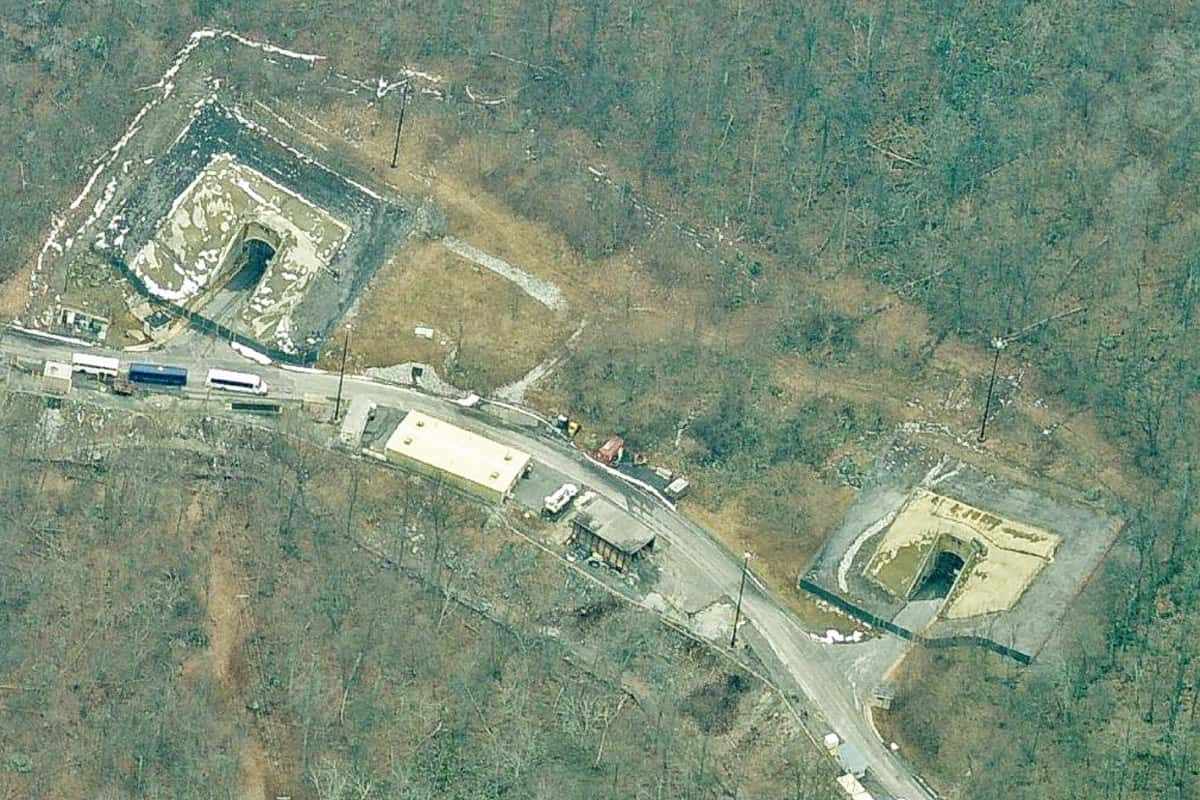
You will not see the inside of Raven Rock without a security clearance almost no civilian will ever hold. The approach along Harbaugh Valley Road takes you through quiet Pennsylvania farmland and Blue Ridge forest before the double-layered chain-link fences, the razor wire, and the camera arrays appear. A large sign at the main gate reads: Raven Rock Mountain Complex. Site R. Secured by the Raven Rock Military Police Company. The mountain behind the fence looks like a wooded hill. Local resident Hal Neill told the Pittsburgh Post-Gazette in 2001 that he had spent years trying to locate all four of the facility's tunnel entrances from the surrounding public roads: "There are four entrances, but I've only ever been able to find three of them."
From those roads, the only visible evidence of what lies beneath is the ridge of communications arrays along the summit and, in winter, the bare ground around the ventilation outlets, where heat rising from the mountain's diesel generators melts the snow in slow concentric rings through the coldest months.
The mountain breathes. It has been breathing for over seventy years, waiting. That much, at least, you can see.
FAQ: Common Questions About Site R and the Underground Pentagon
Is Raven Rock still operational today?
Raven Rock is a fully active, 24/7 military installation. Despite a period of reduced funding after the Cold War ended, the September 11 attacks reaffirmed its strategic purpose and triggered a decade of major upgrades. Its 2018 annual budget stood at $45 million, and a $100 million construction contract was awarded in 2022 for further expansion. It remains the primary Alternate National Military Command Center for the Department of Defense and is continuously staffed regardless of threat level.
Who was actually at Raven Rock on September 11?
Deputy Secretary of Defense Paul Wolfowitz was rushed to Site R on September 11, 2001, along with Secretary of the Army Thomas White and other senior defense officials. Defense Secretary Donald Rumsfeld famously refused to evacuate, instead going to the Pentagon crash site and helping carry stretchers. Vice President Dick Cheney was taken to the Presidential Emergency Operations Center beneath the White House, not to Raven Rock. The COG response that day was marked by widespread refusal to follow protocol among the most senior officials, exposing fundamental flaws in evacuation planning.
How does Raven Rock differ from Mount Weather?
The two sites serve different branches of government. Raven Rock — Site R — is the shadow Pentagon: its function is military command and control for the Secretary of Defense and the Joint Chiefs of Staff. Mount Weather, in Virginia, is managed by FEMA and is designed to house the President, Cabinet, and senior executive branch officials to maintain civil government. The decommissioned Greenbrier Bunker in West Virginia was built for Congress. Together the three formed the core of America's Cold War Continuity of Government architecture.
Can Raven Rock survive a direct nuclear strike?
The facility was hardened in 1963 to withstand approximately 140 psi of blast overpressure. The floating-building spring isolation system further reduces structural damage from seismic shockwaves. A modern bunker-buster warhead targeted with precision at the summit could potentially compromise the facility, but such a strike would require the attacker to commit significant precision-strike capacity to a single mountainside, an inefficient use of limited warheads. The greater vulnerability, as 9/11 demonstrated, is human behavior rather than physics: the most critical officials will not necessarily go where the plan says they should.
Are families included in the evacuation plan?
No, and this has been true since the first Continuity of Government drill in 1954. The evacuation plans cover designated personnel only. Spouses and children are not included. This was identified as a significant morale problem in the early Cold War period — the first major COG drill in 1954 left the wives of Eisenhower's Cabinet officials waiting in Washington while their husbands were evacuated to mountain bunkers — and has never been formally resolved. Personnel assigned to COG facilities understand that if an alert comes, they leave alone.
Can civilians visit the Raven Rock perimeter?
The public roads around Blue Ridge Summit pass close enough to the outer fence to see the communications arrays on the ridge and the security perimeter. Photography is restricted under a 2007 Department of Defense directive. The gates are manned by armed federal military police. There is no visitor program, no decommissioned wing open for tours, and no public access of any kind. Unlike the Greenbrier Bunker — whose Cold War role was exposed by a journalist in 1992 and which now offers public tours — Raven Rock remains an active classified installation with no foreseeable path to public access.
Sources
- Raven Rock: The Story of the U.S. Government's Secret Plan to Save Itself — Garrett M. Graff (2017)
- Command and Control: Nuclear Weapons, the Damascus Accident, and the Illusion of Safety — Eric Schlosser (2013)
- Adams County's Hidden History: Site R — Celebrate Gettysburg / Adams County Historical Society
- Raven Rock Mountain Complex — Atlas Obscura
- Secrets of 9/11: New Details of Chaos and Confusion — NBC News (2016)
- Behind the 9/11 White House Order to Shoot Down U.S. Airliners — History.com / Garrett M. Graff
- 'Raven Rock' and the U.S. Government's Flawed Plan to Survive Nuclear Attack — NPR (2018)
- Cheney Recalls Taking Charge from Bunker — CNN (2002)
- Raven Rock Mountain Complex — War History Online (2019)
- DoD Directive 3020.26: Defense Continuity Policy — U.S. Department of Defense (2022)



%2C%20Konjic%2C%20Bosnia.jpg)


