The Bokor Palace Hotel Inauguration, February 1925
Valentine's Day, 1925. A select group of French colonial officials and their wives sit down to a six-course dinner inside a three-story Art Deco palace they have built on a mountaintop in southern Cambodia. The menu: gazpacho, American-style crawfish, foie gras, and strawberries with Chantilly cream. Electric heaters warm the dining room — an unimaginable luxury in tropical Indochina. Through the tall windows, the "Opal Coast" stretches toward the Gulf of Thailand, and the jungle below disappears into cloud. The nearest Cambodian city, Kampot, is 37 kilometers of switchbacks away. The nearest Cambodian laborer's grave is considerably closer.
Nine hundred workers — Cambodian and Vietnamese, most of them indentured — died in the nine months it took to carve a road through the Damrei Mountains and raise these walls. Disease, exhaustion, and the sheer violence of the terrain killed them at a rate of roughly one hundred per month. The French colonial administration recorded the number. It did not record their names.
Bokor Hill Station is a place that refuses to stay dead or stay alive. Three times built, three times abandoned — by the French fleeing guerrillas, by Cambodia's royal elite fleeing revolution, by the Khmer Rouge fleeing the Vietnamese army. Each wave of occupants erected its own version of paradise on the same summit, and each time the fog rolled back in and the jungle began digesting the ballrooms. The thesis of this mountain is simple and repeating: power builds, power flees, the jungle waits. Now a Cambodian tycoon named Sok Kong holds a 99-year lease on 20,000 hectares of the surrounding national park, and the mountain's fourth construction cycle is underway. The pattern has not changed. Only the investors have.
Why the French Built a Resort in Cambodia's Sacred Elephant Mountains
The Damrei Mountains and the Summit the Colonists Claimed
The Damrei Mountains — the Elephant Mountains — run along southern Cambodia's coast like a granite spine, their peaks wrapped in cloud forest and their ridges considered sacred by Khmer communities for centuries. The name itself carries weight: Phnom Bokor, the highest accessible summit at 1,079 meters, translates roughly as "hump of an ox," a reference to the mountain's profile as seen from the plains below. Buddhist temples dotted the lower slopes. Vietnamese mystics and ascetics had retreated into the highlands long before any European surveyed them. The mountain was not empty. It was occupied — by belief, by tradition, by people who had no interest in a hotel.
The French colonial administration that controlled Cambodia from 1863 onward had a different use for high ground. Across their Southeast Asian territories, the logic was identical: the lowlands were hot, humid, and ridden with malaria; the highlands offered European-style temperatures and the psychological comfort of altitude. The British had perfected the model in India — Shimla, Darjeeling, hill stations where colonial officers could pretend they were in Surrey for a few weeks. France built its own version at Dalat in Vietnam, a fully realized alpine town in the Central Highlands. Cambodia, smaller and less populated with French settlers, had nothing equivalent. In 1917, a French engineer named Marius François Baudouin identified Bokor's summit as the site for Cambodia's first — and, as it turned out, only — colonial hill station.
900 Dead in Nine Months: The Forced Labor Behind Route 39
Construction began in 1920 with the most brutal phase: a 32-kilometer road from Kampot to the summit, designated Route 39, cutting through dense rainforest on near-vertical gradients. The laborers were overwhelmingly Cambodian and Vietnamese, working under the French corvée system — indentured labor that was, in practice, indistinguishable from forced labor. They cleared jungle with hand tools, moved stone without machinery, and slept in the forest between shifts. Malaria, dysentery, exhaustion, and rockfalls killed them steadily. By the time the road was completed in 1921, approximately 900 workers were dead. The construction had lasted nine months.
King Sisowath issued a royal decree on April 13, 1922, formally authorizing the hill station's infrastructure: a 25-room hotel with en-suite bathrooms, a villa for the Résident Supérieur, a post office, a power station, an infirmary, two schools — one French, one Khmer — and several guest chalets. Construction of the buildings continued through 1924, and at the station's peak, 72 structures stood on the summit. The entire complex existed to serve a colonial population so small that the hotel would struggle to fill its rooms for most of its operational life. An academic study of the period would later describe the Bokor Palace as a "colonial white elephant" — a monument to ambition that exceeded demand by an order of magnitude, a tropical cousin to Henry Ford's doomed rubber city in the Amazon in its certainty that Western infrastructure could bend foreign landscapes to Western will.
The 900 dead workers received no memorial. The hotel received a lavish inauguration banquet.
Inside the Bokor Palace Hotel: French Art Deco Architecture Above the Clouds
The Palace Hotel and the Illusion of Europe in the Tropics
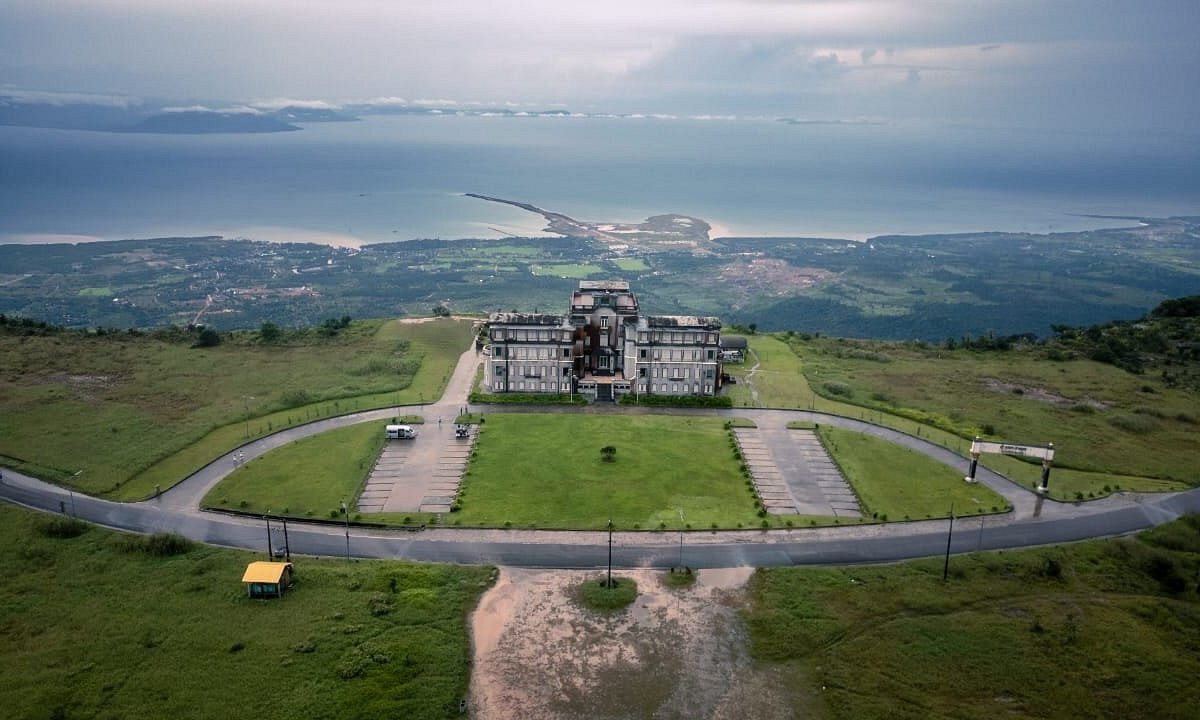
The Bokor Palace Hotel, inaugurated on February 14, 1925, was the architectural centerpiece of the station and a deliberate statement of colonial grandeur. A three-story Art Deco structure with Palladian proportions and Italian stylistic details, it sat on the mountain's western edge with its terraces facing the sea. The building contained 25 large rooms, each fitted with a private bathroom and — remarkably for 1920s Cambodia — electric heaters. A massive stone fireplace dominated the ground-floor lounge. The dining room was vast, designed for formal multi-course meals served on white linen. Pergolas extended from the upper floors, offering views that stretched, on clear days, to the Vietnamese island of Phú Quốc.
Daily life at the station resembled a transplanted fragment of metropolitan France. Colonial officials and military officers arrived from Phnom Penh for weeks-long retreats, escaping temperatures that regularly exceeded 35°C in the capital. At 1,079 meters, Bokor rarely climbed above 22°C. The cooler air, the European food, the architecture — all of it was designed to sustain the illusion that the French belonged here, that this mountain was theirs by right of engineering rather than conquest. The Cambodian staff who cooked the meals, cleaned the rooms, and maintained the generators were invisible by design. The guests looked outward, toward the sea. They did not look down.
The Catholic Church, the Post Office, and the Colonial Enclave
The Palace Hotel did not stand alone. Surrounding it, the French built a self-contained colonial village: the Résident Supérieur's villa, a post office with an arched entrance, shops, and a Catholic church positioned on a rise just east of the hotel. The church — a hexagonal stone structure with a brick exterior — was built to serve the spiritual needs of the European community and would become, decades later, the most photographed ruin in Cambodia. It is the second-oldest surviving Roman Catholic church in the country.
The station also included royal apartments, visited periodically by the Cambodian royal family — who were, in this era, effectively puppets of the French administration. The entire complex functioned as a world within a world: a European enclave at altitude, disconnected from the country it sat upon. The road was the only link to the lowlands, and it was steep, unpaved, and frequently impassable during monsoon season. Bokor was designed to be remote. That remoteness would prove both its charm and its vulnerability.
The station's fundamental problem was commercial. Cambodia's French settler population was tiny compared to Vietnam's, and the journey from Phnom Penh was long and uncomfortable. The hotel was frequently underbooked. Visiting dignitaries and military officers filled some rooms, but the grand dining room often served more staff than guests. The Bokor Palace was born as a statement of prestige, not profitability — and prestige, in colonial Southeast Asia, had an expiration date that was approaching faster than anyone at the Valentine's Day dinner imagined.
The First Abandonment: The Indochina War and the Burning of French Bokor
How the First Indochina War Emptied the Mountain
The party ended in 1946. The First Indochina War — France's brutal, eight-year attempt to retain control of its Southeast Asian colonies — made Bokor's splendid isolation a tactical liability. The station sat exposed on a mountaintop at the end of a single road, surrounded by jungle controlled by forces that wanted the French gone. For a brief period, the Palace Hotel was repurposed as a military hospital, its dining room converted to wards, its terraces used for convalescence. The conversion was short-lived. By the late 1940s, the hill station was deemed too remote and too difficult to defend. The French withdrew.
What they left behind was an entire town's worth of infrastructure — intact, electrified, furnished — sitting unguarded on a mountaintop in a country at war. The jungle, which had been held back by groundskeepers and gardeners for two decades, began its return immediately.
The Khmer Issarak, the "Black Dragon," and the Ransacking of the Palace
The buildings did not decay in peace. The Khmer Issarak — an anti-colonial guerrilla movement founded in 1945, known by their alias "The Black Dragon" — moved through the abandoned station and systematically ransacked it. The Palace Hotel was stripped and burned. Electricity and running water ceased. Windows and doors were scorched black. By 1950, Bokor Hill Station had no power, no water, and no intact interiors. The post office was destroyed. The villas were gutted. Only the church, standing alone on its ridge, and the basic shell of the Palace survived relatively intact — though "intact" is generous for a building whose insides had been consumed by fire.
For the next twelve years, the station sat in the fog, moldering. The jungle crept through the doorways. Moss colonized the stone. The mountain reclaimed what the mountain had never offered willingly.
King Sihanouk's Casino Era at Bokor Hill Station (1962–1972)
The Reopening of Cité du Bokor Under King Norodom Sihanouk
In January 1962, King Norodom Sihanouk — Cambodia's mercurial, movie-directing, politically acrobatic head of state — reopened the hill station under a new name: Cité du Bokor. The Palace Hotel was refurbished and brought back to a version of its former grandeur, this time managed by the Khmer Royal Society Inns. Twenty-two rooms and four apartments were fitted with modern comforts. A lounge, a bar, and a large restaurant served the Cambodian elite who now replaced the French as the station's clientele.
The most significant addition was a casino, built near the lake in conjunction with two new hotels — the Sangkum and the Kiri. A mayor's office, an annex to the Palace, and a distinctive concrete parasol structure were also constructed during this period. Sihanouk himself maintained a personal retreat nearby: the Black Palace (Damnak Sla Khmao), a modest summer residence perched on the mountain's eastern slope, roughly 10 kilometers from the main station. For wealthy Khmer families, Bokor became the place to be seen — a mountaintop playground that combined gambling, cool air, and the frisson of occupying spaces the French had built and lost.
The irony was thick. A Cambodian king was hosting his country's elite in a resort that had cost 900 Cambodian lives to build, in buildings designed to exclude Cambodians, on a mountain the French had seized from a culture that considered it sacred. Sihanouk, characteristically, did not dwell on the contradiction. He was too busy making films.
The Gambling Suicides and the Cliff Behind the Bokor Casino
The casino era introduced a new chapter to Bokor's accumulating folklore. Behind the Palace Hotel, the mountain drops away in a sheer cliff — a vertical plunge of several hundred meters with no guardrail, no barrier, nothing between the stone edge and the canopy far below. Local stories, passed down through Kampot and repeated by guides to this day, claim that gamblers who lost their fortunes at the tables would walk out the back of the casino and throw themselves off the cliff. The stories are unverified. No official records document the suicides. The cliff, however, is real, and the drop is absolute.
The tales fed Bokor's growing reputation as a haunted place. Cambodians began calling the station the "ghost city" — home to the spirits of the construction workers who died building it, the soldiers who fought over it, and the gamblers who, according to legend, ended their lives behind it. The ghosts, locals said, were many. The living were about to become fewer.
In 1970, Lon Nol's military coup overthrew Sihanouk. The hill station closed for a third time. Within two years, the Khmer Rouge controlled the mountain.
The Khmer Rouge at Bokor Mountain: Fortress, Barracks, and Battlefield (1972–1993)
From Colonial Playground to Khmer Rouge Military Stronghold
The Khmer Rouge did not come to Bokor for the views. They came for the elevation. At 1,079 meters, the summit commanded sightlines stretching to the Gulf of Thailand and, on clear days, across the Vietnamese border. The single access road — the same road that had killed 900 workers in 1921 — made the position nearly impregnable. By 1972, the Khmer Rouge controlled the mountain entirely, and the abandoned colonial buildings became military infrastructure overnight.
The Palace Hotel, already burned and stripped, was used as a command post. The Catholic church — the hexagonal stone building that had served French congregants for two decades — was desecrated and converted into a barracks. Weapons and ammunition were stored inside. The pews were gone. The altar was gone. Khmer Rouge soldiers slept where colonial families had once prayed. The transformation was complete and deliberate: the architecture of colonial leisure repurposed for revolutionary war, every trace of its original function obliterated.
Bokor remained under Khmer Rouge control throughout the regime's catastrophic rule of Cambodia (1975–1979), during which an estimated 1.5 to 2 million Cambodians were killed through execution, forced labor, and starvation at sites like Tuol Sleng and Choeung Ek. The mountain was peripheral to the genocide but central to the regime's military strategy — a highland fortress from which to observe and control the southern coast.
The Vietnamese Invasion and the Battle for Bokor's Church
In 1979, Vietnamese forces invaded Cambodia and toppled the Khmer Rouge government. The regime's fighters retreated to remote strongholds, and Bokor Mountain was one of their most defensible positions. Vietnamese troops fought their way up the mountain road and assaulted the entrenched Khmer Rouge positions in and around the colonial buildings. The fighting was fierce. The church, packed with Khmer Rouge weapons and fighters, was attacked directly. Mortar rounds punched through the stone walls. Bullet holes stitched across the facade. The building survived — unlike many of Cambodia's churches, which the Khmer Rouge destroyed entirely during their anti-religious campaigns — but it bore the scars of a battle it was never designed to witness.
The Khmer Rouge held Bokor for months after the initial Vietnamese assault, and the mountain remained one of their last operational strongholds well into the early 1990s. Scattered Khmer Rouge remnants occupied the ruins until the 1991 UN-brokered ceasefire and the arrival of a French peacekeeping battalion in 1993, which established a headquarters nearby. The guerrillas finally left the mountain they had held for over two decades.
The station was abandoned for the third and final time. Every building was gutted. The Palace was a hollow shell with mortar damage and stripped wiring. The church stood bullet-pocked and empty on its ridge. The road was cratered and overgrown. The fog, as always, returned.
Bokor Hill Station's Iconic Ruins: Cambodia's Most Famous Ghost Town
The Fog, the Lichen, and the Birth of a Dark Tourism Legend
For the better part of a decade after the Khmer Rouge departed, Bokor Hill Station existed in a state of pure, atmospheric decay. The buildings — roofless, windowless, their interiors exposed to monsoon rains and mountain winds — developed the patina that would make them famous. Orange and red lichen colonized the stone facades. Black mold crept across the walls. Moss carpeted the floors of the Palace Hotel's dining room, where French officials had once eaten foie gras and Cambodian elites had once rolled dice. Graffiti appeared on the interior walls — left by the few adventurous travelers who made the punishing journey up the old, unpaved road, a grinding 32-kilometer ascent that took up to ninety minutes on a motorbike and considerably longer in anything with four wheels.
The fog was the defining feature. Bokor Mountain sits in a climate zone where warm, moist air from the Gulf of Thailand collides with the cool elevation of the summit, producing cloud cover that can descend without warning and erase visibility completely. Visitors who arrived on a clear morning might find themselves unable to see ten meters by afternoon. The church, the Palace, the crumbling villas — all of them would vanish into white, then reappear as the cloud shifted, as if the mountain were deciding moment by moment what to reveal.
Film crews noticed. Matt Dillon's 2002 thriller City of Ghosts used the abandoned Palace as a location for its climactic sequence — a fitting choice for a film about con artists and disappearances. The Korean horror film R-Point (2004) followed, using the ruins as a backdrop for supernatural warfare. The images circulated online and in travel magazines, and Bokor's reputation as one of Southeast Asia's most atmospheric abandoned sites solidified. Backpackers added it to their itineraries. Dark tourism bloggers wrote about the "energy" of the place. Cambodians, who had known for decades that the mountain was haunted, were unsurprised by the foreign fascination.
The ruins of Bokor joined a specific category of abandoned place — alongside sites like Pripyat, Hashima Island, and Craco in southern Italy — where the decay itself becomes the attraction, where the absence of life is the thing people travel to see. The difference was that Bokor's abandonment was not singular. It was serial. The mountain had consumed three separate civilizations' attempts to domesticate it, and the ruins were layered — French Art Deco under Sihanouk-era concrete under Khmer Rouge bullet holes. Every wall told multiple stories simultaneously.
The Billion-Dollar Redevelopment of Bokor Mountain and Its Controversies
Sok Kong's 99-Year Lease on a National Park
The Cambodian government established Preah Monivong Bokor National Park in 1993, protecting 150,000 hectares of the Elephant Mountains, including the hill station ruins. In 2003, the park received designation as an ASEAN Heritage Park, recognizing its biodiversity — virgin lowland forest, dry dipterocarp, moist tropical evergreen, and wildlife populations including the endangered pileated gibbon, Asiatic black bear, banteng, and clouded leopard.
Four years later, the government handed the mountain to a single man. In 2007, Sok Kong — chairman of the Sokimex Investment Group, a tycoon who built his fortune in petroleum and expanded into hotels, media, and entertainment — received a 99-year lease on approximately 20,000 hectares within the national park. The reported price tag: one billion US dollars, though transparency around the terms has been minimal. Sok Kong's company built a new sealed road to the summit, completed by December 2011 — replacing the treacherous old track with a modern highway engineered with battered slopes and drainage systems to prevent landslides. The 564-room Thansur Sokha Hotel and Casino opened in 2012, a massive structure that visitors have described as resembling a beached whale. The Bokor Palace Hotel itself was restored and reopened in 2018 as a luxury hotel charging close to $1,000 per night.
The pattern was unmistakable. A century after the French built a resort on Bokor Mountain for their own elite, a Cambodian tycoon was building a resort on the same mountain for a new elite — primarily Chinese tourists and wealthy Cambodians. The development echoed the logic of other Asian mega-projects aimed at attracting Chinese investment, from Forest City in Malaysia to Ocean Flower Island in Hainan — enormous, capital-intensive, and increasingly empty. The 900 workers who died building the original road received no more acknowledgment in the new development's marketing materials than they had in the original inauguration's dinner menu.
Bokor City: Forest Clearing, Activism, and the Scam Compound Scandal
The hotel was only the beginning. In August 2019, the Cambodian government unveiled the "Master Plan for Bokor City Development Project until 2035" — a plan to transform nearly 19,000 hectares of the national park into a full-scale city. Luxury residential estates, golf courses, condominiums, water parks, and additional casinos were proposed inside a protected ASEAN Heritage Park. Sok Kong received further land grants: 12,016 hectares in 2020, another 11,177 hectares in a subsequent Royal Gazette sub-decree.
Environmental organizations raised alarms. In late 2020, the activist group Mother Nature Cambodia released drone footage showing large sections of Bokor's forest razed for construction — primary forest cleared for luxury housing estates targeted at buyers who could afford $160,000 villas on a mountaintop. Conservationists estimated that 20 to 30 percent of the park's forest had already been degraded. The development threatened habitat for endangered species, fragmented ecosystems, and violated the conservation principles that the ASEAN Heritage Park designation was supposed to protect. "What you are seeing is just a small part of a much larger plan," an anonymous Mother Nature activist said in the video, their identity concealed because environmental activists in Cambodia face routine arrest.
The irony was staggering. The same dynamic that defined Bokor's colonial origins — powerful outsiders reshaping a sacred mountain for their own benefit, at the expense of local communities and natural systems — was repeating itself in the 21st century. The forced labor was gone, but the pattern of extraction was not. Kampot residents, with a median annual income of approximately $1,500, could not afford the villas being built on their mountain. The development, like the original hill station, was not for them.
The situation grew darker still. In 2022 and 2023, investigative reporting revealed that a cluster of heavily guarded buildings behind the Thansur Sokha Hotel had been operating as a compound for online scam operations linked to human trafficking. Taiwanese law enforcement identified the site as a "stronghold" for the "Big Fatty" gang, which had allegedly trafficked 31 Taiwanese nationals. Chinese, Vietnamese, Thai, and other foreign nationals were confined inside the compound, forced to conduct online fraud. Sok Kong's company denied knowledge of the activities, issuing a statement more than a year after the reports were published. The scam operations had been known since at least 2018, when Chinese police arrested 91 Chinese nationals at the site.
A mountain that began as a monument to colonial extraction had become, a century later, a site of 21st-century exploitation — luxury hotels on one side of the road, trafficking compounds on the other, fog covering both.
Visiting Bokor Hill Station Today: What to See and How to Get There
Reaching the Mountain from Kampot and Navigating the Ruins
Bokor Mountain is accessible via a well-paved road from National Highway 3, near the town of Kampot in southern Cambodia. The drive from Kampot takes approximately 45 minutes. The old 32-kilometer grind is gone — the modern road, built by Sokimex, is one of the best-maintained in the country, engineered specifically to handle the steep gradients and heavy monsoon rainfall. Motorbikes, cars, and taxis make the ascent daily. Tuk-tuks are not recommended — the incline defeats them.
The first landmark on the ascent is the Lok Yeay Mao monument, a 29-meter statue of Cambodia's protective spirit of travelers, built in 2012. Further up, the Black Palace (Damnak Sla Khmao) — King Sihanouk's abandoned summer retreat — sits in quiet decay roughly 10 kilometers before the main station. The colonial ruins cluster around the summit: the Catholic church, standing alone on its ridge with its bullet-scarred walls and panoramic views; the surrounding shells of French-era buildings, overgrown and atmospheric; and the restored Bokor Palace Hotel, now a functioning luxury hotel whose yellow exterior divides opinion sharply among visitors.
The contrast between old and new is jarring. Moss-covered ruins sit minutes from a 564-room casino hotel. Half-finished construction projects — remnants of the "Bokor City" plan — create an almost post-apocalyptic landscape in places. The Popokvil Waterfalls, whose name means "Swirling Clouds," cascade through mossy rocks during the rainy season (June through October) and are worth the short detour. Wat Sampov Pram, a Buddhist temple on the summit, is a popular pilgrimage site during Khmer New Year and Pchum Ben.
The best season to visit is December through April, when rainfall is minimal and visibility is highest. Monsoon season brings the famous fog — atmospheric, but limiting. The mountain's elevation means temperatures hover around 18–22°C year-round, a welcome relief from the lowland heat that motivated the French to build here in the first place.
The Ethics of Standing Where the Fog Erases Everything
Bokor Hill Station asks a question that has no comfortable answer: what do you do with a place that every generation has tried to own and none has managed to keep? The French built it on Cambodian bodies. Sihanouk's elite gambled in rooms the French had designed to exclude Cambodians. The Khmer Rouge turned a church into an armory. A 21st-century tycoon is clearing protected forest to build condominiums inside a national park. The mountain does not care about any of them. The fog rolls in on schedule, the jungle reclaims what it can, and the lichens keep growing on whatever stone the latest builder has placed.
Standing at the edge of the cliff behind the old Palace — the cliff where gamblers allegedly jumped, where the view drops away into green infinity — a visitor confronts the full weight of Bokor's history. This is not a ruin preserved in amber. This is a ruin still being written over, still being fought over, still being exploited. The ghosts, as the Cambodians say, are many. And the mountain, patient as it has always been, is waiting to see who leaves next.
Frequently Asked Questions About Bokor Hill Station
What is Bokor Hill Station in Cambodia?
Bokor Hill Station is a collection of French colonial buildings constructed in the early 1920s atop Bokor Mountain (1,079 meters) in the Elephant Mountains, approximately 37 kilometers west of Kampot in southern Cambodia. Built as a luxury retreat for French colonial officials and military personnel, the station's centerpiece was the Bokor Palace Hotel, inaugurated in 1925. The resort was abandoned three times — during the First Indochina War in the late 1940s, after the 1970 coup that overthrew King Sihanouk, and following the Khmer Rouge's use of the site as a military stronghold through the early 1990s. The Palace Hotel was restored and reopened in 2018, while several surrounding colonial ruins remain in various states of decay.
How many workers died building Bokor Hill Station?
Approximately 900 Cambodian and Vietnamese laborers died during the nine-month construction period of the mountain road (Route 39) and resort buildings between 1920 and 1921. The workers were primarily indentured laborers working under the French corvée system. Deaths resulted from malaria, dysentery, exhaustion, rockfalls, and the extreme difficulty of the terrain. The 32-kilometer road from Kampot to the summit had to be carved through dense tropical rainforest on steep mountain gradients using hand tools.
Is Bokor Hill Station haunted?
Cambodians have long referred to Bokor as a "ghost city," believing the summit is inhabited by the spirits of the workers who died building the station, soldiers killed during the various conflicts fought on the mountain, and — according to local folklore — gamblers who lost their fortunes at the 1960s casino and threw themselves from the sheer cliff behind the Palace Hotel. The gambling suicides are unverified by official records, but the stories remain a fixture of local oral tradition. The site's atmospheric fog, decaying colonial architecture, and layered history of violence have reinforced its reputation as one of Cambodia's most haunted locations.
How do you get to Bokor Hill Station from Kampot?
Bokor Mountain is reached via a modern paved road that branches off National Highway 3 near Kampot. The drive takes approximately 45 minutes by car or motorbike. The road, completed in 2011 by the Sokimex Group, replaced the original unpaved colonial-era track that once took up to 90 minutes to ascend. Tuk-tuks are not recommended due to the steep gradient. Day tours can be arranged through guesthouses and travel agencies in Kampot, and self-guided visits by rented motorbike are common. There is no entrance fee for the national park road, though some facilities on the summit are privately operated.
What happened to the Bokor Palace Hotel?
The Bokor Palace Hotel has undergone multiple cycles of construction, destruction, and restoration. Inaugurated in 1925 as a luxury Art Deco hotel with 25 rooms, it was burned and ransacked by the Khmer Issarak guerrillas in the late 1940s, refurbished under King Sihanouk in 1962 with the addition of a casino, abandoned again in 1972 when the Khmer Rouge seized the mountain, and used as a military position during the Vietnamese invasion of 1979. After decades as one of Southeast Asia's most famous ruins, the hotel was restored by Sokha Hotels & Resorts and reopened in 2018 as a luxury property with 36 rooms, dining facilities, and preserved colonial-era features. Visitor reports suggest, however, that the hotel has at times appeared shuttered and underoccupied.
Why is the Bokor Mountain development controversial?
In 2007, Cambodian tycoon Sok Kong received a 99-year lease on approximately 20,000 hectares within Preah Monivong Bokor National Park — an ASEAN Heritage Park — for a reported one billion US dollars. His company, Sokimex, has since built a large casino hotel, restored the Palace Hotel, and proposed the "Bokor City" master plan, which would develop nearly 19,000 hectares with luxury estates, golf courses, and condominiums inside the protected park. Environmental groups have documented significant forest clearing using drone footage, and conservationists warn of habitat loss for endangered species. In 2022–2023, investigative reports also revealed that buildings behind the Thansur Sokha Hotel were being used as compounds for online scam operations linked to human trafficking.
Sources
- [The Bokor Palace Hotel: A Colonial White Elephant Atop Cambodia's Elephant Mountains] — Eric Jennings, Journal of Tourism History, Vol. 17, No. 3 (2025)
- [Imperial Heights: Dalat and the Making and Undoing of French Indochina] — Eric Jennings, University of California Press (2011)
- [Indochina, An Ambiguous Colonization] — Pierre Brocheux and Daniel Hémery, University of California Press (2011)
- [A History of Cambodia] — David Chandler, 4th edition, Westview Press (2008)
- [Le Cambodge et la colonisation française] — Alain Forest, L'Harmattan (1980)
- [Kampot of the Belle Époque: From the Outlet of Cambodia to a Colonial Resort] — Kitagawa Takako, Southeast Asian Studies, Vol. 42, No. 4 (2005)
- ['A Disgrace': Luxury Housing Plans Threaten Cambodia's Bokor National Park] — Mongabay Environmental News (2021)
- [Sokha Group Clearing Bokor National Park Forests for Massive Housing Projects] — CamboJA News (2021)
- [Scams, Human Trafficking Thrived at Bokor Mountain Behind Tycoon's Luxury Hotel] — Jack Brook, CamboJA News (2023)
- [11,177 Hectares in Bokor National Park Granted to Tycoon Sok Kong] — CamboJA News (2022)
- [La marchandisation et le pillage du mont Bokor au Cambodge] — Cristina Del Biaggio, Journal of Alpine Research (2018)
- [Church of Mount Bokor: A Witness to the Battle Between Vietnamese and Khmer Rouge Forces] — RVA Cambodia (2024)