The Battle of Shanhai Pass, 1644: How the Great Wall Was Opened From the Inside
Wu Sangui Surrenders Shanhai Pass to the Manchus
Wu Sangui stood on the gate tower of Shanhai Pass on the morning of 27 May 1644 with a rebel army in front of him, a Manchu army behind him, and no emperor left to serve. He was 32 and commanded the eastern anchor of the Great Wall, where the fortifications run down off the mountains and into the sea, with the best troops the Ming still possessed. The Ming no longer existed. A month earlier a former shepherd from Shaanxi named Li Zicheng had taken Beijing, and the last Ming emperor had hanged himself from a tree on Coal Hill behind the palace.
Li Zicheng had Wu's father in a Beijing prison, and, in the version told later, had taken Wu's concubine, Chen Yuanyuan, for one of his own generals. He sent an army of perhaps 60,000 east to the pass to bring Wu over or destroy him. Behind the wall, in the country the Great Wall had been built to shut out, a Manchu army under the prince regent Dorgon was waiting for exactly this.
Wu Sangui chose the Manchus. He shaved his forehead in the Manchu fashion, opened the gates of Shanhai Pass, and let Dorgon's cavalry through the Great Wall. On 27 May 1644, in a dust storm that blinded both armies, the Manchu horsemen rode into Li Zicheng's flank and broke it. Li fled west, killing Wu's father and thirty-seven members of his family on the way. Dorgon entered Beijing within a fortnight. The dynasty that had spent two centuries and uncounted lives building the wall was finished, and the wall had been opened for its conquerors by the man paid to hold it. Wu Sangui served the Qing for thirty years, rose to rule a province, rebelled against them in 1673, declared himself emperor and died of dysentery five years later with his rebellion collapsing around him.
Why the Great Wall of China Was Built and What It Cost
The Great Wall is the largest structure human beings have ever built, and the stories it holds are almost all stories of what it cost. Rulers built it to stop the horsemen of the steppe; they also built it to fix their own people in place, to conscript and tax and count them, and to show the frontier garrisons who owned them. The men who raised it were soldiers, convicts and peasants sent north for years at a time, and enough of them never came home that the story of their bones being inside the wall became the wall's oldest legend. The wall was breached by the Mongols, walked around by the Manchus at Wu Sangui's invitation, and shelled by the Japanese army in 1933, and each of those moments left dead men on it. Since 1949 it has been looted for building stone, rebuilt as a monument, declared the symbol of the nation, and allowed to fall apart everywhere the monument does not reach.
How Long Is the Great Wall of China and Who Built It
The Qin Dynasty Great Wall of Qin Shi Huang and Meng Tian
The Warring States had built border walls against each other and against the steppe for two centuries before Qin Shi Huang united them in 221 BCE. Seven years later he sent his general Meng Tian north with 300,000 men to drive back the Xiongnu nomads and join the old walls into one. The work was rammed earth, layers of soil pounded between boards, and it ran for thousands of kilometres across the loess country of the north-west. Very little of it stands. Most of what the First Emperor built has weathered back into the ground it was made of.
Meng Tian did not outlive his emperor by long. When Qin Shi Huang died in 210 BCE the ministers who forged the succession ordered Meng Tian to kill himself. Sima Qian records his last words: he searched his conscience for the crime that deserved death and concluded that it must have been the wall, that in building ten thousand li of it he had cut through the veins of the earth. He took poison. The Han dynasty extended the earth walls west into the Gobi over the following centuries, and those too are mostly dust.
The Ming Dynasty Great Wall and Why the Brick Wall Was Built
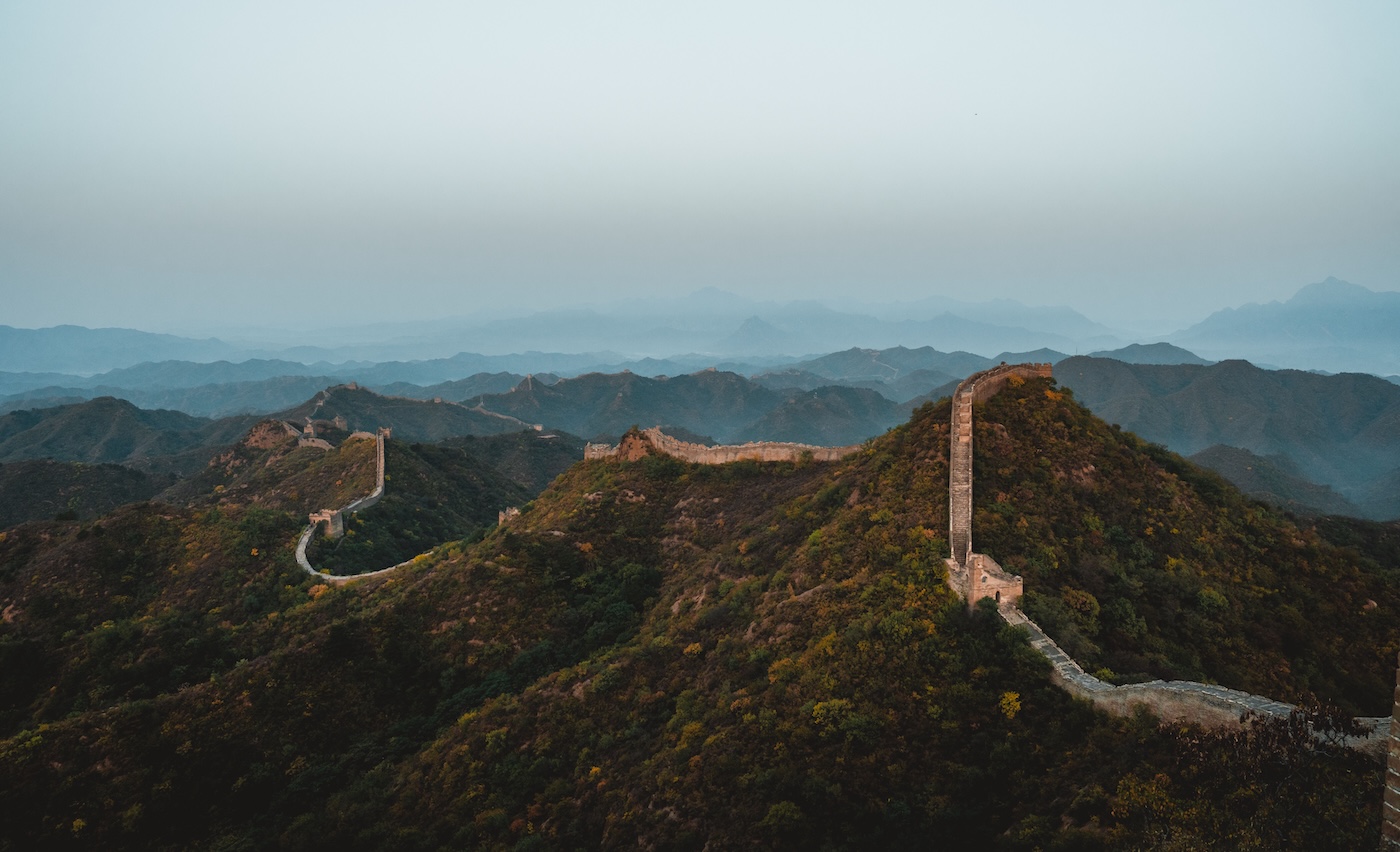
The brick and stone wall of the photographs, with its crenellations and watchtowers marching over mountain ridges, is Ming, built between 1368 and 1644 and mostly in the last hundred years of that span. A Chinese state survey in 2009 measured the Ming line at 8,851 kilometres including branches and natural barriers; a wider survey in 2012 put the total length of all walls of all dynasties at 21,196 kilometres. The Ming built theirs because the alternative had been tried. In 1449 the Zhengtong Emperor led an army north to fight the Mongols and was captured at Tumu, sixty kilometres from the wall, the only Chinese emperor ever taken on the battlefield by the steppe. In 1550 the Mongol khan Altan rode past the frontier defences to the suburbs of Beijing and burned them for eight days while the Jiajing Emperor's ministers argued inside the city walls about what to do. The great building programme began after that. Its logic was that if the army could not beat the horsemen in the field, it would have to stand behind stone.
Who Built the Great Wall of China: Conscripts, Convicts and Soldiers
The Legend of Meng Jiangnü and the Bodies Inside the Great Wall
The oldest story about the wall is about a woman who never saw it. Meng Jiangnü's husband, Fan Xiliang, was taken by the First Emperor's press gangs on their wedding night and sent north to build the wall. When winter came she sewed him a padded coat and walked north to bring it to him, and at the wall she learned that he had died and been buried inside it with the other dead, as the overseers did with anyone who fell. She wept, and her weeping split the wall open and exposed the bones of thousands of men, and she found her husband's among them by pricking her finger and letting her blood run to the bones that were his. Then she carried them to the sea and drowned herself.
The story is at least a thousand years old and has been told a hundred ways. A temple to Meng Jiangnü stands on a hill above Shanhaiguan, six kilometres from the pass Wu Sangui opened, with a stone said to be where she stood looking for her husband. No historian treats it as an event. Every historian treats it as evidence of what the people who lived along the wall believed about the people who built it, and the belief has never gone away.
How Many People Died Building the Great Wall of China
The records do not give a death toll. Sima Qian gives Meng Tian's 300,000 men and says nothing about how many came back, and the popular figures of a million dead, or of the wall being the longest cemetery on earth, are extrapolations with no document behind them. What the sources do show is who did the work. Under the Qin it was conscripted peasants and convicts sentenced to frontier labour, marched hundreds of kilometres to a border with no towns, and kept there. Under the Ming it was mostly the army itself. Soldiers of the frontier garrisons built the wall they then manned, hauling brick and lime up mountainsides in the years between raids, living in the towers they built, growing food on the slopes below when the grain shipments from the south failed to arrive, which was often. Ming officials wrote memorials to the throne about garrisons that had not been paid for years, about soldiers deserting south, about men who had sold their weapons to eat.
The bricks carry the evidence. Ming kilns stamped their output with the year, the unit and sometimes the officer responsible, so that a badly fired brick could be traced to the man who had made it and he could be punished. At Gubeikou the stamps read Seventh Year of Wanli, the year 1579. The men who pressed them are in the hills somewhere, unmarked. The building of the wall was a punishment before it was a wonder, and everybody who did it knew which.
Qi Jiguang and the Great Wall Watchtowers at Jinshanling and Simatai
The Hollow Watchtowers of the Ming Great Wall
For twenty years in the second half of the sixteenth century the wall north of Beijing did what it was built to do, and the reason was one man. Qi Jiguang had made his name destroying the pirates who terrorised China's south-east coast, and in 1567 the court sent him north to command the Jizhou sector, the stretch of wall that covered the capital. He found a wall with no depth: a single line with a few solid platforms on it, from which a handful of men could see the Mongols coming and do nothing. He redesigned it. Between 1569 and 1582 his troops built some 1,200 hollow watchtowers along the line, two- and three-storey brick towers with rooms inside where a squad could live, store grain and powder, sleep out of the weather and fight from loopholes on every side. The wall at Jinshanling and Simatai, the most photographed stretch in China, is Qi Jiguang's.
He drilled his men, fed them, paid them from his own resources when the court's silver did not come, and wrote training manuals that were still in use three centuries later. The Mongols came, looked at the towers, and went elsewhere. For two decades the frontier held.
The Fall of Qi Jiguang and the Decline of the Ming Frontier
His protector at court was the grand secretary Zhang Juzheng, the same minister who ran the empire for the boy who would become the Wanli Emperor. Zhang died in 1582 and his enemies moved against everyone he had favoured. Qi Jiguang was transferred to the far south in 1583, dismissed in 1585, and died in poverty in 1588, unpaid and unvisited. The emperor whose frontier he had made safe was by then building the tomb at Dingling that would cost two years of state revenue, and had begun the thirty-year withdrawal from government that hollowed out his dynasty. The towers stayed. The men in them went back to being unpaid, and the wall went back to being a wall, which is a thing that is only ever as strong as the people standing on it.
Battles of the Great Wall of China: Mongols, Manchus and the Japanese Army
Genghis Khan Breaks Through the Great Wall at Juyong Pass, 1211
The walls that faced the Mongols in the thirteenth century were not Ming and not Chinese; they were the Jin dynasty's, built by a people who had come off the steppe themselves. In 1211 Genghis Khan brought his army south against them. The Jin met him in the field at Yehuling and were destroyed, and his general Jebe took the Juyong Pass, the gateway to Beijing, by the oldest trick in the steppe: he attacked, fled, drew the garrison out after him, turned and killed them in the open. The Mongols went through the wall, and what followed for the cities of north China over the next two decades is among the largest killings in the medieval world. The khan whose tomb has never been found made the Ming remember, two centuries later, exactly why they were building.
Altan Khan's Mongol Raid on Beijing, 1550
The Gengxu Incident of 1550 was eight days that decided the shape of the wall. Altan Khan's Mongols came through a weak sector of the frontier in the autumn, rode to the walls of Beijing, and burned the villages and suburbs around the capital while a court paralysed by faction watched from the ramparts. Thousands of civilians died or were carried off. The emperor's response was not an army but a construction programme, and the wall the tourists see is in large part the answer to those eight days.
The Defence of the Great Wall in 1933 at Gubeikou and Xifengkou
The last men to die fighting on the Great Wall wore the uniform of the Republic of China and faced the Japanese Kwantung Army. Japan had taken Manchuria in 1931 and in the spring of 1933 struck south through the passes of the wall into Hebei. At Xifengkou the 29th Army's broadsword companies, peasant soldiers with rifles and the two-handed dadao, went out at night to cut down Japanese sentries, and the song written about them became the marching anthem of the war. At Gubeikou the 17th Army fought for the pass from 9 to 12 March 1933 against artillery, aircraft and tanks, using the Ming battlements as trenches and knocking firing holes through the brick. A regimental commander, Wang Runbo, was killed on the wall on 9 March; a general was blown apart by a grenade in a watchtower that carries his name today. The Chinese lost more than 15,000 killed along the wall between January and May before a truce gave the Japanese the passes.
At Gubeikou, when the fighting was over, local villagers collected the bodies from the slopes and buried 360 of them together in a single mound below the wall. The grave is still there. So are the firing holes, and the bullet scars in the Ming brick, and the Wanli-era stamps on the same bricks, so that a visitor standing on the Gubeikou wall can put a hand on a brick stamped 1579 and a bullet mark from 1933 at the same time.
The Great Wall Under Mao and Deng: Destruction and Restoration
The Great Wall During the Cultural Revolution
Mao wrote the line in 1935, in a poem composed on the Long March as his army crossed Mount Liupan and saw the old walls on the horizon. It became a slogan, and the wall became the Communist Party's symbol of national endurance in a way it had never quite been for the emperors who built it. The symbolism did not protect the structure. In the 1950s the wall's stone was quarried for dams and roads. During the Cultural Revolution, from 1966, villages along the line pulled it down for pigsties, houses and terraces, Red Guards attacked it as a feudal relic, and the state did nothing. Whole sections north of Beijing were dismantled in a decade. When Richard Nixon stood at Badaling in February 1972 and said that it was indeed a great wall, he was standing on one of the few stretches that had been kept whole for exactly such photographs.
The 1984 Great Wall Restoration Campaign and UNESCO Listing
Deng Xiaoping launched the campaign in 1984, and the wall was rebuilt as a monument. Badaling, first restored in 1957, was expanded into the showpiece it remains; Mutianyu followed. The money came from public donation, the labour from the army, and the result was a wall in the image of what people thought a Great Wall should look like, some of it more complete than any Ming garrison ever saw. UNESCO listed the wall in 1987. That same year a British runner named William Lindesay set out to run the length of the Ming wall from the Gobi to the sea, was arrested nine times by police who could not believe a foreigner was there for the reason he gave, and finished anyway. He spent the next thirty years documenting what was left and pressing the state to protect the parts it did not show visitors. The distinction he drew has stuck: there is the restored wall, which is a monument, and there is the wild wall, which is the wall.
Why the Great Wall of China Is Disappearing
Great Wall Brick Theft and the 30 Per Cent That Has Vanished
The 2012 survey by the State Administration of Cultural Heritage found that under ten per cent of the Ming wall was well preserved, about twenty per cent was in moderate condition, and nearly thirty per cent had disappeared. Weather did some of it; the wall was built on ridgelines that take the worst of the wind and rain, and where a tower's roof goes the tower follows within decades. People did the rest. Villagers along the line have taken bricks for as long as there have been villages, and in the poorer counties of Hebei and Shanxi they still do. A Ming brick stamped with an inscription sold for 30 yuan in 2015. The fine for taking one is 5,000 yuan and is almost never levied, because the officials who would levy it live in the same villages.
A man named Xu Guohua was photographed in 2016 on a collapsed stretch of wall near Qinhuangdao, picking out unbroken bricks from the rubble and stacking them, to be kept for repairs the state might one day fund. He was doing by hand, for nothing, what the county had no budget to do.
The 2016 Xiaohekou Great Wall Cement Restoration
In Suizhong county, Liaoning, an eight-kilometre stretch of Ming wall built in 1381 and known to hikers as the most beautiful wild wall in China had begun to crumble. In 2014 the county's cultural relics bureau repaired it. The work involved knocking the remaining towers and battlements flat, spreading sand and lime mortar over the top and smoothing it, so that the wall became a pale, level path running over the hills like a raised cycle track. Nobody outside the county noticed for two years. In September 2016 photographs went up on Weibo and the country saw what had been done. The county insisted the work followed regulations. The head of the provincial antiquities bureau, Ding Hui, conceded it really was an ugly repair job. The battlements cannot be put back. The stretch is still there, smooth, and hikers walk it to see what was lost.
Great Wall of China Myths: Visible From Space and the Longest Cemetery
The wall is not visible from space with the naked eye; China's first astronaut, Yang Liwei, said so on his return in 2003, and the schoolbooks were corrected. It is not one continuous wall; it never was. It is not the longest cemetery on earth in any sense a historian can support, though the belief is not baseless, since the labour was lethal and the bodies went somewhere. And the wall at Badaling, where most of the world's visitors form their idea of it, is a 1950s and 1980s reconstruction on Ming foundations. The Ming wall is at Gubeikou, with the bullet holes, and at Jiankou, falling off its ridge one brick at a time, and it will be gone within this century if the counties that hold it are left to keep it alone.
Visiting the Great Wall of China Today
Badaling, 70 kilometres north-west of Beijing, is the reconstructed showpiece and the busiest, reachable by high-speed rail from the capital in twenty minutes; it is the wall as monument, complete, crowded and safe. Mutianyu, 70 kilometres north-east, is restored but quieter, with a cable car and a long stretch of towers. Both are open daily and both are appropriate for anyone who wants to stand on the wall without effort.
The Ming wall is at Jinshanling and Gubeikou, 130 kilometres north-east of Beijing on the Hebei border. Jinshanling is lightly restored and holds Qi Jiguang's hollow towers in their densest concentration. Gubeikou is unrestored and open, with the 1933 firing holes and bullet scars in the battlements, the General's Tower, the Wanli-era brick stamps, and the mass grave of the 360 soldiers below the line at the village. A full day covers both on foot. Jiankou, north of Beijing, is the wild wall of the photographs, steep, collapsing and officially closed to climbing under Beijing regulations that are enforced when the police are present; people are injured on it every year and some have died.
Shanhaiguan, on the coast 300 kilometres east of Beijing, is the pass Wu Sangui opened, with the gate tower, the walled town and, six kilometres away, the Meng Jiangnü temple on its hill. The Old Dragon's Head, where the wall runs into the Bohai Sea, was destroyed by foreign troops in 1900 and rebuilt in the 1980s; it is a reconstruction and says so. Jiayuguan, at the far western end of the Ming line in Gansu, 2,000 kilometres away, is the fortress where the wall ends in the desert and where, in the Ming, exile began.
Every section has the same rule and it is the only one that matters: leave the bricks. Villagers took a third of the wall over four centuries because each brick, on its own, was worth more in a wall of their own than in a wall of the emperor's, and the arithmetic has not changed. The gate at Shanhaiguan stands open, as it has since the morning Wu Sangui gave the order. There is a ticket office in it now. The men who built the wall he opened are, by the only account their country kept of them, still inside it.
Frequently Asked Questions About the Great Wall of China
How many people died building the Great Wall of China?
No reliable figure exists. The historian Sima Qian records that the Qin general Meng Tian was sent north in 214 BCE with 300,000 men to build and join the early walls, but gives no death toll, and the popular claims of a million dead or of the wall being the longest cemetery on earth have no documentary basis. What the records do show is that Qin labourers were conscripted peasants and convicts marched to a frontier with no towns, and that Ming soldier-builders lived in the towers they raised, often unpaid and underfed for years. Deaths were certainly heavy; their number was never counted.
Are people really buried inside the Great Wall of China?
The belief comes from the legend of Meng Jiangnü, whose husband was conscripted to build the wall and died there, and whose tears are said to have split the wall open to reveal the bones of the dead entombed within it. The story is more than a thousand years old and has a temple near Shanhaiguan. No archaeological evidence has been found of bodies deliberately built into the wall, and historians treat the legend as a record of what people along the frontier believed about the labour rather than as an event. Workers who died were more likely buried in graves near the construction sites.
Who opened the Great Wall to the Manchus in 1644?
The Ming general Wu Sangui, commander of the fortress at Shanhai Pass at the eastern end of the Great Wall, opened its gates to the Manchu army under the prince regent Dorgon in May 1644. The rebel Li Zicheng had captured Beijing and the last Ming emperor had killed himself, leaving Wu with no dynasty to serve and his father held hostage by the rebels. Wu allied with the Manchus, defeated Li Zicheng's army at the Battle of Shanhai Pass on 27 May 1644, and allowed Dorgon's forces through the wall to take Beijing. Wu later rebelled against the Qing dynasty he had installed and died in 1678.
What happened at the Great Wall in 1933?
Between January and May 1933 Chinese forces fought the Japanese Kwantung Army along the eastern passes of the Great Wall, including Xifengkou, Lengkou and Gubeikou, in a campaign known as the Defence of the Great Wall. At Gubeikou the Chinese 17th Army fought from 9 to 12 March 1933 using the Ming battlements as trenches, knocking firing holes through the brick that remain visible today. Chinese losses across the campaign exceeded 15,000 killed. At Gubeikou villagers buried 360 fallen soldiers in a single mound below the wall, which still stands. The fighting ended with the Tanggu Truce and Japanese control of the passes.
How much of the Great Wall of China has disappeared?
A 2012 survey by China's State Administration of Cultural Heritage found that nearly 30 per cent of the Ming dynasty Great Wall had disappeared, about 20 per cent was in moderate condition and under 10 per cent was well preserved. Erosion on exposed ridgelines accounts for part of the loss; the removal of bricks by villagers for building over four centuries, accelerated during the Cultural Revolution, accounts for much of the rest. In 2016 a county in Liaoning province was criticised nationwide after an eight-kilometre Ming section at Xiaohekou was flattened and covered in mortar in the name of restoration.
Which section of the Great Wall is the most authentic to visit?
Badaling and Mutianyu near Beijing are extensively reconstructed and are the wall as monument. The most authentic Ming sections open to visitors are Jinshanling and Gubeikou, about 130 kilometres north-east of Beijing, where the hollow watchtowers built under General Qi Jiguang in the 1570s survive and where the 1933 battle left bullet marks and firing holes in the brick. Gubeikou also has Wanli-era brick stamps and the mass grave of the 1933 defenders. Jiankou is the unrestored "wild wall" of photographs but is officially closed to climbing and has caused deaths. Shanhaiguan on the coast is the pass opened in 1644, with the Meng Jiangnü temple six kilometres away.
Sources
The Great Wall: China Against the World, 1000 BC – AD 2000 — Julia Lovell, Grove Press (2006)
The Great Wall of China: From History to Myth — Arthur Waldron, Cambridge University Press (1990)
The Great Wall Revisited: From the Jade Gate to Old Dragon's Head — William Lindesay, Harvard University Press (2008)
Records of the Grand Historian: Qin Dynasty — Sima Qian, translated by Burton Watson, Columbia University Press (1993)
1587, A Year of No Significance: The Ming Dynasty in Decline — Ray Huang, Yale University Press (1981)
The Great Enterprise: The Manchu Reconstruction of Imperial Order in Seventeenth-Century China — Frederic Wakeman Jr., University of California Press (1985)
Meng Jiangnü Brings Down the Great Wall: Ten Versions of a Chinese Legend — Wilt L. Idema, University of Washington Press (2008)
The Sino-Japanese War, 1937–41: From Marco Polo Bridge to Pearl Harbor — Frank Dorn, Macmillan (1974)
The Great Wall of China (Survey Results) — State Administration of Cultural Heritage of China, national Great Wall resource survey (2012)
Loss of Great Wall, Brick by Brick — Edward Wong, The New York Times (2015)
Section of Great Wall of China Marred in Name of Restoration — Associated Press (2016)
The Writing on the Great Wall Is Grief — China Daily (2016)