Catching the Midwinter Sun: The 17 Minutes That Justify 5,000 Years
On the morning of the winter solstice, inside a chamber that has stood in total darkness for over five thousand years, a thin line of light appears on the stone floor. It does not come through the doorway. It enters through a deliberate slot built into the structure above the entrance — a feature archaeologists call the roof-box — and as the midwinter sun clears the horizon, the blade of light lengthens, creeps up the long passage, and spreads across the floor of the inner chamber. For about seventeen minutes the dark heart of the mound is lit by the rising sun of the shortest day of the year. Then the beam narrows, retreats back down the passage, and the chamber returns to the darkness it will keep for another twelve months.
This has happened every winter for more than five thousand years. It was happening before the first stone of the Great Pyramid was laid, before the great trilithons were raised at Stonehenge, before iron, before writing reached this corner of the world. The alignment is not an accident or a coincidence of a convenient doorway; the roof-box is a separate, purpose-built aperture, engineered specifically so that the solstice light could enter even when the entrance itself was sealed. Someone, more than fifty centuries ago, understood the movement of the sun with enough precision to build a stone machine that would catch one sunrise a year, and built it well enough that it still works.
This is the truth at the center of Newgrange, and it is stranger and more haunting than any of the myths attached to it. The people who engineered this left no writing, no name for themselves, and no record of what they believed. The popular imagination has handed Newgrange to Celts and Druids — peoples who arrived in Ireland thousands of years after the mound was already an ancient ruin. The real builders, the Stone Age farmers who actually dragged the stones and aligned the passage, have been almost entirely erased from their own monument. We remember the wrong people. The ones who built one of humanity’s first great works of astronomy and architecture poured generations of labor into capturing a single beam of light, and then disappeared so thoroughly that we cannot say their name.
What Is Newgrange? The Passage Tomb Older Than the Pyramids
Newgrange is a Neolithic passage tomb, a type of monument in which a stone passage leads into a chamber buried beneath a great mound. It is the most famous of three enormous passage tombs — alongside Knowth and Dowth — in the bend of the River Boyne in County Meath known as Brú na Bóinne, a complex of some forty tombs that together form one of the most important concentrations of prehistoric monuments in Europe. Newgrange is the one that draws the world, because it is the one that still catches the sun.
Built Around 3200 BC: The Boyne Valley and the Brú na Bóinne Tombs
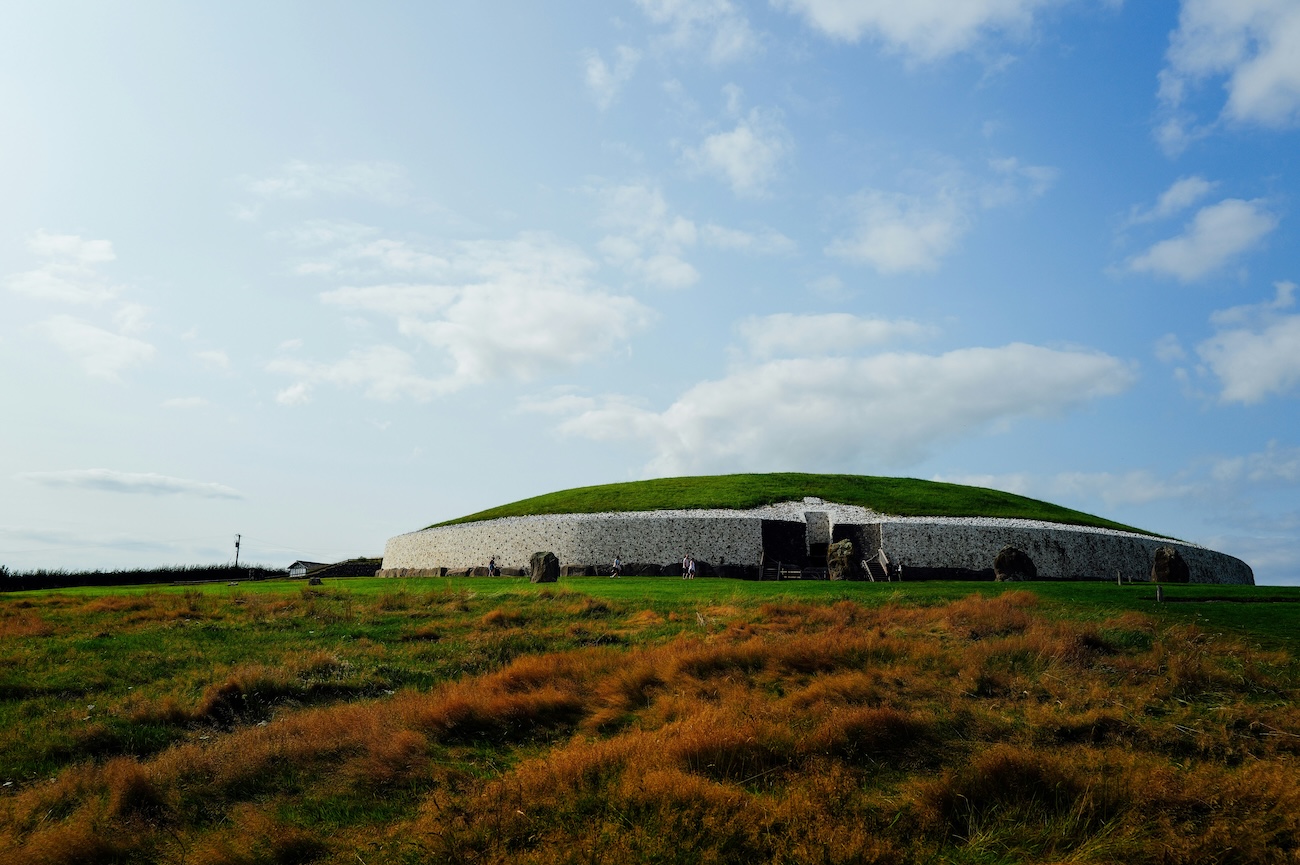
The mound was raised around 3200 BC, roughly five thousand two hundred years ago, by the Neolithic farming communities of the Boyne Valley. It is a great circular dome of earth and stone about 280 feet across, ringed at its base by 97 massive kerbstones, several of them carved with the swirling abstract art of the period. The scale of the thing is the first clue to the society that built it: assembling a monument this size, with stones hauled from miles away, demanded careful planning, sustained organization, and the coordinated labor of a large community over a long period. This was not the work of a handful of people in a single season. It was a generational project by a society capable of the kind of social organization usually associated with much later civilizations, accomplished by people working with stone, bone, and antler.
The Roof-Box and the Engineering of a Solar Instrument
The genius of Newgrange is in its precision. A passage about 62 feet long runs from the entrance into a cruciform chamber at the heart of the mound, roofed by a corbelled vault — overlapping stones rising to a single capstone — that has remained intact and watertight for over five thousand years, without mortar, a feat of dry-stone engineering that modern builders still admire. Above the entrance sits the roof-box, the deliberate slot that admits the solstice light. The builders aligned the entire structure to the southeast, toward the point on the horizon where the sun rises at midwinter, and calibrated the roof-box so precisely that the beam reaches the chamber floor only in the days around the solstice. To achieve this without writing, without metal instruments, and without any of the mathematical apparatus we associate with astronomy, the builders must have observed the sun across many years, marked its extremes, and then encoded that knowledge permanently into stone. Newgrange is not merely a tomb that happens to face the sunrise. It is an instrument, built to measure and capture a single moment in the solar year.
The People We Lost: Who Actually Built Newgrange
The hardest thing to hold in the mind at Newgrange is the gap between how much we know about the building and how little we know about the builders. We can date the mound, map the passage, measure the alignment to the minute, and describe the carving on the stones. We cannot say what language these people spoke, what they called their dead, what they believed happened to the light when it left the chamber, or why the solstice mattered enough to organize a society around it. They are present in everything they made and absent in everything they thought.
Stone Age Farmers, No Metal, No Writing
The builders of Newgrange were Neolithic farmers, people who had brought agriculture to Ireland and lived by their crops and herds in the Boyne Valley. They worked entirely in stone, wood, bone, and antler, with no metal of any kind, and they left no written record because writing did not yet exist in their world. Everything they achieved at Newgrange was accomplished with muscle, rope, timber, and an accumulated knowledge passed down by speech and demonstration. The largest of the kerbstones weigh several tons, and some of the stone used in the monument was transported from many miles away, hauled overland and possibly by water to the building site. The people who did this hauling left no monuments to themselves as individuals — no tombs of named kings, no inscriptions of triumph — only the collective achievement of the mound, raised by the anonymous labor of a community that has otherwise dissolved entirely into time.
The DNA in the Chamber: A Clue to a Vanished Society
In 2020, a study of ancient DNA opened a startling window into that vanished society. Researchers analyzed the remains of an adult man whose bones had been placed in the chamber at Newgrange, and found something that stopped them cold: the man was the product of a first-degree incestuous union, meaning his parents were either siblings or parent and child. In almost every human society, such unions are subject to the most powerful of taboos, and they are broken systematically in only one well-documented context — among ruling dynasties who consider themselves so far above ordinary people, often divine, that they may only marry within their own bloodline, as the pharaohs of Egypt and the royal houses of the Inca later would. The discovery suggests that the people who built Newgrange may have had a ruling elite of god-kings, a hereditary dynasty set apart from the rest of society and buried with extraordinary ceremony inside the great mound. It is a single individual, and the conclusion is an inference rather than a proven fact, but it is the closest thing we have to a glimpse of the social order behind the monument — a hint that the labor of catching the sun was commanded by a class who believed themselves children of it.
The Druid Myth and the Gods of the Mound
Newgrange has been claimed by people who had nothing to do with building it, and untangling those claims is part of understanding the place. Two quite different layers of belief have attached themselves to the mound: a false historical claim that it was a Celtic or Druid temple, and a genuine body of ancient Irish mythology that grew up around it long after its builders were gone. The first is simply wrong. The second is one of the most beautiful surviving traditions of early Ireland.
Why Newgrange Is Not Celtic or Druid
The popular association of Newgrange with the Celts and their Druid priests is a chronological impossibility. The mound was built around 3200 BC. The Celtic peoples and their culture did not arrive in Ireland until roughly 2,500 years later, by which time Newgrange had already been standing, and for much of that time lying overgrown and partially collapsed, for longer than the entire span of recorded history since. The Druids never worshipped here in any meaningful sense; they arrived to find an ancient, mysterious mound whose origins were already lost. The misattribution is the same instinct that operated at Externsteine in Germany, where a later age assigned an ancient sacred meaning to a site to suit its own story — except that at Newgrange the later arrivals were not fabricating a lie so much as honestly mistaking a monument they had inherited but not made. The error has proved nearly impossible to dislodge, because “ancient Celtic temple” is a more familiar story than “structure built by a people we cannot name.”
The Tuatha Dé Danann and the Fairy Mound
The genuine mythology that grew around Newgrange is richer than the false one. In early Irish tradition, the mounds of Brú na Bóinne were the dwellings of the Tuatha Dé Danann, the supernatural race of gods and ancestors who were said to have retreated into the síde — the fairy mounds — when mortals took the surface of Ireland. Newgrange was held to be the home of the Dagda, the great father-god of the old Irish pantheon, and later of his son Aengus, the god of youth and love, who in legend won the mound from his father through a trick of words. To the people of early medieval Ireland, the great mound in the Boyne was not a tomb but a doorway, a place where the boundary between the human world and the otherworld of the gods and the dead wore thin. This is the tradition that earns Newgrange its place among Ireland’s sacred landscapes — not a Druid altar, but a fairy palace, the house of gods who had themselves inherited a structure older than memory. Even the mythology of the mound is a story about a vanished people, told by those who came after.
Rediscovery and Restoration: The Tomb That Came Back
For most of recorded history, Newgrange was a forgotten hill. The passage was sealed, the mound was overgrown, and the monument that had once caught the solstice sun was indistinguishable from a natural rise in the landscape, its purpose entirely lost. Its return to human attention began by accident in 1699, when a local landowner named Charles Campbell, quarrying the mound for stone, had his labourers dig into it and uncover the entrance and the passage within. The discovery drew the curiosity of antiquarians, but for centuries the site was treated as a curiosity rather than a wonder, its true age and function unrecognized.
The transformation of Newgrange into one of the understood marvels of the ancient world came only in the twentieth century, through the excavations led by the archaeologist Michael O’Kelly between 1962 and 1975. It was O’Kelly who, acting on local tradition that the sun entered the tomb, stood inside the chamber at dawn on the winter solstice of 1967 and became the first person in modern times to witness the beam of light come down the passage exactly as the builders had intended — confirming that the alignment was real and deliberate, not folklore. His excavation also produced the monument’s most debated feature: the striking white quartz façade that now faces the entrance, a reconstruction by O’Kelly’s team based on quartz stones found fallen around the entrance. Whether the original builders ever raised such a wall, and whether it looked as the reconstruction suggests, remains contested among archaeologists, and the bright modern frontage is the one part of Newgrange that visitors are right to regard with some skepticism. The light through the roof-box is genuine. The gleaming white wall is a twentieth-century interpretation.
Visiting Newgrange Today: The Solstice Lottery and the Brú na Bóinne Tour
Newgrange can be visited only through the Brú na Bóinne Visitor Centre near Donore in County Meath, and only on a guided tour, with a shuttle bus carrying visitors from the centre to the monument itself. Pre-booking is essential and the tours sell out, particularly in summer; there is no direct access or parking at the mound, and photography is not permitted inside the passage or chamber, where the space is genuinely tight and the corbelled roof of the builders presses close overhead. The standard tour includes a simulation of the solstice event, in which the guide extinguishes the lights and recreates the creeping beam, so that every visitor can experience a version of the seventeen minutes the monument was built for.
Witnessing the real thing is a matter of extraordinary luck. Access to the chamber for the actual solstice sunrise, over the mornings of 19 to 23 December, is decided by a public lottery — in a recent year, more than 16,000 people applied for around 38 places, with the winners drawn by children from local primary schools, a touch that keeps the event rooted in the community that lives beside the mound. For everyone else, the Office of Public Works now livestreams the solstice sunrise from inside the chamber, allowing the world to watch the five-thousand-year-old beam arrive in real time.
Standing in the chamber, even in the dark of an ordinary day, the visitor is inside a machine built to catch a sunrise by people whose names, language, and gods are lost beyond recovery. The achievement is overwhelming and the silence around its makers is total. Newgrange asks the hardest question any ancient place can ask: not what happened here, which we largely know, but who these people were, which we never will. They aimed a building at the sun with a precision that still works after five thousand years, and then they vanished, leaving the light to keep their appointment long after everyone who understood why had turned to dust in the chamber they built.
Frequently Asked Questions About Newgrange
How old is Newgrange and is it older than the pyramids?
Newgrange was built around 3200 BC, making it roughly 5,200 years old. This makes it older than the Great Pyramid of Giza, which was built around 2560 BC, and older than the main stone construction at Stonehenge. It is one of the oldest surviving structures of its kind in the world. The monument predates the arrival of metal tools, writing, and the wheel in Ireland.
What happens at Newgrange during the winter solstice?
At sunrise on the winter solstice, a beam of sunlight enters Newgrange through a specially built opening above the entrance called the roof-box. The light travels about 62 feet down the passage and illuminates the inner chamber for roughly 17 minutes before withdrawing. The monument was deliberately aligned to the southeast to capture this midwinter sunrise. The event occurs over several mornings around December 21st each year.
Was Newgrange built by the Celts or Druids?
Newgrange was not built by the Celts or Druids. It was constructed around 3200 BC by Neolithic farming communities, roughly 2,500 years before Celtic culture arrived in Ireland. By the time the Celts and their Druid priests existed, Newgrange was already an ancient, overgrown ruin whose origins had been lost. The popular association with Druids is a historical error, though genuine later Irish mythology did connect the mound to the gods of the Tuatha Dé Danann.
Who is buried at Newgrange?
Newgrange is a passage tomb that held cremated and unburnt human remains in its inner chamber. A 2020 study of ancient DNA from an adult man buried there found that he was the product of a first-degree incestuous union, a practice historically associated with ruling dynasties who considered themselves divine. This has led researchers to suggest the builders may have had a hereditary ruling elite. The full identity and social structure of those buried there remain largely unknown.
How do you get tickets to see the Newgrange solstice?
Access to the Newgrange chamber for the actual winter solstice sunrise is decided by a public lottery held each autumn. In a recent year, over 16,000 people applied for around 38 available places, with winners drawn by local schoolchildren. For those who do not win, the Office of Public Works livestreams the solstice sunrise from inside the chamber. The standard guided tour, available year-round, includes a simulation of the solstice illumination.
Can you visit Newgrange year-round?
Newgrange can be visited year-round, but only through the Brú na Bóinne Visitor Centre near Donore, County Meath, and only by guided tour. A shuttle bus brings visitors from the centre to the monument, and pre-booking is essential as tours sell out, especially in summer. There is no direct access or parking at the monument itself. Photography is not permitted inside the passage or chamber.
Sources
Newgrange: Archaeology, Art and Legend — Michael J. O’Kelly (1982)
A Cohort of Individuals with Elite Status at Neolithic Newgrange — Lara Cassidy et al., in Nature (2020)
Newgrange: Monument to Immortality — Anthony Murphy (2012)
The Boyne Valley Vision — Martin Brennan (1980)
Brú na Bóinne World Heritage Site Documentation — UNESCO World Heritage Centre
Excavations at Newgrange, 1962-1975 — Michael J. O’Kelly, Royal Irish Academy
Astronomy and Ritual in the Irish Neolithic — Clive Ruggles, in Archaeoastronomy
The Tuatha Dé Danann and the Mythological Cycle — early Irish literature (various editions)