The Last Radio Transmission from Playa Girón
On the morning of April 19, 1961, José "Pepe" San Román crouched in the sand at Playa Girón with a radio pressed to his ear and no ammunition left to distribute. He had not slept in three days. Soviet-made T-34 tanks were grinding down the narrow causeways toward the beach, and the Cuban Air Force's surviving jets were strafing anything that moved on the shoreline. San Román's brigade — 1,400 men who had been told they were the vanguard of a national liberation — was pinned between the Caribbean Sea and the largest swamp in the Caribbean. There was nowhere to go.
His final transmissions to the American destroyer USS Eaton, hovering just beyond the horizon, were logged by Navy radio operators. They shifted from tactical — requesting air cover, coordinates for resupply — to raw. "We are out of ammo and fighting on the beach. Please send help. We cannot hold." The American ships could see the smoke rising from the bay. They did not come. San Román gave his last order: scatter into the Zapata Swamp. Then he walked toward the approaching Cuban soldiers with his hands up.
The Bay of Pigs invasion is the definitive case study in what happens when institutional overconfidence meets physical reality. Men in air-conditioned offices in Virginia designed a war for a landscape they had never touched, against an enemy they fundamentally underestimated, and then abandoned the men they sent to fight it. Every element of the plan depended on assumptions that turned out to be wrong: that Castro's air force could be destroyed in a single strike, that the Cuban people would rise up against their government, that the president would commit American firepower when the plan started to fail. The Bay of Pigs did not collapse because of bad luck. It collapsed because the people who designed it confused their own confidence for evidence.
Why the CIA Planned to Invade Cuba
Castro's Revolution and the End of American Control
Fidel Castro's guerrillas descended from the Sierra Maestra mountains in January 1959 and swept the dictator Fulgencio Batista from power in a matter of weeks. Washington's initial reaction was cautious curiosity. Within months, it was alarm. Castro nationalized American-owned oil refineries, seized millions of acres of sugar plantation land controlled by the United Fruit Company, and began executing Batista-era officials at La Cabaña Fortress in Havana — trials broadcast on live television to cheering crowds. By the time he signed a trade agreement with the Soviet Union in February 1960, the CIA had already concluded that the revolutionary government could not be allowed to survive. A communist state 90 miles from Florida was not a diplomatic inconvenience. To the men at Langley, it was an existential threat — a potential Soviet aircraft carrier in the Caribbean, a base for subversion across Latin America. The question was never whether the United States would act. It was how to do it without starting a third world war.
How Brigade 2506 Was Built in the Guatemalan Jungle
The CIA's answer was a proxy army. Throughout 1960, agency recruiters moved through Miami's Cuban exile community — the lawyers, doctors, students, and former military officers who had fled Castro's revolution — and assembled a paramilitary force of roughly 1,400 men. They called it Brigade 2506, named after the serial number of a recruit who had died during training. The men were transported to a secret base in the volcanic highlands of Retalhuleu, Guatemala, codenamed JMTRAX, where American instructors drilled them in amphibious landings, paratrooper operations, and guerrilla tactics.
The brigade's political leader was Manuel Artime, a 28-year-old psychiatrist who had initially supported Castro's revolution before turning against it when the government began executing political opponents. Artime had escaped Cuba hidden in the trunk of a car, made his way to the United States, and convinced the CIA that he could serve as the political face of the invasion — a young, articulate, anti-communist Cuban who would lead a provisional government the moment the beachhead was secured. He believed, because the CIA told him so, that once the brigade landed, the Cuban military and civilian population would rise up and join them. The Americans called it a "catalyst" operation. Light the match, and the whole island burns. Artime staked his life on that promise.
Operation Zapata and the Fatal Compromises
The Tactical Design of the Bay of Pigs Invasion
The plan looked clean on the drafting tables in Virginia. The Bay of Pigs — a shallow inlet on Cuba's southern coast, flanked by the vast Zapata Swamp — was chosen for its isolation. CIA planners believed the remoteness would give the brigade enough time to establish a beachhead, declare a provisional government, and secure international recognition before Castro could mobilize a response. The operation had three interlocking components: a series of pre-emptive air strikes to destroy the Cuban Air Force on the ground, a nighttime amphibious landing at two beaches (Playa Girón and Playa Larga), and a paratrooper drop to seize the three narrow causeways that were the only roads through the swamp.
The logic rested on controlling those causeways. If the brigade held the bottlenecks, Cuban tanks and infantry couldn't reach the beach. The invaders could sit behind the swamp's natural barrier indefinitely while the world decided which Cuban government to recognize. On paper, the Zapata Swamp was a defensive fortress. In reality, it was a trap. The swamp is a prehistoric landscape of peat bogs, mangrove thickets, and limestone sinkholes — nearly impassable for infantry and completely impenetrable to heavy vehicles. If the brigade couldn't break out of the swamp, they'd be pinned against the sea with no retreat and no resupply.
Kennedy's Cancellation of the Air Strikes
The plan's fatal weakness was political, not tactical. President John F. Kennedy, who inherited the operation from Eisenhower, was obsessed with maintaining "plausible deniability" — the fiction that the invasion was a purely Cuban affair with no American involvement. This obsession crippled the operation before it began.
The first round of air strikes launched on April 15, two days before the invasion. Eight B-26 bombers — old American planes repainted with Cuban Air Force markings to look like they'd been flown by defecting pilots — hit Cuban airfields at Ciudad Libertad, San Antonio de los Baños, and Santiago de Cuba. The strikes destroyed some aircraft but left several of Castro's T-33 jet trainers and British-made Sea Fury fighters intact. CIA Director Allen Dulles and operations chief Richard Bissell had assured Kennedy that a second wave of strikes would finish the job. Kennedy cancelled it. The reason was diplomatic: at the United Nations, Cuba's foreign minister was denouncing the strikes as American aggression, and the cover story about defecting pilots was already falling apart. Kennedy feared that continued air attacks would make the fiction unsustainable and trigger a confrontation with the Soviet Union.
That single decision — made in a White House meeting room while brigade members were loading onto transport ships in Nicaragua — sealed the fate of 1,400 men. The Cuban Air Force would survive. And it would be the planes, not the tanks, that destroyed the invasion.
The 72-Hour Battle at Playa Girón
The Coral Reefs That Destroyed the Landing Craft
The invasion began just after midnight on April 17, 1961, and unraveled within minutes. CIA frogmen slipped into the water ahead of the main force to mark the landing zones with signal lights. What they found in the shallows stopped them cold. The dark patches that CIA photo analysts had identified on U-2 spy plane imagery — classified as seaweed, soft vegetation that landing craft could glide over — were ancient coral formations. Razor-sharp limestone ridges, some just inches below the surface, stretched across the approach to both beaches.
The first landing craft to reach Playa Girón scraped across the reef and stalled. Engines choked with coral debris. Hulls split open. Men carrying 80 pounds of equipment were forced to jump into chest-deep water in the dark, the reef edges slicing through boots and fatigues as they waded toward shore. Radios, ammunition crates, and medical supplies went into the water. At Playa Larga, the situation was worse — a local militia patrol spotted the signal lights and immediately radioed Havana. The element of surprise, the single advantage the brigade possessed, evaporated before the first soldier stepped onto dry sand.
The reef intelligence failure was not a minor miscalculation. It was a symptom of the operation's core disease: the CIA had planned an amphibious invasion of a coastline it had studied only from 70,000 feet. No one in the planning chain had set foot on the beach, sampled the water, or consulted anyone who had.
Castro's Counterattack and the Sinking of the Supply Ships
Fidel Castro learned of the landing within hours and understood immediately that the survival of his revolution depended on the next 48 hours. He did not delegate. He drove to the Australia sugar mill, a few kilometers from the beachhead, and set up a forward command post. From there, he personally directed the counterattack by radio — ordering T-34 tanks down the causeways, mobilizing 20,000 militia troops, and coordinating the air strikes that would break the invasion.
The Cuban Air Force struck at dawn on April 17, and its pilots went straight for the jugular — not the men on the beach, but the supply ships anchored offshore. The Houston, carrying an entire infantry battalion and critical ammunition reserves, took a direct hit from a Sea Fury rocket and began listing. Its captain ran the ship aground on the western shore of the bay to save the crew, but the battalion's heavy weapons and supplies sank with the hull. Hours later, a T-33 jet caught the Rio Escondido in open water. The Rio Escondido was carrying ten days' worth of ammunition, the brigade's communications equipment, aviation fuel for the B-26s, and the field hospital supplies. A single rocket hit the fuel stores. The ship detonated in a fireball visible from 50 miles away.
In one morning, Brigade 2506 lost its ammunition reserve, its fuel supply, its communications gear, and its medical equipment. The men on the beach were now fighting with what they carried on their backs.
The Final Stand and the American Pilots Who Died in Secret
By the morning of April 19 — 60 hours into the invasion — the brigade was being squeezed from three directions. Castro's tanks had pushed through the causeway defenses. Artillery shells were landing on the beach. The men had been awake for three days, rationing their last magazines.
Erneido Oliva, the brigade's deputy commander, led the rearguard defense at the San Blas crossroads, holding the eastern causeway against advancing armor with a handful of men and a few remaining bazookas. Oliva, a former Cuban army officer who had refused to serve under Castro, fought a textbook delaying action — falling back position by position, buying time for the rest of the brigade to attempt an evacuation that would never come. His defense at San Blas is one of the few purely tactical successes of the entire operation.
The most closely guarded secret of the invasion came in these final hours. Four American pilots from the Alabama Air National Guard — volunteers flying under CIA contract — climbed into B-26 bombers for an unauthorized combat sortie over the bay. Thomas "Pete" Ray and Leo Francis Baker were shot down over Cuba. Ray survived his crash landing and was killed in a firefight with Cuban militia near the wreckage of his plane. Baker's aircraft was hit over the bay and went into the water. The United States government denied their existence for decades. Ray's body was kept in a Havana morgue freezer for 18 years before it was returned to his family. The CIA did not officially acknowledge its American combat dead from the Bay of Pigs until 1979.
Kennedy, in a last gesture, authorized six unmarked Navy jets from the USS Essex to provide one hour of air cover for a final evacuation attempt. A confusion between the jets' time zone (Eastern) and the B-26s' time zone (Nicaraguan) meant the fighters arrived over the bay an hour after the bombers had already been shot down. The cover never materialized. San Román gave the order to scatter. Of the 1,400 men who had landed 72 hours earlier, 114 were dead and 1,189 would be captured within days.
What Happened to the Bay of Pigs Prisoners
The 20-Month Captivity and the $53 Million Baby Food Ransom
Castro put the prisoners on national television. In a remarkable piece of political theater broadcast across Latin America, the captured brigade members were seated in a Havana auditorium while Castro himself interrogated them — asking each man his profession, his reason for fighting, his feelings about the revolution. The spectacle served its purpose: it humiliated the United States and reinforced Castro's image as a leader who had faced down a superpower.
The 1,189 prisoners spent 20 months in Cuban jails. Many were held at La Cabaña Fortress, the same colonial-era military prison where Castro's government had executed Batista loyalists two years earlier. The conditions were harsh — overcrowding, limited food, psychological pressure — but Castro recognized that the prisoners were more valuable alive than dead. They were leverage.
The ransom negotiations that followed were extraordinary even by Cold War standards. Castro initially demanded $28 million in cash, then shifted to a demand for $53 million worth of baby food, pharmaceuticals, and medical equipment — a number calculated to match the economic damage he claimed the invasion had caused. Attorney James B. Donovan, the same lawyer who had negotiated the release of U-2 pilot Francis Gary Powers from the Soviet Union, brokered the deal. The last prisoners flew back to Miami on December 24, 1962. Five days later, Kennedy addressed the returned brigade at Miami's Orange Bowl stadium. Standing before a crowd of 40,000, he accepted the brigade's battle flag and made a promise: "I can assure you that this flag will be returned to this brigade in a free Havana." It never was. The flag sits today in the John F. Kennedy Presidential Library in Boston.
How the Bay of Pigs Invasion Led to the Cuban Missile Crisis
The invasion's most dangerous consequence played out 18 months later. Soviet Premier Nikita Khrushchev watched the Bay of Pigs unfold and drew a specific conclusion: Kennedy was young, indecisive, and unwilling to commit American military power when it mattered. Castro, shaken by how close the invasion had come to his capital, demanded Soviet military protection against what he was certain would be a second, larger American attack.
Khrushchev obliged. In the summer of 1962, Soviet ships began delivering medium-range nuclear missiles to Cuba — weapons capable of reaching Washington, D.C. in thirteen minutes. The direct causal chain runs from the cancelled air strikes over Playa Girón to the thirteen days in October 1962 when the world came closer to nuclear war than at any other point in history. The Bay of Pigs did not just humiliate the CIA. It nearly ended civilization. Soviet military infrastructure from that crisis — gun emplacements, tunnels, and coastal batteries — can still be seen at the Hotel Nacional de Cuba overlooking Havana's Malecón, and the broader architecture of Cold War escalation played out simultaneously at flashpoints like Checkpoint Charlie in divided Berlin, where the same superpower brinkmanship was measured in meters rather than miles.
Visiting the Bay of Pigs Battlefield Today
The Museo de Playa Girón and the Battlefield Memorials
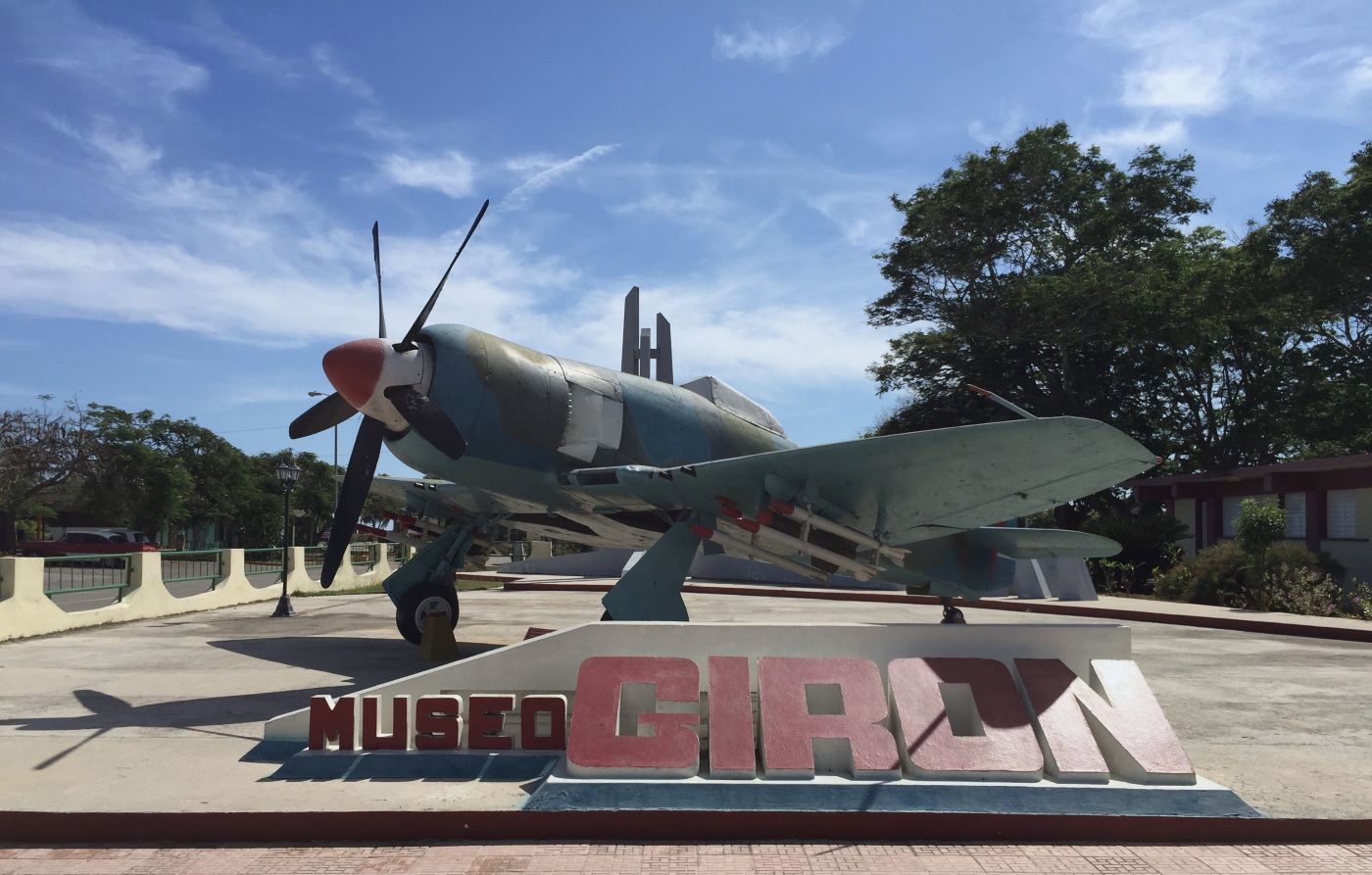
The Bay of Pigs sits on Cuba's southern coast in the Matanzas province, roughly three hours by car from Havana. The primary destination is the Museo de Playa Girón, located in the village at the eastern end of the bay. A British-made Sea Fury fighter — the same type that sank the brigade's supply ships — sits outside the entrance alongside a Soviet T-34 tank. Inside, the exhibits tell the story entirely from the Cuban perspective: captured American weapons, blood-stained militia uniforms, large-format battle maps, and photographs of Castro directing the counterattack from the Australia sugar mill. The narrative is deeply partisan, but the physical artifacts are genuine and the tactical detail is meticulous.
The drive into the bay passes through the Zapata Swamp on the same narrow causeways that Castro's tanks used to reach the beachhead. Roadside billboards punctuate the route — faded propaganda murals declaring "Playa Girón: La Primera Derrota del Imperialismo Yanqui en América Latina" (The First Defeat of Yankee Imperialism in Latin America). Small concrete memorials mark the spots where Cuban militia members were killed during the fighting. Visitors can stay in local casas particulares in Playa Girón or Playa Larga, and guided tours of the battlefield sites are available through the museum.
Diving the Invasion Reefs and the Zapata Swamp
The coral reefs that destroyed the CIA's landing craft are now one of the Caribbean's premier dive sites. Punta Perdiz, a few kilometers east of Playa Girón, offers wall dives along the same reef line that shredded the brigade's boats — the limestone formations are still sharp, still unforgiving, and now teeming with parrotfish, barracuda, and elkhorn coral. Cueva de los Peces, a 70-meter-deep flooded tectonic sinkhole a short drive from the beach, is a freshwater cenote connected to the sea by underground caves, surrounded by the same dense scrubland the brigade's survivors tried to disappear into.
The Zapata Swamp itself is a UNESCO Biosphere Reserve and Cuba's largest protected wetland — home to the Cuban crocodile, the bee hummingbird (the world's smallest bird), and over 175 species of birds that draw naturalists from around the world. The landscape has changed remarkably little since 1961. The peat bogs are still impassable. The causeways are still the only roads. The geography that trapped Brigade 2506 is now the ecosystem's greatest protection, keeping development and heavy tourism at bay. The reefs that wrecked an invasion now sustain a marine sanctuary. The swamp that was supposed to be a fortress became one — just not for the army the CIA intended.
Frequently Asked Questions About the Bay of Pigs
Can you visit the Bay of Pigs invasion site in Cuba today?
The Bay of Pigs is open to visitors and sits roughly three hours south of Havana by car in the Matanzas province. The main historical site is the Museo de Playa Girón, which displays captured American weapons, Cuban militia uniforms, battle maps, and a British-made Sea Fury fighter jet and Soviet T-34 tank outside the entrance. The surrounding area offers casas particulares for accommodation, guided battlefield tours, and access to the Zapata Swamp. The region is also one of Cuba's top diving and ecotourism destinations.
Why did the Bay of Pigs invasion fail?
The invasion failed because of a chain of compounding errors, not a single mistake. CIA photo analysts misidentified coral reefs as seaweed, shredding the landing craft on arrival. President Kennedy cancelled the second wave of air strikes to maintain plausible deniability, leaving Castro's air force intact to sink the brigade's supply ships. The CIA's core assumption — that the Cuban population would spontaneously rise up against Castro — proved entirely wrong. The brigade was stranded on a beach with no ammunition, no air cover, and no popular support, pinned against the sea by a swamp that made retreat impossible.
How many people died in the Bay of Pigs invasion?
Brigade 2506 suffered 114 killed in action during the 72-hour battle. Cuban military and militia casualties are estimated at approximately 161 dead, though exact figures vary between sources. An additional 1,189 brigade members were captured and held in Cuban prisons for 20 months before being ransomed back to the United States. Four American pilots flying under CIA contract were also killed — a fact the US government concealed for nearly two decades.
What happened to the Bay of Pigs prisoners after the invasion?
The 1,189 captured brigade members were imprisoned in Cuba for 20 months, many of them held at La Cabaña Fortress in Havana. Castro televised their interrogation as political theater. Attorney James B. Donovan negotiated their release in exchange for $53 million worth of baby food, pharmaceuticals, and medical equipment. The last prisoners returned to Miami on December 24, 1962. President Kennedy addressed them at Miami's Orange Bowl five days later, promising to return their battle flag "in a free Havana" — a promise that was never fulfilled.
How did the Bay of Pigs lead to the Cuban Missile Crisis?
Soviet Premier Nikita Khrushchev interpreted the invasion's failure — and Kennedy's refusal to commit American military force — as evidence that the young president was indecisive. Castro, convinced a second and larger American invasion was imminent, demanded Soviet military protection. Khrushchev responded by secretly deploying medium-range nuclear missiles to Cuba in the summer of 1962, triggering the October crisis that brought the world closer to nuclear war than at any other point in history. The direct causal line from the Bay of Pigs to the missile crisis is one of the most consequential sequences in Cold War history.
Were any Americans killed during the Bay of Pigs invasion?
Four American pilots from the Alabama Air National Guard died during the invasion. Flying B-26 bombers under CIA contract, they launched unauthorized combat sorties over the bay in the final hours of the battle. Thomas "Pete" Ray was shot down, survived the crash, and was killed in a firefight with Cuban militia. Leo Francis Baker's aircraft was hit over the bay. The US government denied their involvement for decades. Ray's body was kept in a Havana morgue freezer for 18 years before being returned to his family in 1979.
Sources & References
- Bay of Pigs Invasion Collection — CIA Freedom of Information Act Electronic Reading Room (2016)
- The Bay of Pigs Invasion: Milestones in U.S. Foreign Relations — U.S. Department of State, Office of the Historian
- The Bay of Pigs — John F. Kennedy Presidential Library and Museum
- Inspector General's Survey of the Cuban Operation (Kirkpatrick Report) — CIA Inspector General, Lyman Kirkpatrick (1961, declassified 1998)
- Decision for Disaster: Betrayal at the Bay of Pigs — Grayston L. Lynch (2000). Lynch was a CIA paramilitary officer who led the first frogman team onto the beach.
- Bay of Pigs: The Untold Story — Peter Wyden (1979). Definitive account drawing on interviews with brigade members, CIA officers, and Cuban military commanders.
- The Brilliant Disaster: JFK, Castro, and America's Doomed Invasion of Cuba's Bay of Pigs — Jim Rasenberger (2011)
- Brigade 2506: The Exile Perspective — National Archives, Prologue Magazine (2001)
- Cold War International History Project: Bay of Pigs — The Wilson Center Digital Archive
- Ciénaga de Zapata Biosphere Reserve — UNESCO Man and the Biosphere Programme
- Thomas W. Ray: Alabama Air National Guard — U.S. Air Force Historical Records (declassified personnel files)