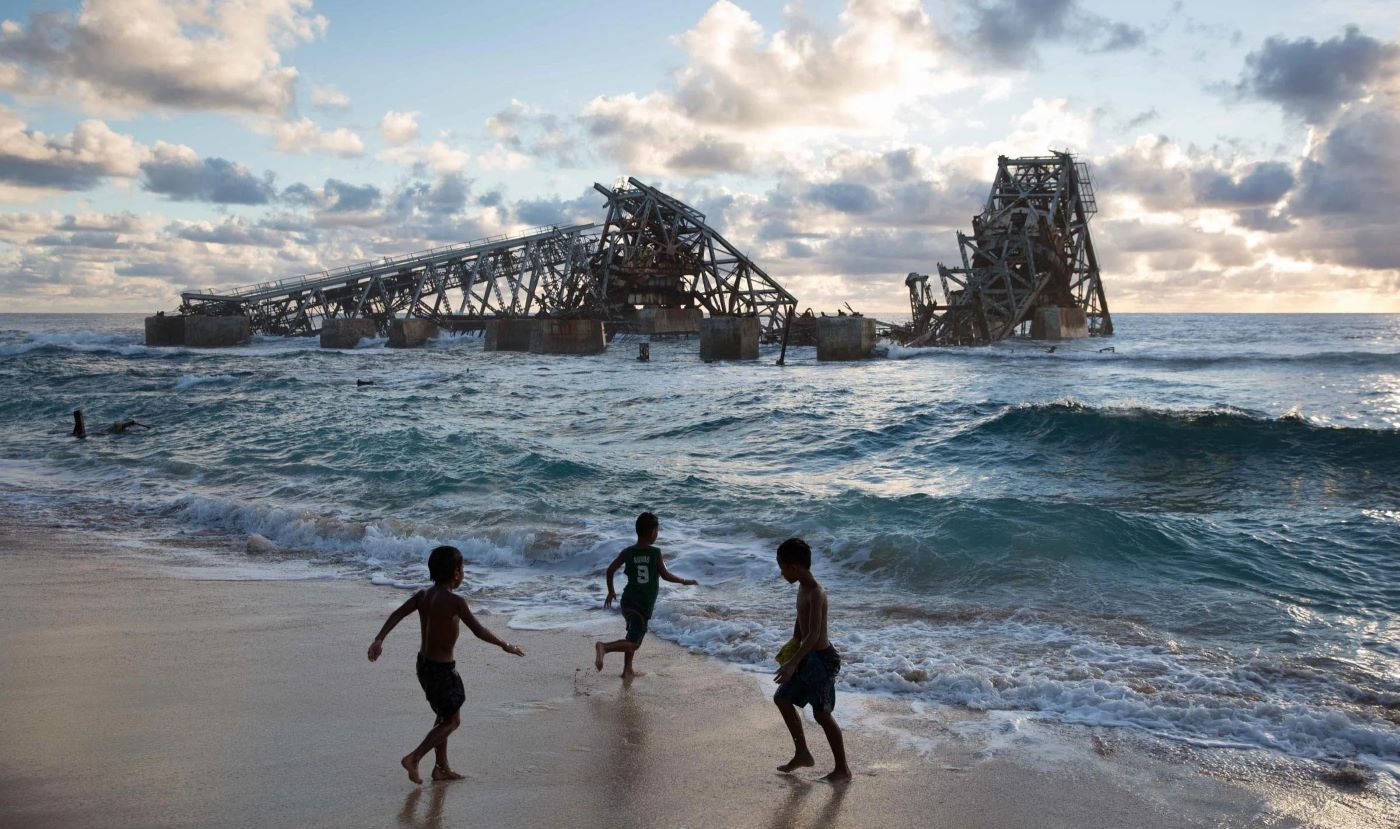
The Boeing That Left and Never Came Back
In December 2005, a team of repossession agents arrived on Nauru to collect the Republic's last remaining Boeing 737. Air Nauru — the national airline of a country smaller than most airports — had once operated nine aircraft serving destinations across the Pacific. The fleet had been sold off, one plane at a time, to cover debts the government could not service. This was the last one. The agents came because General Electric, which held a A$236 million consolidation loan the Nauruan government had defaulted on, had run out of assets to seize. The Melbourne high-rise was gone. The international real estate portfolio was gone. The bank had collapsed. The airline was, functionally, the final liquid asset of a sovereign nation. The plane flew out. Nobody on Nauru could stop it.
Fifteen years earlier, this same country had held an estimated A$2.5 billion in accumulated wealth — more than A$500,000 for every man, woman, and child on the island. The money came from the same place everything on Nauru came from: the ground. Phosphate rock, millions of years in the making, dug up in less than a century and shipped to the farms of Australia, New Zealand, and Japan. The wealth was real while it lasted. The problem was that the ground was finite, the investments were reckless, and nobody with authority over the fund had ever managed money before. Nauru is the finished product of a process that began with a rock sitting in a Sydney office in 1899 and ended with an island that had consumed the earth beneath its own people's feet. Every stage — colonial extraction, post-independence mismanagement, financial ruin, and finally the sale of the island's sovereignty to a larger neighbour — followed with the logic of a controlled demolition. The remarkable thing is not that it happened. The remarkable thing is how completely it happened, and how little the world noticed until there was almost nothing left to notice.
Nauru Before Phosphate: Indigenous History and Early Contact
Nauru exists because seabirds needed somewhere to land. For millions of years, migratory species crossing the Pacific stopped on this coral outcrop, and their accumulated guano calcified into the earth, creating deposits of phosphate rock of extraordinary purity. Phosphate is the key ingredient in agricultural fertiliser. The rest of the twentieth century follows from that basic geological fact.
Micronesians settled the island approximately 3,000 years ago. By the time British captain John Fearn sighted Nauru in 1798 — naming it Pleasant Island, a designation that would not age well — its 12 clans had developed a language found nowhere else on Earth, a sophisticated aquaculture system using the island's interior lagoon, and a social structure built around matrilineal descent. European contact delivered the standard colonial package: alcohol, firearms, and a decade-long civil war beginning in 1878 that reduced the population from roughly 1,400 to around 900. Germany annexed the island in 1888, arriving with 36 marines, placing the 12 chiefs under house arrest until the raising of the Imperial flag, and confiscating 765 guns within 24 hours. A German administrator named Robert Rasch married a 15-year-old Nauruan girl and became the island's first colonial governor. Nauru was a dot on a map that nobody cared about, and the Germans cared least of all.
That changed because of a doorstop.
Albert Ellis and the Discovery of Nauru's Phosphate Deposits
In 1896, a cargo officer named Henry Denson, working for the Pacific Islands Company aboard a vessel called the Lady M, picked up a peculiar-looking rock on Nauru during a brief stopover. He believed it was petrified wood. He took it back to the company's Sydney office, where it sat for three years as a doorstop.
In 1899, Albert Fuller Ellis, a management official in the company's phosphate division, was transferred to the Sydney office to analyse rock samples from the Pacific. Something about the doorstop caught his attention. Three months after his transfer, he had it tested. It was phosphate ore of the highest quality. Ellis traced it to Nauru, then to the neighbouring island of Banaba, and the Pacific Phosphate Company immediately moved to secure extraction rights. By 1906, an agreement was in place with Germany. By 1907, the first ships were loading. The island that nobody had cared about was suddenly the most valuable piece of rock in the Pacific.
Phosphate Mining Under Colonial Rule: The British Phosphate Commission
For the next six decades, Nauru functioned as a mine with an island attached. The population was not removed — they were simply left in place while the island around them was extracted.
After the First World War, Nauru was stripped from Germany and placed under a League of Nations mandate administered jointly by Australia, the United Kingdom, and New Zealand. The British Phosphate Commission took over extraction. The arrangement was efficient and cynical in equal measure: the three administering powers paid Nauruan landowners well below market rate for their rock, kept 98% of revenues, and allocated 2% — two cents in every dollar — back to the people whose island it was. By 1948, annual revenue from phosphate mining was A$745,000. Nauru received A$14,900 of it.
The phosphate fed Australian and New Zealand farmland. It was, in the most literal possible sense, a transfer of one island's geological inheritance to enrich the agricultural land of two much larger ones. The structure was not unique to Nauru — across the Pacific, small islands were being hollowed out for the benefit of distant economies. Bikini Atoll was being irradiated for American nuclear tests. Hashima Island was being mined to exhaustion for Japanese coal. The pattern was always the same: extract until there is nothing left, then leave. By the 1960s, around 80% of Nauru's surface had been mined. The Australian government, recognising that the island was becoming uninhabitable, offered to relocate the entire Nauruan population to an island off the coast of Queensland. The Nauruans refused.
The Japanese Occupation of Nauru: 1942–1945
On 26 August 1942, Japanese forces occupied Nauru. They executed seven Europeans almost immediately, built two airfields using forced labour, and began trying to restart phosphate mining for their own agricultural needs. American bombers arrived in March 1943, targeting the airstrips, and the island spent the next two years being bombed by both sides of a war that had nothing to do with it.
In June and August 1943, the Japanese deported 1,200 Nauruans — roughly one in three of the entire population — to the Chuuk islands as forced labourers. The Nauruans were sent to Tarik, Tol, Fefan, and other atolls in the archipelago, where they were put to work excavating Japanese defensive positions and growing food for the garrison. The native Chuukese population treated the Nauruans as unwanted competitors for scarce resources. The Japanese treated them worse. Women were assaulted. There was no medical care. American bombing of Chuuk cut off food supplies; the Nauruans starved alongside their captors.
On 13 September 1945, Australian troops accepted the Japanese surrender on Nauru. Arrangements were made to return the deportees. On 31 January 1946, 737 Nauruans stepped off a ship and onto what remained of their island. Of the 1,200 who had been taken, 463 had died — one death every two days across the duration of the exile. Some of the returnees walked inland to check on their family land and found it stripped bare by mining that had continued in their absence.
The Nauruan government later chose 31 January as Independence Day, so that the anniversary of their return from Chuuk would be the birthday of their republic. The occupation had burned one understanding permanently into the national consciousness: what it meant to be a pawn in someone else's war on your own land. When Australia again offered to relocate them, the answer was the same. They wanted their island — whatever was left of it.
Nauru's Independence and the Phosphate Boom: 1968–1990s
Nauru became independent on 31 January 1968 and took control of its phosphate industry in 1970, purchasing the extraction rights from the British Phosphate Commission for A$21 million. For the first time, the Nauruan people owned what was under their feet.
The Richest Small Nation on Earth
What followed was extraordinary, at least on paper. Revenues from the Nauru Phosphate Corporation ran at A$100–120 million annually. The country accumulated an estimated A$2.5 billion in wealth by the early 1980s, translating to more than A$500,000 per person for a population of roughly 4,000. GDP per capita placed Nauru second in the world, behind only the United Arab Emirates. The government abolished income tax. It provided free housing, free healthcare, free education. Most Nauruans received royalty payments and had little practical need to work. The fishing boats were largely left to rot. The kitchen gardens were abandoned. The coconut palms went untended. A generation grew up in a welfare state funded by the slow removal of the ground beneath them.
The Nauru Phosphate Royalties Trust was established specifically to manage the island's future — to invest the windfall so that when the phosphate ran out, something would remain. The theory was sound. The execution was a disaster that would have been comic if it had not been so total.
How Nauru Lost A$2.5 Billion: Failed Investments and Financial Collapse
The trust's investment decisions across the 1980s and early 1990s would become a case study in how not to manage a sovereign wealth fund. The portfolio included luxury real estate in Melbourne, Sydney, Hawaii, Guam, Samoa, the Philippines, the United States, and the United Kingdom. Nauru House, a high-rise tower in Melbourne, became something of a symbol of the windfall years. There were hotel investments, aviation investments, and a series of ventures that bore little relationship to any coherent strategy.
The most infamous was the 1993 investment of A$4 million in a West End production called Leonardo the Musical: A Portrait of Love — a staging of the romantic life of Leonardo da Vinci that collapsed after weeks of bad reviews and closed without recovering its costs. It was not the largest loss in the trust's history. It was simply the most visible distillation of how the fund was being run: by people with access to enormous wealth, no financial expertise, and no accountability. The parallel with Fordlândia — where Henry Ford sank millions into a jungle rubber city built on total ignorance of local conditions — is structural. In both cases, the money was real, the ambition was genuine, and the competence was absent.
By the mid-1990s, the trust had taken on a A$236 million loan from General Electric to consolidate its other debts. When the government could not repay it, GE seized Nauru's international real estate portfolio, including Nauru House. Then came the Boeing. The Bank of Nauru went bankrupt. The Republic of Nauru Finance Corporation ceased operations. In the space of a few years, an island that had held half a billion dollars in assets was functionally insolvent, with a collapsed telecom system, no functioning bank, and an unemployment rate approaching 90%.
Nauru After Phosphate: The Topside and What Strip Mining Left Behind
The word Nauruans use for the mined interior is topside. Walk through it and the scale of what was extracted becomes physical. The coral pinnacles — sharp, unstable, up to 15 metres tall — cover approximately 80% of the island's land area. Between them, there is no soil. No organic matter. No root system. Just exposed limestone and the occasional introduced weed that has found a crack to grow in.
Researchers have concluded that meaningful soil regeneration will not occur on any human timescale, even after all mining activity ceases. The process that created the phosphate deposits took millions of years. The process that removed them took less than a century. The island's coastline, where the remaining population is now concentrated in a strip roughly 300 metres wide, is under active erosion. Nauru's average elevation is approximately seven metres above sea level. In a warming Pacific, this is not a comfortable margin.
Nauru's Money Laundering Era and International Blacklisting
In the late 1990s, facing bankruptcy and operating on Australian foreign aid, Nauru briefly rebranded as an offshore banking haven. The timing coincided with the collapse of the Soviet Union, and Russian organised crime groups moved quickly to exploit an unregulated financial system with no meaningful oversight. Billions of dollars were laundered through Nauru's offshore banks. By 2001, the island had been internationally blacklisted for money laundering. Its offshore banking sector was subsequently abolished. The brief experiment had generated revenue and further damaged what little international standing remained.
The Pacific Solution: How Nauru Became Australia's Offshore Detention Island
On 10 September 2001, Nauruan President René Harris and Australia's Minister for Defence, Peter Reith, signed a Statement of Principles that would define Nauru's role for at least the next quarter-century. Under the arrangement, Australia would establish an offshore immigration detention facility on the island, housing asylum seekers intercepted at sea before they could reach Australian territory. In exchange, Australia pledged A$20 million in development aid.
Australia's Offshore Detention Centre on Nauru: Origins and Structure
The political context was the MV Tampa affair: a Norwegian cargo vessel had rescued 438 asylum seekers from a distressed vessel in the Indian Ocean in late August 2001, and the Howard government had refused to allow the ship to dock on Australian territory. The Pacific Solution — offshore processing on Nauru and Manus Island in Papua New Guinea — was designed to ensure that asylum seekers who arrived by boat would never set foot on Australian soil and could therefore never formally invoke Australian domestic law.
For Nauru, the transaction was existential. The island had no functioning economy, no foreign reserves, and no pathway to solvency. The Australian aid was not a policy choice — it was a lifeline. What Nauru sold was the use of its geographic location and its legal jurisdiction. The detention centre was placed not on the coast, where Nauruans lived, but in the topside — the gutted interior, among the coral pinnacles, in the most visually desolate part of what had once been a Pacific island.
Conditions Inside the Nauru Detention Centre
The Nauru Regional Processing Centre opened in 2001, was closed in 2007, reopened in 2012, scaled back in 2019, and reopened for a third time in September 2021. As of early 2025, it held over 100 asylum seekers — the highest figure in more than a decade.
The conditions inside have been extensively documented. In 2015, the UN Special Rapporteur on Torture concluded that Australia's offshore detention regime constituted systematic violations of the International Convention Against Torture. In January 2025, the UN Human Rights Committee found Australia had breached the human rights of detainees under the International Covenant on Civil and Political Rights — a ruling that came nine years after the original complaints were filed. Fourteen people died in Australia's offshore detention system across Nauru and Manus Island combined.
In 2019, the last four children were resettled from Nauru — the survivors of an original 200 child detainees held on the island in 2013. By 2024, asylum seekers moved from closed detention into the Nauru community reported receiving A$230 per fortnight on an island where drinking water alone costs A$70. The contract for the facility was extended in late 2025 to run until at least 2027. The cost to Australia: approximately A$485 million in 2023, with maintenance running at A$350 million per year even when the centre sat empty.
The legal structure rests on Nauru's sovereignty. What happens on Nauru is, formally, under Nauruan jurisdiction. Australia intercepts the boats, transfers the people, funds the infrastructure, hires the contractors, and sets the policy — but the territory belongs to Nauru. This is the most direct possible continuation of the relationship that began in 1906: a larger, wealthier country using a small Pacific island as a processing facility for something it does not want to handle on its own soil, and paying for the privilege.
Nauru Today: Climate Threat, Health Crisis, and an Uncertain Future
Nauru today is a strip of functioning coastline wrapped around a gutted interior, on an island sitting seven metres above a warming sea. The population of approximately 10,000 lives almost entirely on imported processed food — the consequence of two generations in which there was no need to farm or fish, followed by a collapse that made it impossible to start again. By 2011, Nauru had the highest obesity rate of any country on Earth. Type-2 diabetes is a population-level crisis. Survey data has measured the rate of attempted suicide among school-age children at 30%.
Deep-Sea Mining and Nauru's Next Extraction Gamble
The Nauruan government has positioned itself as a leading advocate for deep-sea mining, proposing to extract polymetallic nodules from the Pacific seabed through the International Seabed Authority. Marine scientists have warned that harvesting these nodules could cause irreversible ecological damage across vast swaths of ocean floor. The familiar logic reasserts itself: a small, economically desperate island, sitting on something the larger world wants, with very little leverage over what happens next. The specific mineral changes. The structure does not.
Nauru's Deportation Agreement with Australia
The relationship with Australia acquired a new dimension in late 2024, when Australia passed legislation enabling the deportation of certain individuals to third countries, and Nauru became the first nation to sign a deportation agreement under the new laws. The island that was once used to process asylum seekers now accepts deportees. The A$20 million that bought Australia's Pacific Solution in 2001 has been followed by 24 years of recurring payments, legal battles, UN rulings, and parliamentary inquiries — and the arrangement continues.
What the Nauruan economy now runs on, in descending order: Australian aid tied to the detention centre, fishing licence fees from foreign tuna fleets, the sale of citizenship and passports, and a small amount of residual phosphate extraction. There is no agriculture. The soil is gone.
Visiting Nauru: How to Get There and What to Expect
Nauru is the least-visited country on Earth by most calculations — somewhere between 200 and 1,000 tourists arrive annually. Access is via Nauru Airlines, which operates routes from Brisbane and occasional Pacific Island connections. Flight schedules are limited and subject to change. Accommodation is sparse, centred on the Menen Hotel on the northeastern coast.
The topside — the mined interior — is the defining experience, accessible from the plateau road. The scale of environmental destruction only becomes comprehensible in person; photographs compress it in a way that dulls the impact. The coastal strip is a functional, if economically subdued, Pacific town. Buada Lagoon, in the interior near the topside boundary, is a remnant of the island's freshwater ecology and one of the few places where traditional aquaculture was once practiced.
There is no formal dark tourism infrastructure on Nauru. The detention facility is not accessible to visitors and sits in the interior behind the topside. Nauruan residents generally speak freely about the phosphate history and its consequences; the island's identity is inseparable from what happened to it.
The ethics of visiting are not straightforward. The country needs tourism revenue. It also sits at the intersection of multiple ongoing human rights situations — the detention centre operates, and the conditions inside remain the subject of active legal proceedings. Standing at the edge of the topside today, looking across the pinnacle field that extends from one side of the island to the other, it is possible to see the entire arc in a single glance. Here is what a century of extraction looks like when it finishes. Here is the landscape that remains when everything of value has been removed and the parties responsible have satisfied their legal obligations and moved on. The rock that sat as a doorstop in a Sydney office in 1899 set in motion a process that ended here: a shattered plateau, a coastline shrinking toward the sea, and an island that has spent 120 years being useful to everyone except itself.
Frequently Asked Questions About Nauru
What happened to Nauru's phosphate wealth?
Nauru accumulated an estimated A$2.5 billion in phosphate revenues by the early 1980s, briefly holding one of the highest GDP per capita figures on Earth. The Nauru Phosphate Royalties Trust, established to manage the windfall for future generations, was devastated by mismanagement and reckless investment decisions across the late 1980s and 1990s. These included failed real estate ventures across Australia, Hawaii, and the United Kingdom, and an A$4 million investment in a West End musical that closed after weeks of bad reviews. A A$236 million loan from General Electric, taken out to consolidate earlier debts, led to GE seizing Nauru's international property portfolio when the government could not repay it. By the mid-2000s, the island's only airline had its sole Boeing 737 repossessed, its national bank had collapsed, and unemployment had reached crisis levels.
Why does Nauru have such high obesity rates?
Nauru consistently ranks among the most obese nations on Earth — by 2011 it held the highest obesity rate globally. The cause is directly traceable to the phosphate era. When royalty payments made work economically unnecessary, Nauruans largely abandoned traditional food practices including fishing, aquaculture, and subsistence farming. The population shifted to imported processed foods. When the phosphate economy collapsed, the island had no functioning agricultural land to return to — 80% of the interior had been stripped of topsoil by mining, leaving no arable land. All food must now be imported, and the diet remains dominated by processed, high-calorie goods. Type-2 diabetes is a population-level health crisis.
What is the Nauru detention centre and is it still operating?
The Nauru Regional Processing Centre is an offshore Australian immigration detention facility established in 2001 under Prime Minister John Howard's Pacific Solution policy. It has operated in three distinct phases: 2001–2007, 2012–2019, and from September 2021 to the present. Under the arrangement, asylum seekers intercepted at sea by Australian naval and border forces are transferred to Nauru for processing rather than being brought to Australian territory. As of early 2025, the facility held over 100 people. The centre has been the subject of sustained criticism from the UN Special Rapporteur on Torture, the UN Human Rights Committee, and multiple international human rights bodies. The contract was extended in late 2025 to run at least until 2027.
What does Nauru's interior look like today?
Approximately 80% of Nauru's land surface — the interior plateau Nauruans call the topside — is covered by jagged coral pinnacles up to 15 metres tall, the remnant structures left after phosphate extraction removed all topsoil and organic material. The landscape is uninhabitable and essentially unrestorable on any human timescale. Researchers have concluded that meaningful soil regeneration is impossible because the organic substrate that took millions of years to accumulate has been physically removed and exported. The entire Nauruan population now lives on the coastal strip, roughly 300 metres wide. The detention centre sits in the topside interior.
How did Albert Ellis discover Nauru's phosphate?
In 1896, a cargo officer named Henry Denson picked up an unusual rock on Nauru and brought it back to the Pacific Islands Company's Sydney office, believing it was petrified wood. It sat as a doorstop for three years. In 1899, Albert Fuller Ellis — a management official transferred to the office to analyse Pacific rock samples — had the doorstop tested. It proved to be phosphate ore of the highest quality. Ellis traced its origin to Nauru and the neighbouring island of Banaba, and the Pacific Phosphate Company moved immediately to secure extraction rights. Mining began in 1906, the first shipment left in 1907, and the process that would consume 80% of the island's surface had begun.
Can you visit Nauru?
Nauru is accessible but not easy to reach. Nauru Airlines operates scheduled routes from Brisbane, with occasional connections to other Pacific Island nations. Flight schedules are limited and should be confirmed well in advance. Accommodation is limited primarily to the Menen Hotel on the northeast coast. There is no formal tourism infrastructure. The topside — the mined interior — is the defining landscape of the island and is accessible by road. The detention centre is not open to visitors. Nauru rewards travellers who arrive with knowledge of its history; the island's story is not self-evident from the surface, and locals are generally forthcoming about what happened here.
Sources
- [Ocean Island and Nauru: Their Story] - Albert F. Ellis (1935)
- ["Nauruans During World War II"] - Nancy J. Pollock, The Journal of Pacific History (1991)
- ["Japanese Atrocities on Nauru During the Pacific War"] - Yuki Tanaka, The Asia-Pacific Journal: Japan Focus (2010)
- [Certain Phosphate Lands: Nauru v. Australia — Case Documents] - International Court of Justice (1989–1993)
- ["Indefinite Despair: The Tragic Mental Health Consequences of Offshore Processing on Nauru"] - Médecins Sans Frontières (2018)
- [Report of the UN Special Rapporteur on Torture: Mission to Australia] - United Nations Human Rights Council (2015)
- ["The Nauru Files"] - The Guardian investigative reporting team (2016)
- [Views on Communications No. 3624/2019 and 3449/2019] - UN Human Rights Committee (January 2025)
- [Offshore Processing Statistics] - Refugee Council of Australia (updated December 2025)
- ["How Phosphate Mining Ruined Nauru"] - Global Landscapes Forum / Think Landscape (2025)
- [The Economy of Nauru — Country Report] - Asian Development Bank (2023)
- [Paradise for Sale: A Parable of Nature] - Carl McDaniel and John Gowdy (2000)