The 17 Seconds That Destroyed the Arecibo Telescope
The drone was hovering beside Tower 4 when the first wires went. Since mid-November nobody had been allowed near the Arecibo telescope, so engineers were watching it from the air, and on the morning of 1 December 2020 the drone’s camera was trained on the steel cables that ran from the top of the tower to the 900-ton platform hanging over the dish. Just before eight o’clock the strands began to unwind. Paint chips burst off them like sparks. The first wires parted slowly, then the rest let go together, and the cables whipped free of the tower.
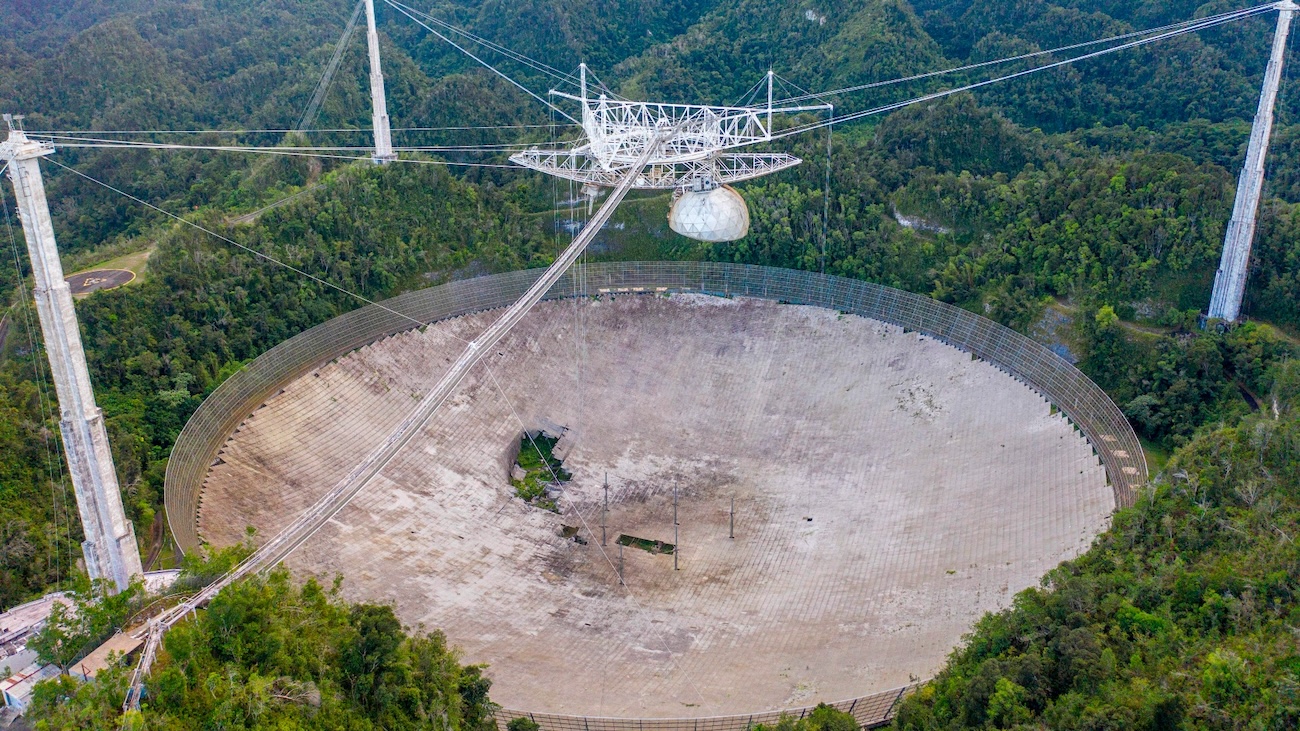
The platform swung down on its remaining supports and fell about 450 feet into the northern side of the 1,000-foot dish, dragging a four-storey dome of reflectors with it. As it went it tore the tops off all three towers that had held it for 57 years. A camera at the control building caught a severed tower top rolling down the hillside. The whole failure took 17 seconds. Nearby, Jonathan Friedman, who had worked at the observatory for 26 years, heard a rumble. “I knew exactly what it was,” he said. He ran up a small hill near his home and saw a cloud of dust where the telescope had stood. “I was screaming. Personally, I was out of control.”
The US Department of Defense built the Arecibo telescope to measure the upper atmosphere that nuclear warheads would pass through on their way down. Science turned it into something closer to a cathedral: the instrument that tested Einstein, found worlds around a dead star and spoke, once, for the whole species. Its owners spent its last decade and a half trying to work out how to stop paying for it. Arecibo is the story of a machine too famous to close and too expensive to keep, and of the quiet, bureaucratic way such machines die. The cables that failed that morning had been creeping out of their sockets since Hurricane Maria in 2017. Inspection photographs showed it. Nothing was done.
The committee that later reconstructed the collapse found something stranger still. Its leading suspect for what sped the cables’ slow escape was the telescope’s own radio energy, running as current through the steel. The most famous ear on Earth may have been loosened, in part, by its own voice.
Why the Pentagon Built the Arecibo Telescope in a Puerto Rican Sinkhole
Project Defender: Listening for Soviet Warheads in the Ionosphere
The Arecibo telescope began as a Cold War weapons question. In the late 1950s, after Sputnik, the newly created Advanced Research Projects Agency was pouring money into Project Defender, its search for a way to stop Soviet nuclear missiles. One theory held that a warhead plunging back through the ionosphere, the electrically charged layer of the upper atmosphere, left a distinctive signature that could tell it apart from the decoys around it, if only someone could read that layer precisely enough. William E. Gordon, a Cornell University professor, had worked out in 1958 that a powerful enough radar could measure the ionosphere by catching the faint echo scattered back by individual electrons. The catch was size. The antenna would have to be enormous.
ARPA paid for it, the Air Force administered it and Cornell ran it. The site’s first name made no secret of its purpose: the Department of Defense Ionospheric Research Facility. Gordon’s original plan was a fixed dish that would stare straight up. ARPA wanted to be able to steer the beam, which is why the finished telescope hung its receivers from cables high above the dish on a platform that could track objects across the sky. The design that made Arecibo famous was a military requirement. The same physics fed the other side of the Cold War’s ionospheric arms race, where the Soviet Union built the Duga radar to bounce signals off the same layer and catch American launches as they happened. The line between studying the upper atmosphere and watching for war stayed thin long after both were built: in January 1995 a Norwegian research rocket fired from Andøya to study the aurora was read by Russian early-warning radar as a possible missile.
Building a 1,000-Foot Dish in the Karst Hills of Barrio Esperanza
Northern Puerto Rico is limestone country, eaten by rain into cone-shaped hills and deep natural sinkholes, and one of those sinkholes south of the town of Arecibo was almost the right shape for a 1,000-foot (305-metre) dish. The island was also close enough to the equator for the planets to pass through the telescope’s view. Construction began in the middle of 1960 on about 120 acres of land in a rural district called Barrio Esperanza, Spanish for hope, and cost a little over $9 million. Three concrete towers went up around the bowl, the tallest 365 feet high, and steel cables strung between them carried the receiver platform over the dish.
The man who patented that suspension had spent his war as a spy. Helias Doundoulakis was a teenager in Crete when German paratroopers invaded in 1941. He joined the resistance, reporting on Luftwaffe aircraft at Heraklion airfield, then escaped to Egypt, enlisted in the US Army and was sent into German-occupied Salonica for the Office of Strategic Services, transmitting coded radio reports from inside the city through most of 1944. After the war he studied engineering in New York on the GI Bill. The cable-suspended telescope patent he received in September 1966, developed from an idea of his brother George, listed among its co-assignees William J. Casey, the wartime OSS spymaster who would later run the CIA. The Arecibo Ionospheric Observatory was commissioned on 1 November 1963. In 1970 the Defense Department handed it to the National Science Foundation, and the warhead question quietly became an astronomy budget line.
The Golden Age of the Arecibo Observatory: Mercury, Pulsars and the First Exoplanets
Gordon Pettengill and the 59-Day Day on Mercury
Arecibo’s first great result overturned a fact astronomers had held for almost a century. Textbooks taught that Mercury kept one face permanently turned to the Sun, spinning once in each 88-day orbit. In 1965 Gordon Pettengill and Rolf Dyce bounced Arecibo’s radar off the planet and measured the shift in the returning echo. Mercury turns once every 59 days, three rotations for every two trips around the Sun. The finding came from a radar built to watch for missiles, and it set the pattern for the next half-century: a defence instrument repeatedly producing answers to questions nobody in the Pentagon had asked.
Russell Hulse and the Binary Pulsar That Proved Einstein Right
Russell Hulse was 23, a graduate student from the University of Massachusetts running a computerised pulsar search at Arecibo for his doctorate, when he found PSR 1913+16 on 2 July 1974. The signal cleared his detection threshold by a hair. Its period of 59 milliseconds made it one of the fastest pulsars then known, and he wrote “fantastic!” on the form. When he tried to pin the period down weeks later, it refused to stay put, shifting by tens of microseconds from one day to the next. His reaction, he recalled in his Nobel lecture, was “a rather annoyed ‘Nuts — what’s wrong now?’”
The fault lay in the sky. In September Hulse worked out that the pulsar was whipping around an unseen companion star every eight hours or so, its pulses bunching and stretching as it moved towards Earth and away. On 18 September he reported it to his supervisor, Joseph Taylor, who flew down to Arecibo with specialised equipment. Over the following years the two stars’ orbit shrank at precisely the rate Einstein’s general relativity predicted for a system losing energy as gravitational waves, the first evidence that such waves exist. Hulse and Taylor shared the 1993 Nobel Prize in Physics. Direct detection had to wait for LIGO in 2015, forty-one years after a graduate student’s irritation in a control room in the Puerto Rican hills.
The Broken Telescope That Found the First Planets Beyond the Solar System
The first confirmed planets outside the solar system were found because the Arecibo telescope was out of action. In early 1990 the observatory was shut down for repairs, its platform locked in one position each day. Aleksander Wolszczan, a resident astronomer, proposed using the crippled instrument as a fixed transit telescope to sweep the strip of sky drifting overhead for millisecond pulsars, a speculative survey that would probably never have won time on a working machine. Among the objects he caught was PSR B1257+12, whose pulses arrived with a wobble that matched no standard model. When he separated the pattern out, there were two periods running at once. “That was the first time that I suddenly got this illumination,” he said. “‘It has to be planets.’”
He needed a precise position to rule out an error, and Dale Frail of the Very Large Array in New Mexico supplied one. Frail’s fax ended with a joke about a rival British team’s planet claim: “And don’t go finding any planets, ha-ha.” Wolszczan faxed straight back with two orbital periods and two planetary masses. He presented them in January 1992. The British claim was later withdrawn. The first worlds humanity ever confirmed around another star turned out to be orbiting the corpse of one, a spinning neutron star bathing its planets in radiation, found by a telescope that was officially under repair.
The Arecibo Message: Humanity’s First Deliberate Broadcast to the Stars
Frank Drake’s 1,679 Bits and the Ceremony of 16 November 1974
The most famous three minutes in Arecibo’s history were a publicity event. In 1974 the observatory finished an $8 million upgrade, a new reflecting surface and a powerful radar transmitter, and on 16 November it held a ceremony to mark the occasion. Frank Drake, the observatory’s director and the astronomer who had run the first modern search for alien radio signals, designed a message for the day with a small team that included Carl Sagan. It ran to 1,679 bits, a number chosen because it is the product of two primes, 73 and 23, so that any intelligence decoding it could arrange the ones and zeros into a grid of 73 rows by 23 columns. Laid out that way, it drew a picture: the numbers one to ten, the chemistry of DNA and its double helix, a stick figure of a human being, the population of Earth, a map of the solar system with the third planet raised out of line, and the telescope itself.
The crowd heard it as a warbling pair of alternating tones for about three minutes. It was aimed at M13, a globular cluster of several hundred thousand stars in the constellation Hercules, roughly 25,000 light-years away. Any reply would take another 25,000 years to come back. Drake treated it as a demonstration of what interstellar communication might look like, not a serious attempt to start a conversation.
Martin Ryle, Britain’s Astronomer Royal, who had been named a Nobel laureate in physics only weeks earlier, saw danger in it. He objected publicly, warning that broadcasting Earth’s location could invite the attention of a hostile civilisation, and called on astronomers to use their instruments to listen to the universe rather than talk to it. The argument he started, over whether humanity should be shouting into the dark at all, has never been settled. Arecibo had already made its contribution to it, once, on behalf of four billion people who were not asked.
GoldenEye, Contact and SETI@home: Arecibo as the World’s Most Famous Dish
The telescope’s shape made it a film set. In 1995 GoldenEye staged its climax on the dish, with James Bond fighting a former MI6 agent on the platform above it. Two years later Contact put Jodie Foster’s radio astronomer in the control room listening for alien signals, borrowing the real lives of the scientists who worked there. In 1999 the SETI@home project began cutting Arecibo’s recordings into small pieces and sending them to volunteers’ home computers, millions of which spent their idle hours searching the observatory’s data for a signal. By the end of the century the dish in Barrio Esperanza was the image the world had in mind when it imagined humanity looking for company.
Hurricanes and Budget Cuts: The Slow Abandonment of Arecibo Observatory
The 2006 Review That Recommended Dismantling Arecibo
Arecibo’s fame bought it admirers, not money. In 1997 the observatory added the Gregorian dome, a four-storey structure housing secondary reflectors, along with more cables to carry it, at a cost of $25 million. Nine years later a National Science Foundation panel reviewing the agency’s astronomy spending recommended cutting Arecibo’s $12 million annual budget, finding partners to cover the difference, and dismantling the telescope if none had been found by 2011. NASA had already stopped paying for planetary radar in 2006, even though Arecibo was carrying out about two-thirds of all the radar observations used to characterise asteroids passing close to Earth. A National Research Council report warned in 2010 that “immediate action is required to ensure the continued operation of the Arecibo Observatory.”
The money kept shrinking and the management kept changing. Cornell gave up the observatory in 2011 after almost half a century, SRI International took it over on a five-year contract, and in 2018 a consortium led by the University of Central Florida took over from SRI. Members of Congress repeatedly pushed back against the cuts. The one thing that kept it standing through those years was arithmetic: in 2011 closing the telescope was estimated to cost about $88 million, eight times what it took to run it for a year. Arecibo survived largely because demolishing it was too expensive.
Hurricane Maria and the Scientists Who Rode Out the Storm at Arecibo
The eye of Hurricane Maria passed directly over the observatory on 20 September 2017. Gerrit Verschuur, an astronomer emeritus, had planned to sit out the Category 4 storm in his beachfront apartment in Arecibo until the authorities ordered the coast evacuated, so he packed supplies and drove up into the hills. He sheltered in the concrete Visiting Scientists Quarters in a group of eight scientists, two children, three dogs, two rabbits and two security guards. The observatory’s anemometer recorded a gust of 107 miles an hour and then stopped working. Close to a metre of rain fell in little more than a day.
The long antenna that hung beneath the platform for the 430 MHz radar was smashed, and its pieces punched about twenty holes in the dish below. Communication with the outside world collapsed. On 21 September the observatory’s deputy director, Joan Schmelz, stranded on an academic trip to San Diego, learned that Verschuur was safe from an amateur radio operator in Connecticut. The observatory ran on its own generators while diesel ran short across the island, and Verschuur noted that without fuel even the atomic clock would go down. Verschuur described the devastation around the observatory as “a war zone.” The hurricane killed nearly 3,000 people in Puerto Rico. On 29 September the telescope made its first pulsar observations since the storm. Verschuur recorded that the coquí frogs sounded “glad to be alive.”
The Cable That Slipped at 2:45 a.m. on 10 August 2020
The Arecibo telescope survived Maria with no significant structural damage, according to the inspections at the time. Three years later, at about 2:45 in the morning of 10 August 2020, a three-inch auxiliary cable slipped out of its socket at the top of Tower 4. It crashed down, tore a 100-foot gash in the dish and damaged up to eight panels of the Gregorian dome. It was one of the cables added in 1997, and it had pulled free while carrying less than half the load it was rated to hold. Nobody could explain why. The staff began planning repairs, and engineers were brought in to work out how to take the weight off the remaining cables while the cause was investigated.
Why the Arecibo Telescope Collapsed
Two Cables, One Letter and the NSF Decision to Let Arecibo Go
The second cable broke on 6 November 2020. This time it was a main cable, also running to Tower 4, and it snapped outright, taking away a large share of the platform’s support at that corner. “We knew at that point in time that it was just a matter of time,” said John Abruzzo of Thornton Tomasetti, the engineering firm assessing the damage. On 19 November the National Science Foundation announced that it would decommission the telescope. On 23 November its grants officer, Jeff Leithead, put the decision in writing to the University of Central Florida, citing “the paramount priority of human safety” and warning that “attempts at repairs could put workers in harm’s way.”
Some of the observatory’s own people believed the telescope could still be saved. The director, Francisco Córdova, believed options remained, such as relieving the tension on certain cables or using helicopters to shift the weight. The foundation would not send anyone onto or under the structure, and engineers began planning a controlled demolition that would take weeks to prepare. The telescope fell eight days after Leithead’s letter. Ángel Vázquez, the director of operations, described the end as a chain reaction. “It was a snowball effect,” he said. “There was no way to stop it. It was too much for the old girl to take.”
Zinc Creep and the Telescope’s Own Signal: The 2024 National Academies Verdict
The National Science Foundation asked NASA, Thornton Tomasetti and a second firm, Wiss, Janney, Elstner Associates, to explain why cables built to carry far heavier loads had pulled out. None of them could. The question went to a committee of the National Academies of Sciences, Engineering, and Medicine, chaired by the engineer Roger McCarthy, which spent about two years on it and reported on 25 October 2024.
Each of Arecibo’s cables ended in a spelter socket, a steel cone into which the splayed wire strands were set in molten zinc, a method used on bridges and cranes for more than a century. The committee found that the zinc in the sockets had been slowly deforming under the load, a process called creep, until the cables began to pull loose. Hurricane Maria started the sequence. Before the storm the cables had barely moved. After it, visual inspections showed large and growing pull-outs, and photographs taken in 2019 gave what the committee called a “clear indication of major socket deterioration.” The inspection reports made “no mention of such anomalies.” Ray Lugo, a former head of the observatory for the University of Central Florida, told investigators that he had seen cables pulling out after Maria and was told an outside engineer had looked at them and found no real concern. The foundation said it had no record of the exchange.
What sped the creep up was the strangest part of the finding. The telescope’s powerful transmitters soaked the structure in electromagnetic energy, and the committee’s leading explanation was that this induced a weak, constant current in the cables that had to pass through the zinc to reach ground, softening the metal over decades. It could not prove the link. McCarthy recalled the reaction when the idea first came up: “Electromagnetic radiation does not bring down civil structures.” His conclusion afterwards was simpler. “No one ever thought about the electromagnetic radiation problem.” The report described Arecibo’s collapse as the first documented case of long-term zinc creep failure in more than a century of spelter sockets in use, and recommended that the surviving cables and sockets be handed to researchers to study.
Arecibo Observatory After the Collapse: Wreckage, a Classroom and China’s FAST
The NSF Decision Not to Rebuild the Arecibo Telescope
The decision about the future came in October 2022, and it was final. The National Science Foundation would not rebuild the 1,000-foot telescope. In its place it offered $5 million for a science education centre in the observatory’s surviving buildings, about $45 million less than the estimated cost of clearing the wreck. “We understand how much the site has meant to the community,” said Sean Jones, the foundation’s assistant director for mathematical and physical sciences, adding that other American radar facilities could now do much of the same work. Vázquez had already put a replacement at up to $350 million, money that would have had to come from Congress.
The title of the world’s largest single-dish telescope had already moved on. In 2016 China finished FAST, a 500-metre dish set into its own karst depression in Guizhou province, and Arecibo’s 53 years at the top ended four years before it fell. The observatory’s archives remain one of its most productive parts. At Miami University in Ohio, the engineer Qihou Zhou received more than $700,000 from the foundation in 2025 to reanalyse decades of Arecibo’s ionospheric radar data with artificial intelligence, returning, in the end, to the upper-atmosphere physics the Pentagon paid for in 1960.
What Puerto Rico Lost With the Arecibo Telescope
The telescope was a federal instrument, but its loss was felt as a Puerto Rican one. The observatory drew around 90,000 visitors a year, among them generations of Puerto Rican schoolchildren. Some of them came back as scientists. Abel Méndez, now an astrobiologist at the University of Puerto Rico at Arecibo, was one. “I am one of those students who visited it when young and got inspired,” he said after the collapse. “The world without the observatory loses, but Puerto Rico loses even more.” Carmen Pantoja, an astronomer at the University of Puerto Rico who did her doctoral research on the telescope, said simply: “It’s a huge loss. It was a chapter of my life.”
The arithmetic of the island makes the loss heavier. Puerto Rico spent the years around the collapse living through a debt crisis, a hurricane that killed thousands and earthquakes that followed it, while hundreds of thousands of its people left for the mainland in search of work. Arecibo was one of the few places on the island where a Puerto Rican could do frontier science without leaving home. The ruin in the sinkhole is a monument to a telescope, and to a door that closed.
Visiting the Arecibo Observatory Today: The C3 Center and the Dish Remnants Overlook
The site is now the NSF Arecibo Observatory Historic District, and public access runs through the Arecibo C3 STEM Center, the education centre the foundation funded in place of a new telescope. In autumn 2026 the Science and Visitor Center opens to the public on Friday afternoons from 1 to 4 p.m. and on Saturdays from 9 a.m. to 5 p.m., with Tuesday-to-Friday mornings reserved for booked field trips; it is closed on Sundays and Mondays. Tickets cost $5 for adults and $3 for children aged 4 to 12 and seniors, must be booked online at least 24 hours in advance and are not sold at the gate, and daily numbers are limited. General admission includes an exhibition gallery, a trail of artefacts from the telescope, guided historical interpretation and a terrace overlooking what remains of the dish. Hours change around holidays and the summer, and the centre’s own website is the reliable source.
The drive from San Juan takes about an hour west on the PR-22 toll road, followed by narrow, winding and poorly signposted roads south into the karst. No food or drink is sold on site. One rule at the gate is an echo of the old observatory: phones must be switched off or put into airplane mode, and Bluetooth and other wireless devices disabled, at a place whose great telescope no longer exists. The surrounding hills reward the trip on their own terms. The Río Camuy cave system runs beneath the same limestone a short drive to the west, Cueva Ventana’s cave mouth looks out over the Río Grande de Arecibo valley, and the old lighthouse on Punta Morrillos stands above the Atlantic in the town of Arecibo itself.
The view from the terrace shows an unusual kind of disaster site. Nobody died on 1 December 2020, and the people who mourn the telescope mostly mourn it as an idea: the place where Puerto Rico and the rest of the species listened hardest to the sky. What the overlook shows instead is the end of a long, slow neglect, set in a sinkhole in a district called Hope. The dish was built to listen for the end of the world. It found pulsars, planets and a chance to say hello, and then it was left to its owners’ budget meetings and the patient work of zinc. The message it sent in 1974 is still travelling outward at the speed of light, just over fifty light-years from home. It has nearly 25,000 years to go, and the telescope that sent it is gone.
Frequently Asked Questions About the Arecibo Observatory
Why did the Arecibo telescope collapse?
The Arecibo telescope collapsed on 1 December 2020 when the steel cables holding its 900-ton instrument platform pulled out of their sockets at one of its three support towers, sending the platform about 450 feet into the dish below. A 2024 report by the US National Academies of Sciences, Engineering, and Medicine found that the zinc anchoring the cables in their sockets had been slowly deforming under load, a process called creep, and that the problem began after Hurricane Maria in 2017. Inspection photographs from 2019 showed major socket deterioration that was not acted on. The committee suspected, but could not prove, that electrical currents induced by the telescope’s own powerful radio transmitters had accelerated the process.
Can visitors still go to the Arecibo Observatory?
The Arecibo Observatory site is open to the public on a limited schedule through the Arecibo C3 STEM Center, which occupies the surviving buildings. In autumn 2026 the Science and Visitor Center opens on Friday afternoons and Saturdays, with tickets of $3 to $5 that must be booked online at least 24 hours in advance. General admission includes an exhibition, a trail of telescope artefacts and a terrace overlooking the remnants of the collapsed dish. The site lies about an hour’s drive west of San Juan, and opening hours change seasonally, so the centre’s website is the best place to confirm them.
What was the Arecibo message?
The Arecibo message was a radio transmission of 1,679 bits sent from the Arecibo telescope on 16 November 1974, during a ceremony marking an upgrade of the observatory. Designed by the astronomer Frank Drake with a team that included Carl Sagan, it encoded the numbers one to ten, the chemistry of DNA, a human figure, the population of Earth, a map of the solar system and an image of the telescope itself. It was aimed at the globular cluster M13, about 25,000 light-years away, and lasted roughly three minutes. Drake regarded it as a demonstration rather than a real attempt at contact.
Will the Arecibo telescope be rebuilt?
The Arecibo telescope will not be rebuilt. In October 2022 the National Science Foundation, which owns the site, announced that it would instead fund a $5 million science education centre in the observatory’s remaining buildings, noting that other American radar facilities could take over much of Arecibo’s work. Estimates for a replacement telescope ran as high as $350 million, which would have required new funding from Congress. Some smaller instruments and the observatory’s archive of data continue to support research.
What were the Arecibo Observatory’s biggest scientific achievements?
The Arecibo telescope showed in 1965 that Mercury rotates every 59 days rather than keeping one face to the Sun. In 1974 the graduate student Russell Hulse found the first binary pulsar there, which provided the first evidence for gravitational waves and won Hulse and Joseph Taylor the 1993 Nobel Prize in Physics. In 1990 Aleksander Wolszczan used the telescope, then partly immobilised for repairs, to find the first confirmed planets outside the solar system, orbiting the pulsar PSR B1257+12. The observatory also carried out about two-thirds of the world’s radar observations of near-Earth asteroids.
Why was the Arecibo telescope built in Puerto Rico?
The Arecibo telescope was built in Puerto Rico because the island’s karst landscape offered a natural sinkhole almost the right shape for a 1,000-foot dish, saving enormous excavation costs, and because its position close to the equator allowed the planets to pass through the telescope’s field of view. The project was funded by the US Defense Department’s Advanced Research Projects Agency in the early 1960s to study the ionosphere, partly for research into detecting incoming nuclear warheads. It was commissioned on 1 November 1963 and transferred to the National Science Foundation in 1970.
Sources
Analysis of Causes of Failure and Collapse of the 305-Meter Telescope at the Arecibo Observatory — National Academies of Sciences, Engineering, and Medicine (2024)
The Arecibo Ionospheric Observatory (CRS Report R40437) — Congressional Research Service (2012)
A Radar Determination of the Rotation of the Planet Mercury — Gordon H. Pettengill and Rolf B. Dyce, Nature (1965)
The Arecibo Message of 1974 — The Staff at the National Astronomy and Ionosphere Center, Icarus (1975)
The Discovery of the Binary Pulsar — Russell A. Hulse, Nobel Lecture (1993)
A Planetary System Around the Millisecond Pulsar PSR1257+12 — Aleksander Wolszczan and Dale A. Frail, Nature (1992)
Radio Telescope Having a Scanning Feed Supported by a Cable Suspension Over a Stationary Reflector (US Patent 3,273,156) — Helias Doundoulakis (1966)
Arecibo Diaries: Scenes from the Eye of the Storm — Physics Today, American Institute of Physics (2017)
Huge, Already Damaged Radio Telescope Collapses in Puerto Rico — Associated Press (2020)
Major Warning Signs of Arecibo Telescope Collapse Were Missed, Report Finds — AIP FYI, American Institute of Physics (2024)
US Opts Not to Rebuild Renowned Puerto Rico Telescope — Associated Press (2022)
New Oral Histories: The Discovery of the First Exoplanets — American Institute of Physics (2026)